To be privately owned
Ehrenberg Castle
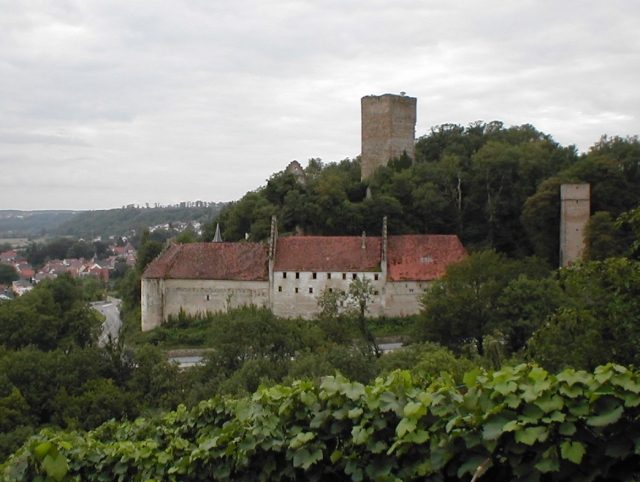
Ehrenberg Castle is a hilltop castle built from the 12th century onwards, located above Heinsheim am Neckar. At this spot, it forms a striking ensemble with the historic buildings of Gundelsheim, situated on the opposite bank of the Neckar, along the Castle Road.
The construction of Ehrenberg Castle in the early 12th century is said to date back to the Counts of Lauffen. By 1193 at the latest, the noble family of Ehrenberg (also Erenberg or Ernberg), who were Swabian vassals, resided at Ehrenberg. Thus, the construction of Ehrenberg Castle is directly linked to the Swabian imperial palace in nearby Wimpfen. In literature, Ehrenberg Castle is often considered an outpost defense system for Wimpfen.
The oldest part of Ehrenberg Castle is the approximately two-meter-thick curtain wall around the core castle. The buildings of the core castle date from the 12th and 13th centuries and also feature very strong stone foundations. Still preserved today are the keep from 1235, which is 50 meters high and is said to have once been 10 meters taller, as well as an approximately 15-meter-high gable of a core castle building. The remaining core castle buildings can only be discerned by their foundations. The severe damage to the castle is believed to stem from the Thirty Years' War. Around the core castle, the outer bailey was built in the 17th and 18th centuries, featuring an approximately 30-meter-high gate tower and residential and utility buildings with Baroque characteristics.
Part of the castle is the St. Alban castle chapel, located south of the curtain wall, dating from 1602. It was built as a Catholic church for the inhabitants of Heinsheim and was redesigned in Baroque style in 1778.
The Ehrenberg family died out in the 17th century. After the death of the last Ehrenberger, ownership of the castle, the village of Heinsheim, and the nearby Zimmerhof estate fell to the Diocese of Worms, whose legal successor became the Landgrave of Hesse in 1803. From him, the Barons of Racknitz acquired the castle and Zimmerhof in 1805.
The outer bailey is still inhabited by the owning Racknitz family, while the ruins of the core castle serve as a breeding station for birds of prey. As the castle is privately owned and inhabited, it cannot be visited.
Viticulture+
The Heinsheim vineyard (Einzellage) of the same name, which belongs to the Baden wine region, is named after Ehrenberg Castle.
Take Mobile History with you
You are reading this text for free. Premium adds what matters on the road: descriptions read aloud, sites found through your camera, whole regions taken offline.
- Every description, including the ~17,700 Premium sites
- Audio guide: have descriptions read to you on location
- AR finder: see sites through your camera, with distance and bearing
- Unlimited saved sites
14 days free, then from €2.99 a month. Cancel anytime.
Source: Wikipedia · Licence: CC BY-SA 4.0 · Image: https://commons.wikimedia.org/wiki/File:Burg-ehrenberg-ansicht-frei.JPG?uselang=en
This description draws on the facts documented in the linked Wikipedia article; Wikipedia content is licensed under CC BY-SA 4.0. Wording and editing: Mobile History.
Location: 49.2672, 9.1462