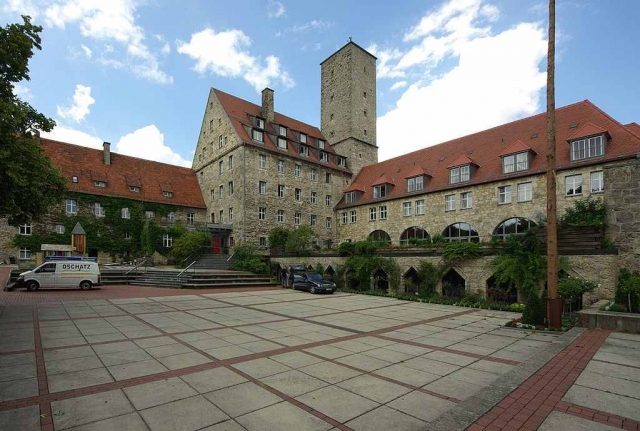
CastleEbermannstadt

Feuerstein Castle

Feuerstein Castle

Catholic youth and community center

Burg Feuerstein is located on the edge of the so-called Lange Meile near Ebermannstadt in the Forchheim district. It was built in 1941 by Professor Oskar Vierling as a laboratory for research in high-frequency technology and electroacoustics and was used until 1945 by 250 employees for research into weapons and communication technology as part of German wartime rearmament during World War II.

Seized by American soldiers at the end of the war, the castle was leased by the Archdiocese of Bamberg under the direction of Jupp Schneider in 1946 and acquired in 1949. Since then, the castle and the entire area have served as a Catholic youth and meeting center.

Professor Oskar Vierling was looking for a centrally located site for his laboratories. The choice fell on a mountain with the field name Feuerstein. The castle's architectural style corresponded to the image of Franconian Switzerland and was also chosen for camouflage reasons. During the war, it was disguised as a medical facility (red cross made of bricks on the roof), but the castle actually housed a laboratory for secret armaments projects of the National Socialists. After the war, it was abandoned, and building plans and documents were destroyed. However, in 2011, cryptography historian Norbert Ryska came across a document from the American special unit Ticom (Target Intelligence Committee) that described Vierling's work at Burg Feuerstein in more detail. According to this, Vierling worked on behalf of the Nazis on speech encryption methods, acoustic torpedo guidance, acoustic mine fuses, anti-detection technology for submarines, and radio and electrical engineering.

A relic from the construction period is today's wine cellar, formerly a walk-in safe with a 10 cm thick steel door. The charm of the castle does not come from a medieval origin, but from its construction history during the war and its young age.

The castle was expanded with dormitory extensions, a dining hall, leisure facilities (bowling alley, table tennis, volleyball, hard court, sports field), conference rooms, campsites, agriculture, riding stables, and a glider airfield. In 1961, the Church of the Transfiguration of the Lord was consecrated. It consists of three church rooms: the crypt, the lower church, and the upper church. Today, Burg Feuerstein presents itself as a modern youth center in the heart of the Bamberg diocese.

In 1999, the Feuerstein Observatory was founded 500 m south of the Burg Feuerstein airfield. The observatory adopted its name from the castle. The castle tower is also used by the observatory as a radio relay station for connection to the town of Ebermannstadt in the valley below. In this way, the tower built by Prof. Vierling to test the first radio link still fulfills its originally intended purpose.

Take Mobile History with you

You are reading this text for free. Premium adds what matters on the road: descriptions read aloud, sites found through your camera, whole regions taken offline.

  • Every description, including the ~17,700 Premium sites
  • Audio guide: have descriptions read to you on location
  • AR finder: see sites through your camera, with distance and bearing
  • Unlimited saved sites

14 days free, then from €2.99 a month. Cancel anytime.

Source: Wikipedia · Licence: CC BY-SA 4.0

This description draws on the facts documented in the linked Wikipedia article; Wikipedia content is licensed under CC BY-SA 4.0. Wording and editing: Mobile History.

Location: 49.7856, 11.1626