CastleAschersleben-Freckleben

Freckleben Castle
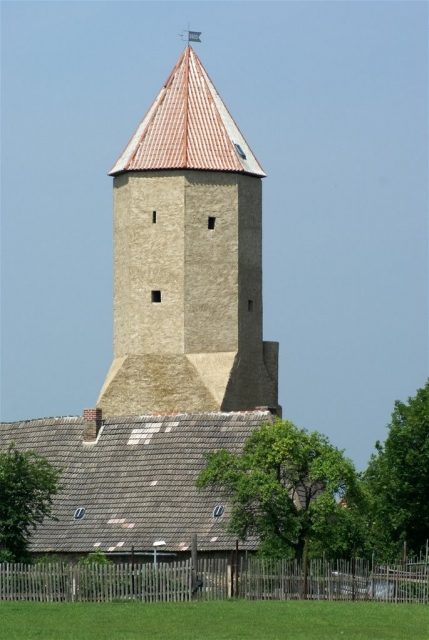
Freckleben Castle

The Castle can be visited

Freckleben Castle is a Romanesque castle in Freckleben in the Salzlandkreis, Saxony-Anhalt. Significant remains of probably Carolingian ramparts and well-preserved Romanesque buildings from around 1200 can be seen.

The exact time of the creation of the first fortification in Freckleben cannot yet be precisely determined. A first documented mention of the place in 762 in the Fulda Foundation Book as Frekenlevo confirms the great age of the place. It is possible that the extensive ramparts, which are still preserved today, date back to this period. The extent of the rampart covers an area several times the size of the later medieval castle. The approximately oval castle area has dimensions of 300 x 600 meters at its greatest extent. The terrain, located on a spur, is protected on three sides by steep slopes. The south side was protected by a system of three successive ramparts with a double ditch in between. Another outer rampart lies about 120 meters south of it at the natural drop of the terrain. The appearance of the rampart suggests a Carolingian castle.

On October 22, 973, Emperor Otto II confirmed an exchange of goods between Archbishop Adalbert of Magdeburg and Abbot Werner of Fulda, in which Adalbert received Freckleben. Adalbert died there in 981. It can be assumed that a representative noble residence existed at that time.

In the 12th century, the Margraves of the Northern March from the comital family of Stade owned the castle. The round tower of the lower castle (Bergfried 1) dates from the time of their rule. Stylistically, it can be classified in the first half of the 12th century, as indicated by its massive construction, but also by the simple Romanesque building elements. It is remarkable that the tower was reinforced in a second construction phase by an outer shell. (Wall thickness: three meters, inner diameter: four meters, shell wall: 1.3 meters, preserved height: 16 meters) In addition to the tower, parts of the curtain wall and the basement of a residential building in the southeast of the castle from the time of the Margraves are preserved.

The last representative of the family of Stade, Count Udo of Freckleben, was slain on March 15, 1130, by the men of Albert the Bear in Aschersleben. Emperor Lothar III seized the lordship as an ownerless fief and granted it as an imperial fief. In 1135, an Eckerich von Frakenleve and an Otto von Frakenleve were mentioned in documents. As part of an exchange of goods, Archbishop Wichmann of Seeburg acquired Freckleben in 1166 from Emperor Frederick I. Located on an important road from Halle to Aschersleben and Halberstadt, it was an important link between the archiepiscopal possessions.

Around 1200, Bergfried 3 was built. The tower, rectangular in its lower four floors, transitions to an octagonal plan on the fourth upper floor. The third and fourth upper floors were built for residential purposes with a fireplace and a latrine bay. The outward-facing front on these floors features Romanesque twin windows. The other buildings of the upper castle also originated during this period. The courtyard of the upper castle must have been built on all sides, as the high-lying access to the tower has a stop for a drawbridge. This presupposes an opposite building. North of Bergfried 1, a building was erected, characterized by stronger walls, and was probably a residential house.

Until 1296, the castle was administered by burgraves. When the last burgrave Walter V of Arnstein joined the Teutonic Order in that year, the office was not reoccupied. The lordship was granted as a fief to various noble families. The lordship was divided several times. In 1479, Princes Waldemar and Georg of Anhalt bought the lordship from the Dorstädt and Strobart families and held it as a fief from the Archbishopric of Magdeburg. From the 16th century, the lordship of Freckleben was a domain.

During the Anhalt partition in the 17th century, Freckleben came to the Dessau line. During the domain economy in the 19th and 20th centuries, the farm buildings were extensively rebuilt and altered. In 1896, the domain fell to the state. Around 1900, a large round tower (Bergfried 2) in the lower castle was demolished. In 1945, the domain was divided, and several new farmsteads were created in the castle buildings.

Visit+

The outdoor areas are freely accessible, and climbing the keep is possible via ladders. The top two floors are equipped with spiral ladders, which are unique in Germany.

Take Mobile History with you

You are reading this text for free. Premium adds what matters on the road: descriptions read aloud, sites found through your camera, whole regions taken offline.

  • Every description, including the ~17,700 Premium sites
  • Audio guide: have descriptions read to you on location
  • AR finder: see sites through your camera, with distance and bearing
  • Unlimited saved sites

14 days free, then from €2.99 a month. Cancel anytime.

Source: Wikipedia · Licence: CC BY-SA 4.0 · Image: Roland Neubert, Halle (Saale)

This description draws on the facts documented in the linked Wikipedia article; Wikipedia content is licensed under CC BY-SA 4.0. Wording and editing: Mobile History.

Location: 51.6972, 11.5464