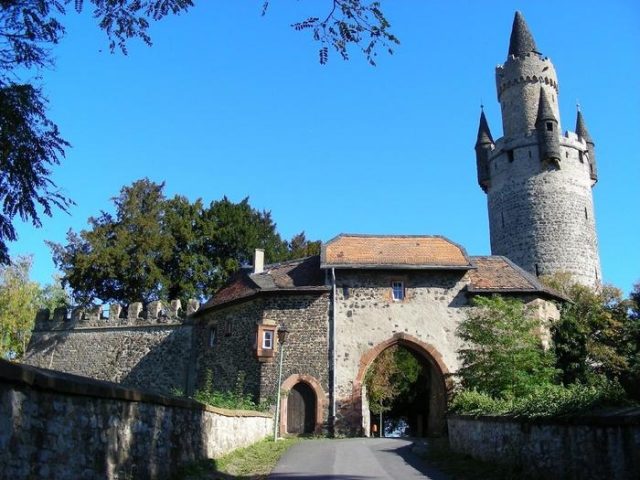
CastleFriedberg

Friedberg Castle

Friedberg Castle

Tax Office
High School

Friedberg Castle in the Hessian city of Friedberg is one of the largest castle complexes in Germany. For centuries, it was the center of the Burggrafschaft Friedberg (Burgraviate of Friedberg). Today, it houses various public institutions. Among others, the media center of the Wetterau district, the tax office, and the Burggymnasium, a senior high school, are located within its historic walls.

Castle and city of Friedberg are situated on a basalt rock in the middle of the Wetterau region. The castle was probably founded by order of Emperor Frederick Barbarossa between 1171 and 1180. The oldest surviving document about the castle dates from 1216.

At the beginning of the first century AD, a Roman military camp, built during Germanicus' campaigns, was located on the Friedberg castle hill. After that, Friedberg was without Roman occupation for decades. Only under the reign of Emperor Vespasian from 69 to 79 was a Roman fort again erected on the castle hill. This complex, expanded and rebuilt several times, was abandoned with the withdrawal of the Romans to the Rhine border around 260. Still visible today is the excavated remnant of a small bathing facility, probably part of the fort's command post, which was incorporated into the basement of a new school building in 1965.

Castle and city of Friedberg were independent legal entities, later as the Burggrafschaft Friedberg, a separate territory within the Holy Roman Empire of the German Nation. This close coexistence of castle and city led to friction that determined Friedberg's history for centuries.

The Burggrafschaft was organized as a cooperative and was immediate to the Empire. The legal status of a Burgmann (castle man) was hereditary and held by noble families from the surrounding area. There were about 100 Burgmannen. The castle's task was the protection of the Wetterau, as was also the case in the other Staufer palatinates and castles of Gelnhausen, Frankfurt, Wetzlar, and Glauburg, some of which were built in the same period. To fulfill the residency requirement, Burgmannen houses were built within the castle from the 14th century onwards. In later times, the duties of the Burgmannen were often carried out by officials residing there. From the 15th century, the castle formed its own small dominion in the Wetterau by acquiring the pledge over the city of Friedberg in 1445 and the Freigericht Kaichen (Free Court of Kaichen). During this time, it had its greatest political influence. It participated in the Virilstimme (individual vote) of the Wetterau counts in the Reichstag.

From the 17th century, the castle increasingly transformed into a noble residence. This is evidenced by the representative buildings of the Burgmannen within the castle, the extensive castle garden, and the castle church. The castle retained its Staufer constitution until 1806 and was then mediatized by the Grand Duchy of Hesse. Only in 1834 was the castle incorporated into the city of Friedberg. In 1846, Sigmund Löw zu Steinfurth, the last of the Burgmannen, died.

Fortification+

The castle was heavily fortified. It had two main entrances:

  • The northern one, whose preserved building fabric dates back to the mid-14th century, featured six gatehouses, three of which are preserved. It led outside the city of Friedberg directly into the open forefield of the castle.
  • The southern access from the city of Friedberg was secured by the deep moat, known as the Hirschgraben (Deer Moat), and a drawbridge.

The Adolfsturm (Adolf Tower)

Originally, the castle had two keeps; the tower at the south gate, presumably dating from the Staufer period, collapsed in 1684, while the other, the Adolfsturm, dates from the mid-14th century and is the oldest preserved medieval building of the castle. Today it is the landmark of the city and, with a height of 54.42 m (58.22 m with weather vane), one of the largest keeps in Germany. In 1347, the Friedberg Burgmannen were able to capture Count Adolf of Nassau. With the ransom, it was now possible to build a new keep, which was named Adolfsturm after the released hostage. The tower was built from quartzite from the Taunus and basalt from nearby Fauerbach.

In the years 1893/96, the Adolfsturm was elaborately romanticized. It received its characteristic appearance with the pointed spire and the four small side towers. In addition, a walkway to the entrance was added, which was originally only accessible by ladder at a height of 13 meters. At a height of 42.5 meters, there is still an observation deck today, from where a view as far as Frankfurt, 30 kilometers away, is possible.

On February 28, 2010, the top of the Adolfsturm was broken off by Hurricane Xynthia.

The Adolfsturm is managed by the State Palaces and Gardens of Hesse and is made accessible to the public by the Friedberg City Historical Society.

The Burggrafiat (Castle)

In the years 1604–1610, the Kronberger Hof was built by the then Burgrave Johann Eberhard von Kronberg. The building complex, built in the High Renaissance style, served as the seat of the Friedberg Burgraves from 1698. From 1817 to 1919, it functioned as the castle of the Hessian Grand Dukes. In 1910, the last Tsar of Russia, Nicholas II, stayed as a guest of the Grand Dukes in Friedberg Castle during a spa visit in neighboring Bad Nauheim. His wife Alix of Hesse-Darmstadt was the sister of the then Duke.

Integrated into the structure of the Burggrafiat are the Marstall (stables), the baroque Deutschordenshaus (Teutonic Order House) (built: 1716–1718), which was the factory of the Commandery of Frankfurt am Main from 1491–1806 and the directorate of the Middle Rhenish Knighthood from 1589–1764, the Kavaliersbau (Cavalier Building) (early 17th century), and the large Renaissance gate (1611/1752).

In June 1990, the Burggrafiat almost completely burned down. Only the outer walls remained.

Outside the castle area is the St. George's Fountain from 1738. The fountain figure of Saint George was created by the Mainz sculptor Burkard Zamels in the Baroque style. The figure that adorns the fountain today is a copy; the original is in the nearby Wetterau Museum.

The Castle Church

The early classical church building was designed by Franz Ludwig Cancrin from Hanau and built by the Bad Nauheim master builder Johann Philipp Wörrishöfer. It replaced the medieval St. George's Church, which was demolished in the 18th century. The compact church building, equipped with a relatively low tower, rises on the floor plan of a Greek cross. Construction began as early as July 14, 1783, but lasted until 1808, which is attributable to political disputes of the time. The interior of the church represents a typical Protestant preaching church. The appearance of the church's interior is dominated by the temple-like facade with its gallery and organ.

On September 30 and October 1, 1947, the Protestant regional churches of Nassau, Hesse-Darmstadt, and Frankfurt united in the Castle Church to form the Evangelical Church in Hesse and Nassau. One day later, Martin Niemöller was elected as its first church president.

For the church's 200th anniversary in 2008, extensive renovation measures were carried out on the church building.

Further Buildings

The double enceinte from the 14th–16th centuries is preserved in its entirety, as is part of the interior development. A number of Burgmannen houses still stand in the spacious castle area. Next to the mighty castle gate is the baroque castle guardhouse (1771/72), which is modeled after the Frankfurt Hauptwache. Now part of the Burggymnasium Friedberg, the baroque portal of the former castle chancellery (1512) deserves special mention. From the mid-19th century, the building served as a teacher's seminary.

Worth Knowing+

Evidence of the history of Friedberg Castle and city is exhibited in the Wetterau Museum on Haagstraße. Significant are, in addition to three city views from the 16th century, the portraits of Friedberg Burgraves. Here you will also find a model of Friedberg Castle and city, which provides a good overview of the castle complex in the late Middle Ages.

Source Text: Wikipedia

Take Mobile History with you

You are reading this text for free. Premium adds what matters on the road: descriptions read aloud, sites found through your camera, whole regions taken offline.

  • Every description, including the ~17,700 Premium sites
  • Audio guide: have descriptions read to you on location
  • AR finder: see sites through your camera, with distance and bearing
  • Unlimited saved sites

14 days free, then from €2.99 a month. Cancel anytime.

Source: Wikipedia · Licence: CC BY-SA 4.0

This description draws on the facts documented in the linked Wikipedia article; Wikipedia content is licensed under CC BY-SA 4.0. Wording and editing: Mobile History.

Location: 50.3424, 8.7528