Cultural center
Gebhardshagen Castle

Gebhardshagen Castle is a former moated castle in Salzgitter-Gebhardshagen. With its first documented mention as Hagen Castle in 1186, it is one of the oldest moated castles in the Braunschweig region. After wartime destruction in 1406 and during the Thirty Years' War, the complex was rebuilt each time. In the 16th century, it became a ducal court and administrative seat. After the castle lost its military significance, it served as an agricultural domain from the mid-17th century until 1986.
The castle was built at the eastern foot of the wooded Salzgitter mountain range on the military and trade route Minden–Halberstadt. The road led from the castle westwards, first through the forest then known as Hagen, and then over a pass across the elevation.
Architectural Description+
The architectural beginnings of the castle complex are presumed to be in the 11th century. The oldest surviving building fabric is attributed to the years around 1200. Due to the wartime destruction in 1406 and during the Thirty Years' War, with subsequent reconstructions, the original appearance of the castle is no longer known. It was likely surrounded by moats fed by the passing mill stream. The former Amtsteich (administrative pond) next to the castle, which is related to the fortification and the watermill economy in the village, is still present today.
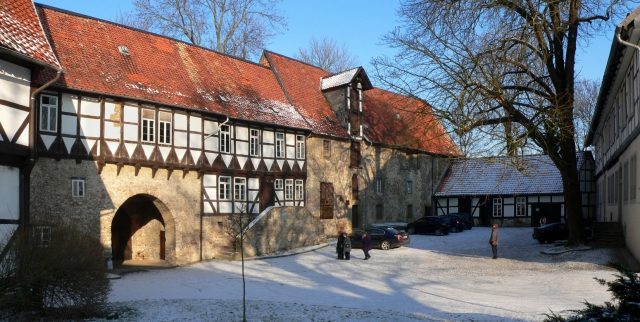
According to Matthäus Merian's description around 1654/1658, the castle measured 75 × 45 m. At that time, it had two towers, the Grey Tower as a keep and the Red Tower, which are no longer extant today. The approximately 80 m long north wing with the gatehouse, the castle barn, and the palas has largely been preserved.
The palas is almost 30 m long and about 10 m wide. It has an unvaulted cellar with originally two floors above it. In the unheated knight's hall, a Romanesque double window faces outwards. At an unknown time, the palas was converted into a three-story granary with two additional floors in the attic for the agricultural operations of the domain. As the floor heights were changed during the alterations, the windows lost their function. In the 19th century, the palas was used as a cooper's workshop, then again as a grain storage for the domain. In 1961, the floor ceilings in the eastern part of the palas were removed for the installation of seven grain silos, which occupy the entire height of the building. Due to the grain silos and mixing plants, the interior of the building gives the impression of a mill operation.
The gatehouse is about 24 m long and about 8 m wide. The gate hall has a lockable round-arch gate on the outside and an open one on the inside. Inside was the gatekeeper's residence. The gatehouse is accessible from the castle courtyard via an outdoor staircase. It housed the court and administrative rooms of the Gebhardshagen office.
The no longer existing Red Tower at the southeast corner of the palas was built of reddish-brown sandstone. It was demolished around 1800 and replaced by an outbuilding that served as a washhouse, dairy, and brewery. The underground tower vaults are still preserved as cellars.
The east wing was renovated in 1906. Today, on the south side of the castle courtyard, there is a 35 m long manor house, which was formerly inhabited by the respective tenant and bailiff. Once, a smaller castle building with the 6 × 6 m Grey Tower stood here. It was demolished around 1850.
In the southern area, there is currently a gap in the buildings, which was still closed on a site plan from 1768. Today, the former domain with its historic stables and outbuildings adjoins it without demarcation. Previously, the Vorwerk (outlying farm) was probably located here as a precursor.
Name+
The castle, the noble family von Hagen as its builders, and the village of Hagen (today Gebhardshagen) were named after a small wooded area on the Salzgitter mountain range, which has been referred to as Hagen or Hagenholz since the Middle Ages. Old field names in the vicinity of the village such as Hagenbach, Hagenkamp, Hagenholz also point to this. Hagen Castle was built at the then edge of the forest, and the forest belonged to its possessions. It was part of the formerly large forest area Hardeweg, which covered the Salzgitter mountain range down to the plain and in which the surrounding villages had timber usage rights.
During the 14th century, when the Lords of Bortfeld resided at Hagen Castle, its name was extended. Gebhard, as the given name of the progenitor and later leading name of the family, was added in 1372, so the castle has since been called Gebhardshagen. Throughout history, there have been various spellings of the name, such as Gheverdeshaghen, Gebershagen, Gevershagen, Gefershag. The settlement around the castle was called Hagen until the 16th century and only then adopted the name Gebhardshagen.
The noble family von Hagen is assumed to be the builders of the castle. Its first, not undisputed, mention is found in a document from June 17, 1129, in which King Lothar III confirms a land exchange between the Goslar Cathedral Chapter and the Riechenberg Abbey. In this document, a von Hagen is first mentioned as Cuonradus de Indagine (Latin: Konrad von Hagen). Although three families with the name Hagen are recorded in the southern Lower Saxony region, it is probable that the mention in 1129 referred to Konrad von Hagen from Hagen Castle, as it concerned a matter in neighboring Lebenstedt.
The first documented mention of the fortification occurred in 1186 as "castle, which is called Hagen," together with its owner, a Ludolf von Hagen. The castle complex became the ancestral seat of the von Hagen family. Under the protection of the fortification, a castle settlement emerged, presumably starting from an outer bailey. It was first documented as Hagen in 1235 with the mention of St. Nicholas Church.
After the extinction of the von Hagen family in 1280, Gebhardshagen Castle passed into the possession of the Dukes of Braunschweig-Lüneburg. In times of financial need, they temporarily pledged the castle to other noble families but always redeemed it. Duke Albrecht II granted it as a fief to the brothers Gebhard and Ludolf von Bortfeld in 1293. They made the castle their main residence. They held the fief until 1354 and then moved their seat to Oelber Castle in Oelber am weißen Wege, where their family died out in 1686. From 1354, Gebhardshagen Castle belonged to the Welf Duke Wilhelm II.
In 1373, Duke Otto I of Braunschweig-Lüneburg acquired the castle, and his family retained it until 1435. In 1396, the castle was pledged to the brothers von Cramm and, with minor interruptions, from 1404 to 1503 to the von Saldern family.
In the Lichtenberg Bedestreit (tribute dispute) of 1406, Gebhardshagen Castle became a border castle for the Dukes of Braunschweig-Lüneburg against the Bishops of Hildesheim in the struggle for supremacy. On May 22, 1406, troops of Hildesheim Bishop Johann III von Hoya, led by Heinrich von Bortfeld and Burghard von Cramm, bombarded Gebhardshagen Castle with modern cannons and captured it. The armory, as well as the Red and Grey Towers, were destroyed. The ducal vassals Burchhard and Johann von Saldern fled the castle. After long negotiations for compensation for the lost castle, reconciliation occurred in 1407. Afterwards, the ducal men Jan and Burchhard von Saldern, as pledge holders, were commissioned to rebuild the destroyed buildings and towers. In 1429, the castle came to Dukes Wilhelm I and Heinrich II of Braunschweig.
The castle was spared from destruction during the Hildesheim Diocesan Feud (1519–1523). In 1568, Duke Julius sold the castle to Melchior von Steinberg for 8,000 thalers for 30 years. Afterwards, he redeemed the complex.
During the Thirty Years' War, Gebhardshagen was first besieged by the Imperial forces and finally by the Swedes and destroyed. During the last capture in 1637, the castle was also destroyed and burned down. The reconstruction then took place in the second half of the 17th century. After that, the castle complex lost its military significance and has since been managed as an agricultural domain. New agricultural buildings were constructed in the southern part for this purpose.
Court and Administrative Seat
In 1539, a ducal judicial office was established in the castle, which exercised jurisdiction over the nearby villages. The last execution took place in 1750.
In the mid-16th century, Duke Heinrich the Younger of Braunschweig established the Gebhardshagen office, which had its seat in the castle. Parts of the Salder office were transferred to it. After Engerode, Calbecht, Leinde, and Lobmachtersen were added in 1542, followed by Heerte in 1647. The bailiff was later also the tenant of the domain. The office existed until 1807. At the beginning of the 19th century, during the French period, the area of the Gebhardshagen office belonged to the Kingdom of Westphalia, which existed from 1807 to 1813. Within it, it became its own canton in the Braunschweig district within the Department of the Oker. After the withdrawal and the restoration of the Duchy of Braunschweig, the office was not re-established.
Domain+
After the castle lost its military significance in the mid-17th century and the surrounding moat was filled in, it served as an agricultural domain. Duke Rudolf August issued the first public tender for the lease of the Gebhardshagen domain and office in 1671. The contract was awarded to the Privy Councillor and Chancellor Hermann Höpfner from Kronstedt. Numerous other tenants followed, who improved and expanded agricultural production. In the mid-19th century, almost 40 workers cultivated about 800 Morgen (acres) of arable land. At that time, there were about 30 horses, 60 cows, 50 pigs, and 1,100 sheep.
After the First World War and the end of the monarchy, the Free State of Braunschweig confiscated the domain, which was owned by the House of Welf. In 1926, the Welfs received it back and leased it again. When the tenant ran into financial difficulties in the 1920s due to German inflation, a state administrative company from Braunschweig managed the estate from 1929. In 1938, the Reichswerke Hermann Göring took over the domain, which ceded large parts of its lands for the construction of industrial facilities and housing. From 1942, 25 prisoners of war worked daily on the estate.
After the Second World War, the domain complex belonged to successor companies such as Salzgitter AG. Agricultural operations continued due to food shortages during the post-war period. In 1946, 80 people were employed, mainly displaced persons. In 1955, the farm cultivated about 260 hectares of land. The acquisition of arable land from the Salder Castle estate, which was shut down in 1969, led to an increase in area. As a result, the Gebhardshagen domain cultivated around 700 hectares of land in the 1970s, predominantly with grain and sugar beet cultivation. In the course of agricultural mechanization, a rationalized large-scale operation developed, employing only eight people in 1980. These included six tractor drivers, the director, and a farm manager. In 1978, unprofitable sheep farming was abandoned, and in 1980, dairy farming for the same reason. In 1986, the domain operation was shut down as the owning steel company divested itself of non-core activities.
Today+
Since 1986, the buildings of the castle and domain have been owned by the City of Salzgitter. They are managed by the "Förderverein Wasserburg Gebhardshagen" (Friends of Gebhardshagen Moated Castle), founded in 1998 and comprising 120 members, which is based in the renovated Hofmeisterhaus (steward's house) of the domain. The neighboring horse stable was restored in 2004 with the help of vocational students and "one-euro jobbers" and converted into an event center. The former official residence of the castle was also renovated. Its vaulted cellars can be used for private celebrations. Already in 1986, the estate barn in the domain courtyard was demolished to make space for the construction of a gymnasium. Regular events such as the shooting festival and music concerts take place in the castle courtyard. It also serves as a training ground for the Gebhardshagen Volunteer Fire Department and as a meeting place for young people.
A significant part of the building fabric remains at risk of decay. In 2007, a commercial utilization concept for the historic complex was announced. According to this, a Braunschweig project development company proposed establishing the Burgarkaden shopping center and a retirement home for an investment sum of 10 million euros. The search for an investor only began in 2009.
Take Mobile History with you
You are reading this text for free. Premium adds what matters on the road: descriptions read aloud, sites found through your camera, whole regions taken offline.
- Every description, including the ~17,700 Premium sites
- Audio guide: have descriptions read to you on location
- AR finder: see sites through your camera, with distance and bearing
- Unlimited saved sites
14 days free, then from €2.99 a month. Cancel anytime.
Location: 52.1041, 10.3587