Youth Educational Center
Gemen Castle

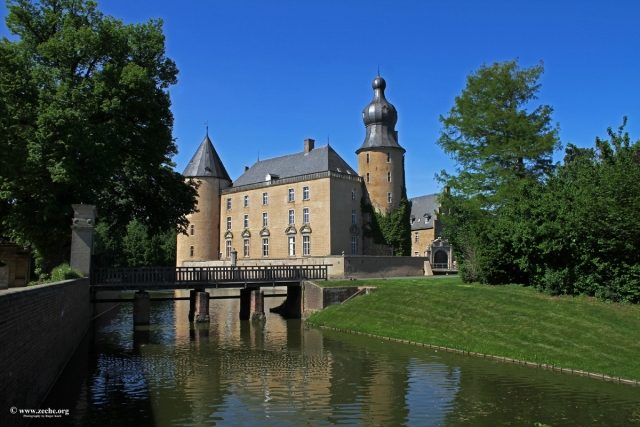
Gemen Castle is located in the Münsterland park landscape in the former swamp area of the Bocholter Aa. Even if the name suggests otherwise, the complex is now a palace. Its former palace freedom gave the present-day Borken district of Gemen in North Rhine-Westphalia its name.
The palace emerged from the gradual conversion of a more than 900-year-old moated castle, built by the noble lords of Gemen, one of the most influential Westphalian noble families of its time. It stands on two islands, surrounded by an extensive moat system. The castle was the center of the Lordship of Gemen.
Residents and Owners+
Middle Ages
In 962, a farm named Gamin was first mentioned in a document as a Vogt fief of the Vreden Abbey for noblewomen. Its then owner, Mathilde, could trace her lineage back to Duke Widukind. From the year 1100, Bernhardus de Ghemene is documented, showing that the Vreden Vogts named themselves after their ancestral seat.
The history of the Lords of Gemen was marked by constant disputes with the Prince-Bishops of Münster since the 12th century, who were also secular rulers of this region at that time. To preserve their imperial immediacy, the castle owners repeatedly and successfully entered into changing alliances, for example, with the Counts and later Dukes of Kleve, the Archbishop of Cologne, and the imperial free city of Dortmund.
Already in the second half of the 13th century, the Lordship of Gemen had significantly expanded its territory through skillful marriage politics and victorious feuds against its neighbors. When Heinrich III von Gemen became head of the family in 1370, the rapid rise of the Gemens to one of the most important noble families in Westphalia began. Heinrich acquired the castle from his liege lord, making it an allodial property of his family. He also had the complex further expanded until 1411. An inscription stone, still preserved today, names him and his wife Katharina von Bronkhorst as the builders.
Heinrich's son Johann II successfully continued his father's policy and was able to expand his dominion westward into Gelderland. When his son Heinrich IV died in 1492 without male heirs, the castle and lordship passed through the marriage of Cordula von Gemen to Count Johann IV von Holstein-Schaumburg and Sternberg.
Modern Era
His grandson Jobst II, a cousin of William of Orange, introduced the Lutheran Reformation in Gemen from 1560, thus laying the foundation for one of the oldest Protestant communities in Westphalia. Because Jobst II also supported the Dutch struggle for freedom against Catholic Spain, Gemen was besieged and plundered in 1568 by Fernando Álvarez de Toledo, the Duke of Alba. However, the lordship fared differently during the Thirty Years' War. Jobst-Hermann, Jobst II's grandson, managed to keep Gemen almost unscathed during the turmoil of the war.
However, when Jobst-Hermann died unmarried in 1635, inheritance disputes over the lordship erupted, during which Jobst-Hermann's aunt, Countess Agnes von Limburg-Styrum, Abbess of Vreden, prevailed. She transferred her inheritance a short time later to her nephew, Hermann Otto I von Limburg-Styrum. His son unsuccessfully tried to reintroduce Catholicism in Gemen.
In 1694, Hermann Otto II von Limburg-Styrum finally succeeded in settling the centuries-long dispute with the Diocese of Münster over territorial sovereignty for his family through a lawsuit before the Imperial Chamber Court. On September 15, 1700, a settlement was subsequently reached between the two warring parties, and the lordship became immediately imperial. Hermann-Otto II was also the one who had the former defensive complex transformed into a palace.
In 1772, Damian August Philipp von Limburg-Styrum, Prince-Bishop of Speyer, was enfeoffed with the Lordship of Gemen. When he renounced the possession in 1775 in favor of Count Ferdinand Menrad von Limburg-Styrum-Illeraichen, Count Simon August von Lippe-Detmold also laid claim to Gemen, as his family had succeeded the Counts of Holstein-Schaumburg. He sent a detachment of soldiers disguised as peasants to the castle and had it occupied by a surprise attack. Only in January 1776 did the Limburgers succeed in recapturing the complex, as a harsh winter had frozen the castle moats, making the castle accessible from all sides.
In 1800, Baron Alois Sebastian von Bömelberg zu Erolzheim inherited Gemen Castle and Lordship. On July 12, 1806, the lordship was mediatized and incorporated into the Principality of Salm. It thus lost its imperial immediacy and was assigned to Prussia only eight years later – as a result of the Congress of Vienna.
On May 24, 1822, the palace complex experienced its last change of ownership for the time being. In that year, it was acquired by Imperial Baron Johann Ignatz Franz von Landsberg-Velen, who was elevated to the rank of count on October 15, 1840, by King Friedrich Wilhelm IV of Prussia and subsequently called himself Count von Landsberg-Velen und Gemen. His family still owns the palace today.
Current Use
On the initiative of the then Bishop of Münster, Clemens August Graf von Galen, the castle was leased to the Diocese of Münster in 1946 and has since been used as its youth education center. The so-called "Jugendburg Gemen" (Gemen Youth Castle) is well-known far beyond the borders of North Rhine-Westphalia and, with over 200 beds and more than 20 seminar rooms, is one of the five largest facilities of its kind in Germany. It is managed on behalf of the church by the castle's chaplain. In addition to many courses from various organizers, "Days of Religious Orientation" are primarily held there under the supervision of a pedagogical team. Furthermore, Eucharist is celebrated on Saturday evenings in St. Michael's Chapel and on Tuesdays, Wednesdays, and Fridays mornings in the von Galen Chapel.
A key focus of the work at the castle is the artistic and cultural offerings. These were already initiated at the beginning of the youth castle's work by committed music educators, which then led to the founding of the "Werkgemeinschaft Musik im Bistum Münster e. V." (Music Working Group in the Diocese of Münster). The main annual activity is the choir and instrumental week, which takes place in the first week of the autumn holidays in North Rhine-Westphalia. Since 1951, an average of about 120 people have met there to make music together in various intergenerational workshops.
Construction History+
It can be assumed that Gemen Castle was built as a motte in the 9th or 10th century. However, it is first mentioned in a document in 1274. The current palace complex is a successor to this first castle, whose construction history is essentially divided into five sections.
13th Century – Expansion into a Ring Castle
In the mid-13th century, the castle had been expanded into a ring castle under Goswin von Gemen. The erected round keep, whose foundation is still preserved today, had two-meter-thick walls and was integrated into an almost circular ring wall. Within the wall, there was probably a residential building, but this can no longer be determined with certainty. Archaeologists assume that this complex was the successor to a tower-mound castle or motte. At that time, the former castle freedom – consisting of houses of castlemen, craftsmen, and serfs – had already grown to the size of today's village center.
14th Century
Presumably in the 14th century, the main castle's extent was almost doubled by the construction of a new ring wall, thus acquiring a polygonal floor plan. A small two-story palas with a floor area of 8 by 17.5 meters was part of the construction, as was probably a rectangular residential tower in the north. The form of possible buildings in the west of the core castle can no longer be determined today.
15th Century
Under Heinrich III, Gemen Castle acquired its present size. By 1411, he had a three-story palas with a large hall and vaulted cellar built in the west and raised the Ballturm (the former keep) to four stories. The construction of the so-called Battery or Chapel Tower made of bricks also dates back to him. A berm wall in the south, west, and north provided additional stability to the ring wall.
16th/17th Century
After some minor construction measures in the 16th century, such as the construction of a clock tower in the courtyard (probably 1571), the complex essentially received its current appearance as a palace under Hermann-Otto II von Limburg-Styrum around 1700. Through small architectural changes to the Gothic exterior, Gemen acquired a slightly Baroque nuance. The portal on the north wing was completely redesigned in the classical Roman style. A special feature in Westphalia are the two lion statues flanking the portal, which descend the stairs. In addition, the palace was clad in 1692 with a yellowish plaster and subdivided by white paint strokes as joint divisions. Inside, in the course of these construction measures, the large rooms were divided into smaller cabinets and equipped with fireplaces and stucco decorations. As a result, only the so-called Knight's Hall, a larger hall in the northern part of the western palas, exists at Gemen Castle today.
19th/20th Century
Construction activities in the 19th and 20th centuries were primarily limited to minor redesigns and modernization work, as the complex suffered no significant damage in World War II. Only the outer bailey received a completely new form. Due to a fire in 1865, the old buildings were destroyed, so they were rebuilt in the Neo-Renaissance style starting in 1882. In the same vein, the current representative palace access was also created.
The last significant construction measure took place in 1950 on the ground floor of the East Palas with the establishment of St. Michael's Chapel.
Lords of the Castle+
Noble Lords of Gemen
- until approx. 1092 Werembold I (* approx. 1035; † after 1092)
- approx. 1092 to approx. 1118 Bernhard, son of Werembold I (* approx. 1065; † after 1118)
- approx. 1118 to approx. 1151 Werembold II, son of Bernhard (* approx. 1097; † after 1151)
- approx. 1151 to approx. 1163 Lambert, son of Werembold II (* approx. 1122; † after 1163)
- approx. 1163 to approx. 1203 Israel, brother of Lambert (*approx. 1125; † after 1203)
- approx. 1203 to approx. 1234 Heinrich I, son of Israel (* approx. 1165; † after 1234)
- approx. 1234 to approx. 1250 Goswin II, son of Heinrich I (* approx. 1197; † after 1250)
- approx. 1250 to approx. 1280 Gottfried III, son of Goswin II (* approx. 1220; † after 1287)
- approx. 1280 to approx. 1317 Goswin III, son of Gottfried III (* approx. 1245; † after 1316)
- approx. 1317 to approx. 1319 Hermann I, son of Goswin III
- approx. 1319 to approx. 1345 Heinrich II, son of Hermann I
- approx. 1345–1368 Johann I, son of Heinrich II († before 1369)
- 1368–1424 Heinrich III, son of Johann I († March 26, 1424)
- 1424–1455 Johann II, son of Heinrich III (* 1391/1401; † after March 8, 1458)
- 1455 to approx. 1458 Johann II and Heinrich IV, son of Johann II (* after 1417; † 1492)
- approx. 1458–1492 Heinrich IV. With the death of Heinrich IV, the line of the noble lords and dynasts of Gemen dies out in the male line.
Heinrich IV bequeaths the Lordship of Gemen to his daughter Cordula, who brings it to her husband Johann IV von Holstein-Schaumburg.
Counts of Holstein-Schaumburg
- 1492–1512 Count Johann IV von Holstein-Schaumburg-Gemen
- 1512–1531 Count Jobst I von Holstein-Schaumburg-Gemen
- 1531–1581 Count Jobst II von Holstein-Schaumburg-Gemen (introduces Reformation)
- 1581–1597 (or 1607) Count Heinrich V von Holstein-Schaumburg-Gemen
- 1597 (or 1607)–1635 Count Jobst Hermann von Holstein-Schaumburg-Gemen
Jobst Hermann dies unmarried, Gemen falls through his relative Countess Agnes von Limburg-Styrum, Abbess of Vreden, to her nephew Hermann Otto
Counts of Limburg
- 1640–1644 Count Hermann Otto I von Limburg-Styrum
- 1644–1657 Count
- 1657–1704 Count Hermann Otto II von Limburg-Gemen
- 1704–1754 Count
- 1743–1771 Count Friedrich-Karl von Limburg-Gemen
- 1771–1775 Damian August Philipp Karl, Prince-Bishop of Speyer
- 1775–1791 Count Ferdinand Gotthard Meinrad von Limburg-Styrum zu Illeraichen
- (1775–1776 occupation by Lippe-Detmold)
- 1791–1798 Count Karl II Joseph Maximillian von Limburg-Styrum-Illeraichen
- 1798–1800 Count Ferdinand August Joseph Johannes Nepomuk Thaddeus von Limburg-Styrum-Illeraichen
After the death of Ferdinand August, Gemen falls through his aunt Isabella Charlotte to her husband Baron Ignaz von Bömelberg.
Barons von Bömelberg
- 1800–1822 Baron Alois Sebastian von Bömelberg zu Erolzheim
In 1806, the immediately imperial Lordship of Gemen fell to Prince Friedrich IV zu Salm-Kyrburg by the provisions of the Confederation of the Rhine Act, and in 1815, by the Congress of Vienna, to Prussia.
In 1822, Alois Sebastian von Bömelberg sold the noble lordship of Gemen to Johann Ignatz Franz von Landsberg-Velen.
Counts von Landsberg-Velen und Gemen
- 1822–1863 Baron Johann Ignatz Franz von Landsberg-Velen, from 1840 Count von Landsberg-Velen und Gemen
- 1863–1898 Count Friedrich von Landsberg-Velen und Gemen
- 1898–1902 Count Max Franz von Landsberg-Velen und Gemen
- 1902–1921 Count Max Friedrich von Landsberg-Velen und Gemen
- 1921–1942 Max Count von Landsberg-Velen und Gemen
- since 1942 Max-Dieter Count von Landsberg-Velen und Gemen
Stamp Series Castles and Palaces+
In 1977, the Deutsche Bundespost dedicated a definitive stamp series to the theme of castles and palaces. The stamp, supplemented in January 1979 with a value of 25 Pfennig, depicts Gemen Castle. The motif was also adopted by the Deutsche Bundespost Berlin.
The stamps are listed under Michel numbers 996 (FRG) and 587 (Berlin) respectively and were designed by Heinz Schillinger.
Take Mobile History with you
You are reading this text for free. Premium adds what matters on the road: descriptions read aloud, sites found through your camera, whole regions taken offline.
- Every description, including the ~17,700 Premium sites
- Audio guide: have descriptions read to you on location
- AR finder: see sites through your camera, with distance and bearing
- Unlimited saved sites
14 days free, then from €2.99 a month. Cancel anytime.
Source: Wikipedia · Licence: CC BY-SA 4.0 · Image: http://www.zeche.org/
This description draws on the facts documented in the linked Wikipedia article; Wikipedia content is licensed under CC BY-SA 4.0. Wording and editing: Mobile History.
Location: 51.8629, 6.8662