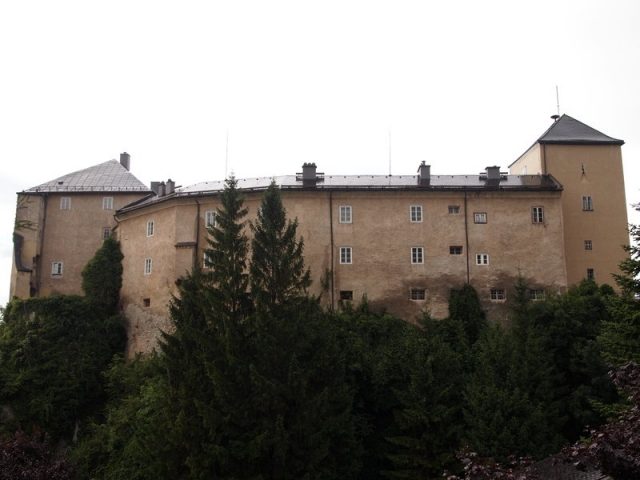
CastleGolling

Golling Castle

Golling Castle

Cultural Events
Museum

Local historians suspect that a wooden watchtower already stood here in ancient times, overlooking the old Roman road. However, the present stone castle was probably built in the first half of the 13th century under Archbishop Eberhard II of Salzburg. Until their extinction at the beginning of the 14th century, the Lords of Guetrat held the district court.

In 1325, Archbishop Friedrich handed over the fortress of Golling to Margarethe von Chuchel and her two sons Konrad and Hartneid for life. This is also when the castle first appears in documented records. In 1375, Hartneid sold his life annuity to Archbishop Pilgrim II of Salzburg. However, due to disputes over fishing rights, the castle probably only definitively fell to the Archbishop in 1438.

From then on, the archdiocese only appointed caretakers to the castle. In the second half of the 15th century, major extensions and alterations took place. In 1526, the castle was attacked and plundered by a peasant army. The severely damaged castle had to be extensively renovated in 1532. In 1573, heavy rainfall caused severe damage to the castle, so that in 1589 extensive reconstruction and expansion work had to be started again. A largely new building was created. In 1599, a lightning strike damaged the castle tower.

Construction on the building continued almost constantly in the 17th century as well. During the great market fire of 1619, the palisades surrounding the castle were torn down to prevent the fire from spreading. Two years later, they were replaced by a wall. With the secularization of the Prince-Archbishopric of Salzburg, the episcopal rule also ended for Golling. From 1803 to 1805, the country, together with Eichstätt and Berchtesgaden, was an electorate ruled by Grand Duke Ferdinand of Tuscany. After that, Golling became Austrian for the first time. Between 1810 and 1816, it belonged to Bavaria. After that, Salzburg was finally assigned to Austria. The castle continued to serve as an administrative and court seat. In 1871, a thorough renovation of the building took place.

In 1923, the district court, which was still located here, was dissolved and the castle was partly divided into apartments. In addition, a customs guard department and a tax supervision office had their offices here. In 1971, the local history museum was set up in some of the rooms.

Take Mobile History with you

You are reading this text for free. Premium adds what matters on the road: descriptions read aloud, sites found through your camera, whole regions taken offline.

  • Every description, including the ~17,700 Premium sites
  • Audio guide: have descriptions read to you on location
  • AR finder: see sites through your camera, with distance and bearing
  • Unlimited saved sites

14 days free, then from €2.99 a month. Cancel anytime.

Source: Wikipedia · Licence: CC BY-SA 4.0 · Image: http://www.wehrbauten.de/thread.php?threadid=1496

This description draws on the facts documented in the linked Wikipedia article; Wikipedia content is licensed under CC BY-SA 4.0. Wording and editing: Mobile History.

Location: 47.5973, 13.1667