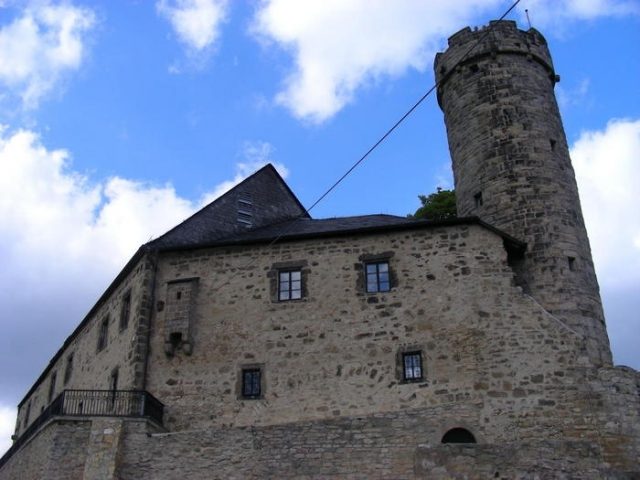
The Castle can be visited
Greifenstein Castle

Greifenstein Castle is a medieval castle ruin near Bad Blankenburg in the district of Saalfeld-Rudolstadt in Thuringia. With its dimensions of approximately 250 by 100 meters, or about 25,000 square meters, it is one of the largest German castle ruins.
The ruin of the hilltop castle rises 390 meters high on the Greifenstein, the local mountain of Bad Blankenburg in South Thuringia.
In 1840, Hesse vividly described the possible appearance of the fortress based on the ruins and wall remains he found. He also directed his gaze to the landscape and the distance. He attempted to reconstruct the time of the castle's origin and discussed the names of the castle, favoring "Greifenstein".
Emperor Henry I is said to have ordered Margrave Günther around 925–932 to build the Blankenburg fortress to secure the region against the raids of the Huns and Hungarians, in order to protect the settlements in the surrounding area that had already formed before this time. Blankenburg belonged to the Orlagau in the Middle Ages, which is evident from a document from 1071. It also names the other places of the Orlagau. The castle near Blankenburg was first mentioned in writing in a disputed deed of gift to Count Sizzo III in 1137. Herein, Konrad von Wazdorf, who was a knight and Vogt on Greifenstein, is named. Later, the name "Greifenstein" died out and was replaced by "Blankenburg". This castle was then transferred to Sizzo, Count of Schwarzburg. Several owners are then named. It is mentioned that a Henry was owner of the castle from 1267–1285, who also owned Saalfeld and Ranis. Blankenburg Castle was then for a long time the seat of the Schwarzburg lineage. Several documents from the 13th century prove this. Günther XXI was the last to be born in the castle in 1304. He was also the elected German Emperor, who then died unexpectedly on June 14, 1349. This prestige was not used appropriately for the castle. Later, there was a dispute over the inheritance and it was divided in Erfurt into the known territories. The guardianship of his son Henry XVII was also clarified, with whose death in 1357 the male line of the Günthers died out. The widow, mother of the deceased son, could then not cover the financial obligations and now concentrated on the Rudolstadt location. At the end of the reign of Henry XXXVII, the buildings of Blankenburg were still retained, but already in 1525, Günther XX and his Countess could not make any provisions for the preservation of the castle, especially since the Count died on July 12, 1538. The subsequent relocation of the office to Rudolstadt around 1560 was probably the beginning of the end of the castle.
Predecessor Buildings
Individual finds indicate Neolithic settlement of the Greifenstein. However, there are no remains from the period between this epoch and the Middle Ages.
First Sources
Although Greifenstein Castle is first mentioned in a document dated 1137, this document is most likely a later forgery, as the name "Greifenstein" was only used in the mid-17th century. The earlier name for the castle and mountain was "Blankenburg".
The oldest credible document is undated and likely originated between 1196 and 1210. Further written sources prove that the castle belonged to the County of Schwarzburg from 1208 at the latest, although an earlier takeover by them is probable.
Construction History
The origins of the castle are unknown. However, building components and archaeological finds indicate that the complex already existed in the 12th century, originally probably merely as a collection of mud houses with ditches, ramparts, and a palisade in the northwest of the hilltop. The complex may have been built in connection with an advance by the Sorbs. However, this is by no means certain.
In the 12th or 13th century, a wall system with a pentagonal ground plan was built, which extended the old fortified area to the east. The old castle core probably remained as a preliminary settlement and additionally shielded the castle from the path leading from the west, in addition to a deep ditch. A similar settlement arose in the east. Overall, the newer castle complex had a surrounding rampart with a ditch.
Already in the 13th century, Blankenburg lost importance compared to Schwarzburg, which became the main residence of the comital family. A document from 1346 mentions two separate comital residences at Blankenburg. This indicates that an expansion of the complex had already taken place at that time. This probably involved the buildings in the southeast of the rock, a round tower, a chapel, as well as residential and utility buildings. The defensive structures of this part of the castle consisted of a Zwinger (outer bailey), a ring ditch, and six round bastions. For water supply, two wells were dug in the ditch and a cistern under the castle courtyard. The older part of the castle also seems to have been modernized during this phase: a more convenient access from the south with a double gate and portcullis was created.
Nevertheless, from the 14th century onwards, the princes usually resided in the more comfortable city dwellings. Blankenburg became the seat of a Vogt and the permanent seat of a detachment of soldiers. Henry XXVI was probably the last count who lived at Blankenburg, at least temporarily, at the end of the 15th century.
A written source from 1547 reports three fires at the castle and the increasing decay of the complex. It was only inhabited by an official from Rudolstadt during the grape harvest. In 1612, the wine press at the castle was repaired. In 1642, the removal of stones from the ruin had to be prohibited. However, in 1664, the fortifications were repaired to be able to use the castle in case of a Turkish attack.
In the 18th century, the castle seems to have been visited several times by treasure hunters, which probably led to the destruction of the main tower: in 1785 it broke apart and completely collapsed in November 1800.
In 1821, initial minor restoration attempts were made. In 1860, a castle restaurant was established. In 1900, the castle community was founded, which, in cooperation with the Representatives' Convention of academic gymnastic fraternities, had the palas and tower rebuilt from 1925 to 1928. In 1962, volunteers gathered and worked on the restoration of the castle in the following years.
Take Mobile History with you
You are reading this text for free. Premium adds what matters on the road: descriptions read aloud, sites found through your camera, whole regions taken offline.
- Every description, including the ~17,700 Premium sites
- Audio guide: have descriptions read to you on location
- AR finder: see sites through your camera, with distance and bearing
- Unlimited saved sites
14 days free, then from €2.99 a month. Cancel anytime.
Source: Wikipedia · Licence: CC BY-SA 4.0 · Image: http://www.wehrbauten.de/thread.php?threadid=638
This description draws on the facts documented in the linked Wikipedia article; Wikipedia content is licensed under CC BY-SA 4.0. Wording and editing: Mobile History.
Location: 50.6902, 11.2629