CastleBreitenbach am Herzberg

Herzberg Castle
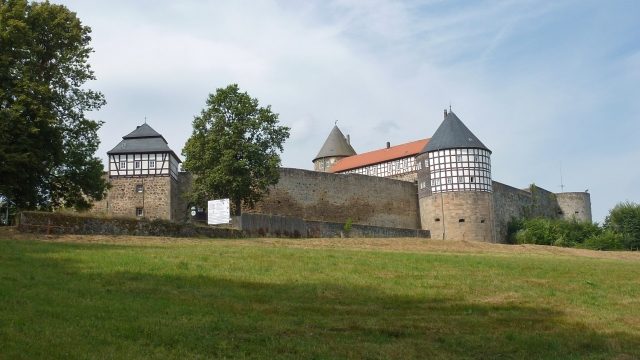
Herzberg Castle

The Castle can be visited

Herzberg Castle (also called Herzberg Palace) is a castle ruin in the municipality of Breitenbach am Herzberg in the district of Hersfeld-Rotenburg in Hesse (Germany).

It is the largest hilltop castle in the state of Hesse and was the original venue for the Burg-Herzberg-Festival.

The ruin of the hilltop castle stands in the southeastern part of North Hesse directly on the border with Central Hesse in the southern foothills of the Knüllgebirge on an open area of the predominantly heavily forested Hirschberg (formerly Herzisberg; 508 m above sea level). It is located almost 2 km (as the crow flies) southwest of Gehau, a small western district of Breitenbach. A section of federal road 62, which connects Breitenbach in the east via Gehau with Alsfeld in the west, passes north of the castle.

The old road "through the Kurzen Hessen" used to run over the Hirschberg, southwards via Alsfeld to Frankfurt am Main and eastwards via Bad Hersfeld to Leipzig.

The main castle is located in the trapezoidal fortified middle castle (the narrow side is in the north). Here still stands the originally Romanesque castle chapel, which was designed as a fortified church. It received its current windows in 1790. Next to it are the remains of the old keep of the main castle. Behind it were the residential buildings of the lords of the castle. They were demolished in 1700 and not rebuilt. Some cellar walls of these buildings are now exposed.

The middle castle was secured by five round towers. Three of these towers stand on the southern side, where the only entrance to the middle castle is also located. The middle tower was the court and prison tower, the right one was the residential tower, and the left tower housed the knight's hall since 1565. In the north were two more towers, which probably never had roofs. Cannons stood on them. The right tower is the powder tower and the left one is the Huhnstädter Tower, from which an underground passage led to the Huhnstadt estate. Who dug the passage and what purpose it served is not known.

To the south, the outer bailey adjoins. Its access was secured by a drawbridge, a double gate, and battlements on the double boundary walls. Today, the inner wall still stands, the drawbridge was removed in 1788, and the moat was filled in. On the left side of the gate is the rectangular commander's tower, through which one had access to the left Zwinger. Opposite, on the other side of the outer bailey, is the rectangular battery, where cannons used to be located. Furthermore, the outer bailey housed the buildings for the cisterns, armories, and magazines.

The path leading to the castle was additionally secured by two bastion-like redoubts, in which cannons stood.

Construction

Between 1280 and 1290, the construction of the castle began, by Heinrich von Romrod, marshal of Landgrave Heinrich I of Hesse. He had received five villages around the Herzberg as a fief from the Landgrave. The castle was probably completed in 1298, as Heinrich enfeoffed the castle to the Landgrave in that year.

Sterner War

In 1344, the "von Romrod" family died out in the male line with Friedrich, the youngest son of Heinrich von Romrod, and the castle came into the possession of Berthold von Lissberg, who had married Friedrich's daughter Mechthild and to whom Landgrave Heinrich II granted the castle fief. The son of Berthold and Mechthild, Friedrich von Lissberg (often also called "von Herzberg"), joined the Sternerbund around 1370, which fought against the increasing power of the Hessian landgraves. Due to the strategically important location of the castle, on the military and trade route and between the spheres of interest of the Landgraviate of Hesse, the Abbey of Hersfeld, the County of Ziegenhain, and the Abbey of Fulda, the castle became an important stronghold of the Sterner. To secure the castle against attacks, the Sterner Duke Otto von Braunschweig-Göttingen sent his captain Breido Rantzow with his own troops to the castle. To regain control of this strategic point, the Hessian Landgrave Hermann II attacked the Sterner in the castle in August 1372, thus starting the Sterner War. He besieged the castle with about 1,000 men. However, since the siege lasted longer, the Sterner were able to raise a relief army of about 1,500 men, and Hermann was forced to break off the siege.

Expansion

Already in 1370, Werner II von Falkenberg and (his brother?) Konrad IV (Kuno), both also Sterner, had acquired a share in the castle. In 1392, Werner II von Falkenberg, Mainz's chief bailiff in Hesse and on the Eichsfeld from 1374-1382, and his son Kunzmann bought Friedrich von Lissberg's half and then received it as a fief from the Landgrave, and in 1400 the Abbey of Fulda ceded its half of the castle to the Diocese of Mainz. After the Herzberg line of the Falkenbergs died out in 1441 with Kunzmann's son Werner, in 1463 the Hessian court master Hans von Dörnberg received the Mainz half of the castle and the court as a fief; his family received the other half as a fief from the Landgrave of Hesse in 1477. Adolf von Dörnberg had the castle enlarged between 1480 and 1497 by the Hesse-Kassel fortress builder Hans Jakob von Ettlingen. It took on the appearance of a fortress, as it can still be seen today. To this day, the castle has been continuously owned by the Barons von Dörnberg.

Thirty Years' War

During the Thirty Years' War, the castle, defended by Hessian troops, was again of strategic importance due to its location on the Kurzen Hessen. In 1631, Tilly and Ottheinrich Fugger stood before the castle, in 1635 Marquis de Grana besieged it, and in 1637 General Piccolomini marched before the castle with 4,000 men and "much heavy artillery". The castle survived these attacks, as well as that of General Isolani's Croatian cavalry in 1641, without being conquered.

Seven Years' War

During the Seven Years' War, the castle was occupied from 1762 to 1763 by the French Duke and Marshal Jacques Philippe de Choiseul-Stainville.

The fortress retained its military significance until 1786. On September 19 of that year, the last Hessian commander, Major Rückersfeld, left the castle.

Take Mobile History with you

You are reading this text for free. Premium adds what matters on the road: descriptions read aloud, sites found through your camera, whole regions taken offline.

  • Every description, including the ~17,700 Premium sites
  • Audio guide: have descriptions read to you on location
  • AR finder: see sites through your camera, with distance and bearing
  • Unlimited saved sites

14 days free, then from €2.99 a month. Cancel anytime.

Source: Wikipedia · Licence: CC BY-SA 4.0 · Image: Joachim Schneeleopard

This description draws on the facts documented in the linked Wikipedia article; Wikipedia content is licensed under CC BY-SA 4.0. Wording and editing: Mobile History.

Location: 50.7700, 9.4594