Hotel
Restaurant
Hirschhorn Castle

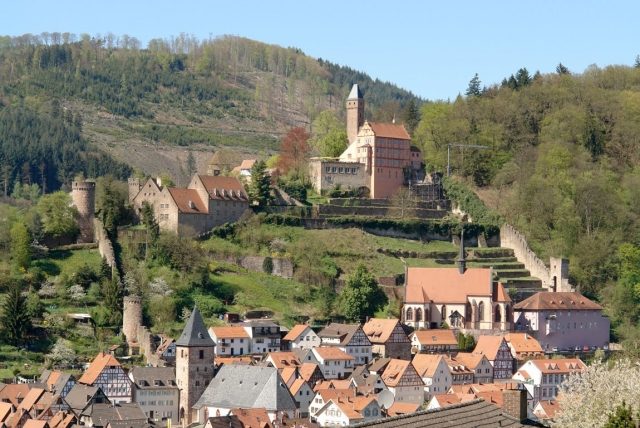
Hirschhorn Castle is a very well-preserved hillside castle and palace complex above the Hessian town of Hirschhorn, located on the Neckar River, on the border between Baden-Württemberg and Hesse.
Hirschhorn Castle is situated on a south-facing spur of the Stöckberg directly above Hirschhorn's old town. It is strategically positioned to control the Neckar Valley as well as the exits of the Finkenbach Valley and the Ulfenbach Valley.
Complex+
Due to the fact that the castle has been preserved for over 800 years through several construction phases, and due to the winding fortifications reaching right up to Hirschhorn's old town, the structure of the overall rather extensive castle complex only reveals itself at second glance. The entire complex essentially consists of the main castle, as well as the upper and lower bailey.
The origin of the castle and the oldest visible components of the complex today are located in the area of the core or main castle, the highest part of Hirschhorn Castle. Particularly striking from this early construction phase is the mighty shield wall facing north behind the up to 15 m deep neck ditch in the area of today's car park. Also belonging to the core castle are the old palas (early 14th century, rebuilt mid-14th century, re-rebuilt after collapse in early 19th century) with the annexed keep and a Renaissance extension of the palas, the so-called Hatzfeld Building (late 16th century).
Immediately below the core castle, the upper bailey adjoins it to the southwest, which is the first part of the complex that visitors arriving from the car park enter. The upper bailey replaced an older 14th-century zwinger in the 15th century. Its most important components are a bastion, whose purpose was probably to monitor access to the northern gate, and a western corner tower, the so-called Prison Tower. It is separated from the lower bailey to the south by a wall and a two-story gatehouse integrated into it. Immediately west of the gatehouse there is still a large well, otherwise the interior of the upper bailey is free of buildings.
The lower bailey was built at the same time as the upper bailey. It houses the stables, a small castle church, and some other buildings. The outermost southern defensive tower of the lower bailey is simultaneously part of the city walls of Hirschhorn. Here, more than anywhere else, the architectural connection between the castle and city fortifications becomes clear. The fortifications of the baileys and the city were probably planned by one hand and begun under Hans V von Hirschhorn around 1391 and completed in the first quarter of the 15th century. Around 1400, Hans V also founded the monastery immediately below the castle and also touched by castle walls, with its associated Carmelite monastery church of the Annunciation of Mary.
Hirschhorn Castle was founded around 1260 by Johann von Hirschhorn, who first named himself after the castle in 1270. He was probably the grandson (possibly son) of a marriage alliance between the noble lords of Steinach and the ministerials of Hirschberg (castle above Leutershausen on the Bergstraße). The canting coat of arms with the stag's antler was adopted from the maternal grandmother's family of Hirschberg, and the new castle was named after it. A castle foundation by Johann von Hirschhorn's father, Konrad Rind von Steinach, around 1250 is also possible. There is no evidence of an even older castle complex. With the economic and political rise of the Lords of Hirschhorn in the 14th century, the castle complex was also expanded and extended. It received its final form through a palace-like renovation in the Renaissance style at the end of the 16th century. The castle, largely built of sandstone, was spared major systematic destruction in modern times and is therefore in a very good state of preservation today.
The castle has had the following owners throughout history:
around 1260–1632 Lords of Hirschhorn, initially as a Lorsch, then as a Palatinate fief 1632–1699 Electorate of Mainz; as a fief to the Barons Raitz von Frentz and to the Lords von der Recke 1699–1803 Electorate of Mainz administrative seat 1803–1918 Grand Duchy of Hesse-Darmstadt (administrative seat) 1918–1945 People's State of Hesse since 1949 Federal State of Hesse
Since 1959, a hotel with a restaurant has been housed in the Renaissance Palas building and in the stables' annex. Another building is privately used. The most striking building of the castle complex is the small gatekeeper's house in the middle of the castle grounds. An external office of the civil registry of the city of Hirschhorn is also located there. The rest of the castle (especially the inner courtyard and tower) is freely accessible. From May to September, combined city/castle tours are offered weekly on Saturdays.
The castle can be reached via a footpath (approx. 10 minutes) from Hirschhorn's old town; however, there are also parking spaces directly in front of the castle grounds.
Take Mobile History with you
You are reading this text for free. Premium adds what matters on the road: descriptions read aloud, sites found through your camera, whole regions taken offline.
- Every description, including the ~17,700 Premium sites
- Audio guide: have descriptions read to you on location
- AR finder: see sites through your camera, with distance and bearing
- Unlimited saved sites
14 days free, then from €2.99 a month. Cancel anytime.
Source: Wikipedia · Licence: CC BY-SA 4.0 · Image: Dr. Gebhard Gaukler
This description draws on the facts documented in the linked Wikipedia article; Wikipedia content is licensed under CC BY-SA 4.0. Wording and editing: Mobile History.
Location: 49.4494, 8.8983