CastleHohenberg an der Eger

Hohenberg Castle
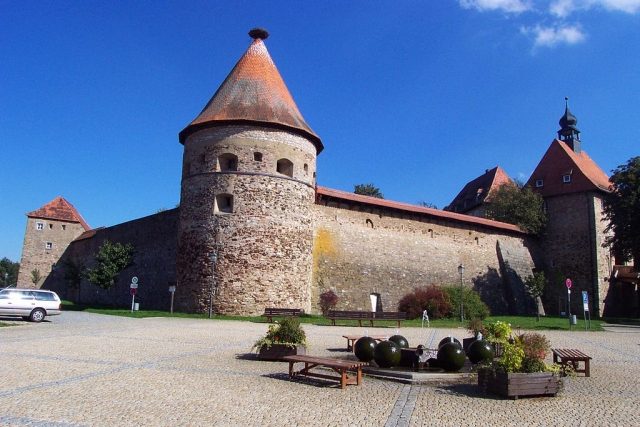
Hohenberg Castle

Educational Institution
Youth hostel


Hohenberg Castle stands on a rocky outcrop rising 125 meters above the Eger river, at the edge of the town center of Hohenberg an der Eger.

Hohenberg Castle, situated high above the Eger valley, was, after Plassenburg above Kulmbach, the most important fortress in the Hohenzollern Margraviate of Brandenburg-Kulmbach-Bayreuth. It secured the once strategically and traffic-wise important Schirnding Pass, which provided access from the Fichtelgebirge plateau to the Eger basin and thus to Bohemia. The castle originated in the Staufer period in connection with the safeguarding of the Imperial Castle of Eger; the place name first appeared in 1222 with a Berchtoldus de honberg acting as a witness to a document.

Around 1300, Hohenberg came into the possession of the Burgraves of Nuremberg, who consolidated their oldest acquisitions in the Egerland region in the Wunsiedel/Hohenberg district. However, the first burgravial bailiff at Hohenberg, Rüdiger von Sparneck, only appeared in 1341. A good hundred years later, in 1433, Hans von Kotzau defended Hohenberg against the Hussites. During the Bohemian invasion in 1462, the Eger basin servant Haußner set fire to a tower of Hohenberg Castle.

The present Hohenberg Castle was built in its essential parts (ring wall, round towers) around 1480. In 1499 and 1504, the construction of the outer bailey was reported. In 1621 and 1622, Margrave Christian had mighty earthworks with seven bastions built around the castle, which were additionally fortified with palisades. However, these precautions were of little use when, in June 1632, imperial troops captured the Schirnding Pass, conquered the Hohenberg border house, and occupied it for three years. After the Thirty Years' War, Hohenberg Castle lost its strategic importance. Margrave Christian Ernst erected the Fürstenhaus in 1666, a building used as a hunting lodge with an attached kitchen wing and a residence for the bailiff. In 1945, along with a large part of the town of Hohenberg, parts of the castle, namely the outer bailey, the gate tower, and the stork tower, were destroyed by American artillery fire. Today, Hohenberg Castle serves as a youth hostel and a meeting and conference center for the Sudetendeutsche Sozialwerk.

The town and Hohenberg Castle were granted the privilege of an imperial sanctuary until 1799. Four stone pillars (now visible in the castle courtyard) stood at the entrance roads to the town and marked off a protected area. If lawbreakers managed to reach the protected area, they were in the emperor's asylum and were initially free from persecution.

The Margraviate of Ansbach-Bayreuth became part of the Kingdom of Prussia in 1791. After a previous four-year French occupation, the town and castle became part of the Kingdom of Bavaria in 1810.

From 1936, the castle belonged to the NS-Lehrerbund and served as a rural school home. At the end of World War II in April 1945, several defensive towers, the outer bailey, and a third of the town fell victim to shelling by American troops when SS troops defended the town. In 1951, the gradual reconstruction by the Bavarian state began.

Current Use+

In cooperation with the Free State of Bavaria, the Sudetendeutsche Sozial- und Bildungswerk established a youth hostel, a rural school home, and later a borderland educational center in 1955.

Layout+

The spacious castle courtyard of the hilltop castle is enclosed by the ring wall, built around 1480 on an irregular hexagonal plan, which is additionally fortified at the corners by the gatehouse, three round gun towers, and the square prison tower. A fourth round tower was lost in the 19th century. Nothing remains of the medieval interior buildings. Margrave Christian Ernst had the so-called Fürstenhaus built in 1666 as an official residence and hunting lodge. Other buildings inside the castle, such as the granary and the cattle shed, were demolished in the 19th century. A remnant of the earthwork from 1621/22 is still preserved in front of the southern ring wall. Until 1959, an 1853-built wooden pavilion, the so-called Königsruhe, was located in the area of the southeastern earth bastion. This commemorated a visit by Queen Therese of Bavaria, who stayed on the wall in 1847 and enjoyed the view of the Egerland. Today, the youth hostel's campfire site is located there; the view of the Egerland is completely overgrown.

Take Mobile History with you

You are reading this text for free. Premium adds what matters on the road: descriptions read aloud, sites found through your camera, whole regions taken offline.

  • Every description, including the ~17,700 Premium sites
  • Audio guide: have descriptions read to you on location
  • AR finder: see sites through your camera, with distance and bearing
  • Unlimited saved sites

14 days free, then from €2.99 a month. Cancel anytime.

Source: Wikipedia · Licence: CC BY-SA 4.0

This description draws on the facts documented in the linked Wikipedia article; Wikipedia content is licensed under CC BY-SA 4.0. Wording and editing: Mobile History.

Location: 50.0970, 12.2242