Restaurant
Hohenbregenz Castle

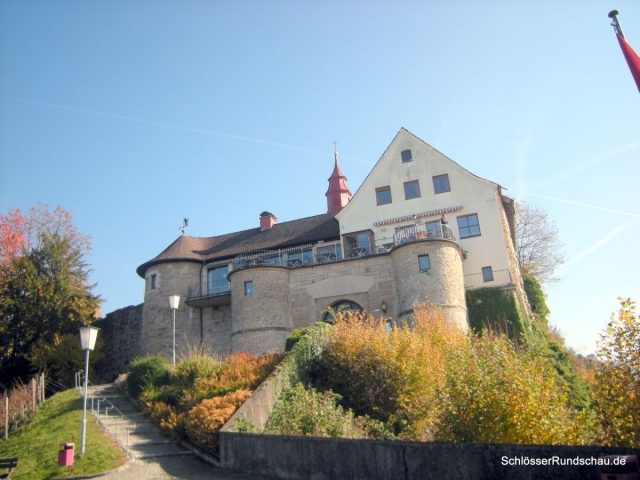
Hohenbregenz Castle is a high medieval castle ruin near Bregenz in Vorarlberg, Austria. The ruin is located on the Gebhardsberg, a 598-meter-high panoramic mountain, southeast of Bregenz. From there, one has a magnificent view of Lake Constance.
Layout+
Today, only the ring wall of the main castle and parts of the palas remain of the castle complex.
In the former palas of the castle, a pilgrimage church of Saint Gebhard was built in 1723, which gives the mountain its name.
The castle was built in the last quarter of the 11th century (before 1097) by the Counts of Bregenz. The castle was first mentioned in a document in 1209.
In 1143, the castle passed to the Counts of Pfullendorf, but remained in their possession only briefly. A few years later (1170), it came into the possession of Count Palatine Hugo of Tübingen (father of Hugo I, Count of Montfort). Through sale, the upper part of the castle went to the Habsburgs in 1451 and the lower part in 1523, who made the castle the seat of Austrian bailiffs.
At the beginning of the 17th century, the castle was expanded into a fortress. In 1647, towards the end of the Thirty Years' War, Swedish troops were able to capture it without a fight. They blew up the fortress in the same year by detonating five mines (see Naval Warfare on Lake Constance 1632–1648).
Hermits settled in the ruins and built the first hermitage. From 1670, the ruin gained importance as a pilgrimage site of Saint Gebhard. In 1723, the church built in the ruin was consecrated in honor of St. George and St. Gebhard, and since then, it has only been referred to as Gebhardsberg.
The church burned down in 1791 but was rebuilt in its current form in the same year. Monks from the dissolved Petershausen monastery near Konstanz, once founded by Gebhard, donated an arm relic of St. Gebhard to the church in 1821. In 1896/1897, on the occasion of the 900th anniversary of St. Gebhard, the Munich painter Gebhard Fugel decorated the church interior with impressive frescoes. The most recent renovation took place in 1994/1995.
Current Use+
In the course of its new use, the ruin has been repeatedly adapted and expanded for religious and gastronomic purposes. In 1964, the castle restaurant was built in its current form according to plans by W. Braun and F. Menia. During this process, a cannon from the Thirty Years' War was found, and a Gothic ceiling from Rankweil was installed in the Knight's Hall. A room named after Empress Maria Theresia, with her portrait, commemorates her and the former Habsburg possession.
Take Mobile History with you
You are reading this text for free. Premium adds what matters on the road: descriptions read aloud, sites found through your camera, whole regions taken offline.
- Every description, including the ~17,700 Premium sites
- Audio guide: have descriptions read to you on location
- AR finder: see sites through your camera, with distance and bearing
- Unlimited saved sites
14 days free, then from €2.99 a month. Cancel anytime.
Source: Wikipedia · Licence: CC BY-SA 4.0 · Image: http://schloesserrundschau.de/vorarlberg/schloesser/bregenz017.html
This description draws on the facts documented in the linked Wikipedia article; Wikipedia content is licensed under CC BY-SA 4.0. Wording and editing: Mobile History.
Location: 47.4900, 9.7471