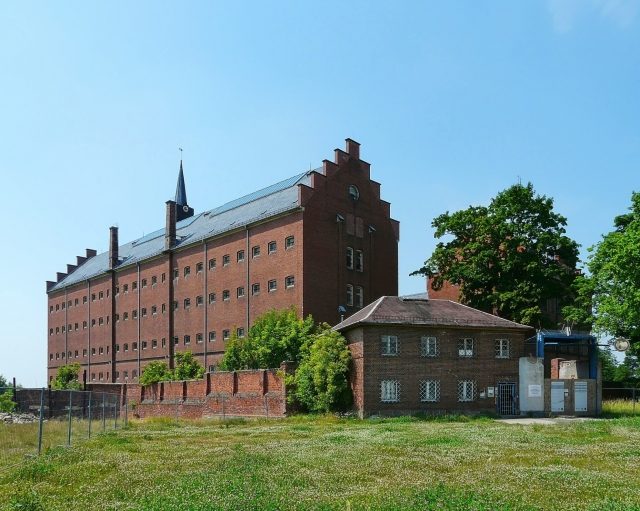
The Castle can be visited
Hoheneck Castle
The Hoheneck Women's Prison, or Hoheneck Women's Penitentiary, known during GDR times as Penal Institution (StVE) Stollberg (Hoheneck), was a prison in Stollberg/Erzgeb. in Saxony.
The building stands on the foundations of a 16th-century hunting lodge, which in turn was built on the ruins of a medieval border fortress, the "Staleburg," which gave the town of Stollberg its name. In the 17th century, the castle was used as a remand prison, for which purpose a new keep (today's clock tower) was erected in the "Hohen Eck" (High Corner), from which the new name of the castle and the later settlement was derived. In 1923, Hoheneck was incorporated into Stollberg as a new district.
The name Hoheneck became synonymous with women imprisoned for political reasons in the GDR. Exact numbers of inmates are not known. Estimates suggest several thousand. There were cells for solitary confinement and dark cells.
In 1862, the penal institution was first mentioned as the Saxon Women's Penitentiary; later it temporarily became a penal institution for men and a reserve hospital during the First World War.
The National Socialists briefly used the prison in 1933 for men in political protective custody. After that, it continued to be used as a penitentiary for regularly convicted criminals.
Immediately after the end of World War II, members of the Volkssturm and Werwolves were imprisoned in the prison, but also those apprehended by the Soviet Military Administration who often came to Hoheneck for minor offenses without proper trial. The care of the prisoners at that time was catastrophic; epidemics and hunger decimated the number of inmates (especially in the winter of 1945/46) or led to early releases due to inability to serve time.
In 1950, 1119 women from Special Camps No. 4 Bautzen and No. 7 Sachsenhausen were transferred to Hoheneck by Soviet military tribunals. The penitentiary, designed for a maximum of 600 inmates, was overcrowded for the first time. Hoheneck became a prison for women imprisoned for political reasons. There were also about 30 infants, born in the camps, in the prison area. They were separated from their mothers a few weeks after birth and distributed to GDR children's homes as so-called "children of the state government." In Hoheneck, at least 27 more children were born until 1952, but not all of them survived imprisonment. These children also went to GDR children's homes after a few weeks.
In 1953, imprisoned women tried to achieve better conditions and a review of their convictions with a hunger strike. This was partially successful, and from 1954 to 1956, some women were released. However, they were forced under threat of punishment to remain silent about their time in detention.
The women had to work in a three-shift system, for example, in sock production for export to the West.
In the 1970s, up to 1,600 inmates were temporarily held in Hoheneck. Many had to sleep on the floor. The combination of political prisoners (multiple applications for emigration, attempted "escape from the republic") with violent criminals, including murderers, was an aggravating factor. In the course of efforts to gain international recognition for the GDR, after inspections by UN commissions in GDR prisons in 1983, the prison conditions were fundamentally changed. Until about mid-1989, 400 prisoners were held, about 30 percent of whom were political prisoners. Until then, all women designated for deportation to the FRG were routed through Hoheneck, which necessitated a prison-internal branch office of the Ministry for State Security. In November 1989, after the fall of the Berlin Wall, an amnesty was granted for the last political prisoners of the GDR. After a prisoner uprising in December 1989, some of the criminal offenders were also amnestied.
In 1990, Hoheneck continued as the only women's prison in Saxony. In the mid-1990s, male prisoners (short sentences) were also housed in the west wing of the correctional facility. Penal sentences for female and male, pre-trial detention for female, and juvenile detention for female convicts were carried out.
At the end of April 2001, the prison was closed, and the last prisoners were transferred to other prisons. In 2002, the Free State of Saxony sold the former women's prison to the Saarland businessman Bernhard Freiberger. The planned repurposing of the prison area into a leisure and recreation complex failed due to economic difficulties and the resistance of victim associations, who saw the character of the memorial site endangered by such a repurposing. Another use has not yet been determined. Hoheneck can be visited upon request.
Take Mobile History with you
You are reading this text for free. Premium adds what matters on the road: descriptions read aloud, sites found through your camera, whole regions taken offline.
- Every description, including the ~17,700 Premium sites
- Audio guide: have descriptions read to you on location
- AR finder: see sites through your camera, with distance and bearing
- Unlimited saved sites
14 days free, then from €2.99 a month. Cancel anytime.
Source: Wikipedia · Licence: CC BY-SA 4.0 · Image: Thomas Eichler
This description draws on the facts documented in the linked Wikipedia article; Wikipedia content is licensed under CC BY-SA 4.0. Wording and editing: Mobile History.
Location: 50.7045, 12.7839