To be privately owned
Hohenhardt Castle

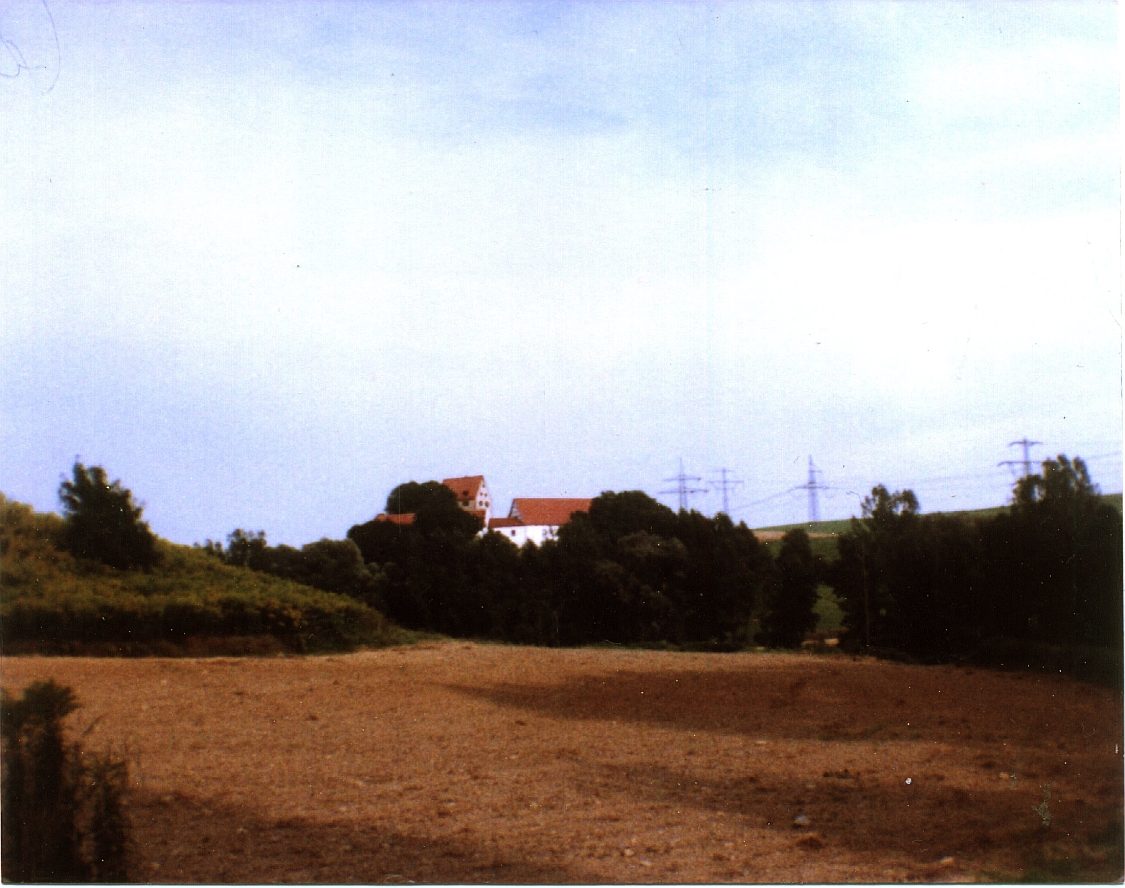
Hohenhardt Castle, today called Hohenhardter Hof, is a motte-and-bailey castle near Wiesloch in the Rhein-Neckar-Kreis in Baden-Württemberg. Located between the districts of Baiertal and Schatthausen, the castle was originally the ancestral seat of the noble free lords of Hohenhart, later a ministerial family of the same name, and passed through numerous other owners such as the Lords Sturmfeder von Oppenweiler or the Barons von Benserod. Since modern times, the castle was mostly leased to tenants who used the property for agriculture. The last noble owners from 1818 were the Barons von Gemmingen-Michelfeld, who were dispossessed there during the land reform after the Second World War. Among the tenants in the early 20th century was the Wiesloch Sanatorium and Nursing Home, which cultivated food and fodder there. In private ownership since 1957, the buildings, especially the manor house, have been renovated in accordance with monument protection regulations. Since 1985, the complex has housed the Wiesloch Golf Club, which uses the entire area belonging to the estate for its operations.
The origin of the castle is shrouded in history and can only be inferred from a few documents and structural findings. Older research has variously linked two documents from 782 and 795, in which a place called Hodomaron or Hohenmartin is mentioned, with the castle. However, this place is now more likely located at an oxbow lake near Walldorf, Ludwig H. Hildebrandt suggests Sandhausen.
According to structural findings, a motte with wooden buildings may have existed as early as the late 11th century, followed by a stone residential tower in the early 12th century. The current building is dated to around 1240 due to its early Gothic windows, embrasures, and the masonry technique found, although the foundations and secondarily used parts such as a Romanesque lintel probably date from the older construction phase.
Documentarily, the noble free lords of Hohenhart first appear in 1127 with a Konrad von Hohenhart, who is mentioned as a witness to a feudal testimony to Bishop Buggo of Worms. The relations of the von Hohenhart point north into the Odenwald and the Bergstraße; in the last third of the 12th century, they were probably sub-bailiffs in parts of Elsenzgau and Lobdengau, and from the 13th century onwards, they are mostly only mentioned as clerics and probably died out soon after the last mention of a Gerhard in 1270.
Hohenhardt Castle probably fell to the Palatinate after the extinction of the noble free lords and then as a fief to a ministerial family, who also called themselves von Hohenhardt. Hans von Hohenhardt was the Palatine Count's vice-dom in 1311.
From the documentary situation, the noble free Konrad von Hohenhart, mentioned from 1127 to 1165, comes into question for the construction of the first stone residential tower. For the current building, dated around 1240 according to structural findings, no obvious person appears in the documents, as the noble free lords were clerics or insignificant at that time. According to the documents, the current building should therefore rather be dated to the period from 1291 under the Palatine ministerialis Hans (I.) von Hohenhart.
The ministeriales von Hohenhart fell into financial difficulties in the 14th century and then sold numerous properties. In 1369, Albrecht (I.) von Hohenhart, with the consent of his sons Hans (IV.) and Wiprecht, finally sold Hohenhardt Castle or parts of it to the Electoral Palatinate. In 1379, Friedrich von Sickingen assigned half of the castle, which he held as a pledge from Hennel von Angelach, to his wife Anna von Gemmingen. In 1398, Wiprecht von Hohenhart, another representative of the ministerial family, received the castle with its appurtenances as a male fief, but he already sold half of it around 1413. His widow Anna Zengerin received a life annuity from half of the castle in 1426.
The first mention of the Lords Sturmfeder von Oppenweiler in the northern Kraichgau dates from 1439 in a letter from the city of Heilbronn to Hans (II.) Sturmfeder the Elder at Honhardt. From the context of the letter and from the relations of the Sturmfeder to the Lords von Bebenburg at Honhardt Castle in Hohenlohe, the Hohenlohe castle could also be meant, but the Kraichgau castle Hohenhardt was certainly in the possession of the Sturmfeder in 1496, so they could have been seated there as early as 1439.
It is sometimes claimed that the castle was destroyed in the German Peasants' War in 1525, but there is no documentary evidence for this. It is only certain that from the time of the Peasants' War, the complex was leased by the respective owners as an agricultural estate to one or more tenants and no longer served as a noble residence.
In 1580, Sturmfeder heirs are still mentioned as owners; in 1593, Philipp Gans von Otzberg acquired the complex as a Palatine chamber estate for 2000 guilders. Via the Lords von Bettendorff, the Palatine master huntsman Georg von Fechenbach, and the Junkers von Brüggen, the estate came to the Barons von Benserod in 1694 through marriage. Grand Master Benserod zu Bruchsal and later his widow litigated unsuccessfully from 1780 to 1803 over jurisdiction over the Hohenhardter Hof; a decision finally became obsolete due to the Reichsdeputationshauptschluss and the transfer of ownership to Baden.
From 1817 to 1819, the estate was owned by two Barons von Koffler; in 1819, the Wiesloch master baker Georg Philipp Schweinfurt acquired the estate, followed in 1822 by the Royal Bavarian Captain Baron von Frays, and in 1828 by the Chamberlain and Knight of Malta Ludwig von Gemmingen-Michelfeld. At that time, in addition to the buildings, 180 acres of arable land, 12 acres of meadows, and five acres of gardens belonged to the estate. In 1869, the estate came to the owner of the Michelfeld ancestral estate of the Gemmingen-Michelfeld line, August von Gemmingen-Michelfeld.
From 1919, the estate was leased to the Wiesloch Sanatorium and Nursing Home, with the long-standing former tenant Jakob Rupp continuing to be employed as a supervisor until his death in 1927. The sanatorium cultivated food and fodder on a leased area of 60 hectares there. In 1931, the sanatorium could no longer agree with Baroness Walpurga von Gemmingen-Michelfeld on an extension of the lease, so that individual tenants then took over again.
In the course of the land reform after the Second World War, the 81.5-hectare estate was expropriated by resolutions of 1948 and 1952. The Badische Landsiedlung sold the estate with about 52 hectares of land to the former tenant Karl Walter in 1957; further partial areas went to farmers in the surrounding area. From 1957 to 1963, Karl Walter had numerous old buildings demolished or modernized and numerous new buildings, including a residential house, newly erected.
In 1977, Karl Mack acquired the estate. At that time, the estate was recognized as a cultural monument by the State Office for Monument Preservation, with the castle hill and the barns also being considered part of the cultural monument in addition to the manor house. With the subsidies and grants still possible at the time from the monument office, the Ministry of Food from the village development plan, the district, and the city of Wiesloch, the owner was able to restore the complex in accordance with monument protection regulations in 1981/82. In 1983, agricultural operations on the estate ceased. Instead, a golf course was built there in 1984/85, occupying most of the area belonging to the estate. The old manor house was converted into a guesthouse. In 1985, only 4 out of 50 hectares of the associated areas were still in agricultural use.
Complex+
Although the castle was located on a hill above the valley, the core castle was built on an artificially raised mound and was thus a motte. The residential tower-like building still existing on the mound dates back to the High Middle Ages at its core. Several farm buildings of the later Meierhof are arranged around the mound, which certainly use the foundations of the former outer bailey.
Above the entrance to the manor house is a coat of arms stone from 1694 with the alliance coat of arms of Benserod/von Brüggen and the initials of the then owners Wilhelm Heinrich von Benserod zu Hohenhardt (WH V B ZH) and Maria Margareta von Brüggen von Benserod (MM V BG V B).
Take Mobile History with you
You are reading this text for free. Premium adds what matters on the road: descriptions read aloud, sites found through your camera, whole regions taken offline.
- Every description, including the ~17,700 Premium sites
- Audio guide: have descriptions read to you on location
- AR finder: see sites through your camera, with distance and bearing
- Unlimited saved sites
14 days free, then from €2.99 a month. Cancel anytime.
Source: Wikipedia · Licence: CC BY-SA 4.0 · Image: Andreas Rockstein Kurpfalzbilder.de / Public domain via Wikimedia Commons
This description draws on the facts documented in the linked Wikipedia article; Wikipedia content is licensed under CC BY-SA 4.0. Wording and editing: Mobile History.
Location: 49.3113, 8.7489