Museum
Youth hostel
CastleHohnstein
Hohnstein Castle
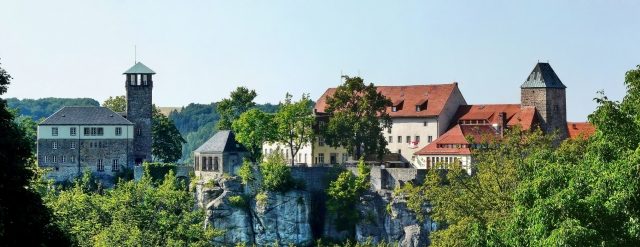
Hohnstein Castle, a rock castle in Saxon Switzerland, stands on a sandstone cliff above the Polenz Valley. It is the landmark of the town of Hohnstein and the only preserved of the once numerous castles on the right bank of the Elbe in this region.
History+
Hohnstein Castle was probably built around 1200 as a Bohemian border fortress, directed against the Margraviate of Meissen. In 1353, the complex came into the possession of the Bohemian nobleman Hinko Berka von Dubá. It was not until 1443, when the Berka von Dubá ceded the castle to Electoral Saxony under Frederick the Gentle through exchange and purchase agreements, that it was first mentioned by name. Nevertheless, it remained a Bohemian fief until 1806. The Wettins later used the castle as a base for hunting and salmon spearing. Hohnstein served alternately as an electoral office, court, and prison. The originally wooden structures were gradually replaced by stone buildings in the 17th and 18th centuries, which even withstood a Swedish siege in 1639. After the dissolution of the administrative seat in 1861, the castle was used, among other things, as a correctional facility for men and from 1919 as a juvenile prison. In 1925, it was converted into a youth hostel, which, with around 1,000 beds, was considered the largest youth hostel in Germany.
Source: Wikipedia · Licence: CC BY-SA 4.0 · Image: Thomas Eichler
This description draws on the facts documented in the linked Wikipedia article; Wikipedia content is licensed under CC BY-SA 4.0. Wording and editing: Mobile History.
Location: 50.9794, 14.1088