CastleLohmar-Honrath

Honrath Castle

Honrath Castle

To be privately owned

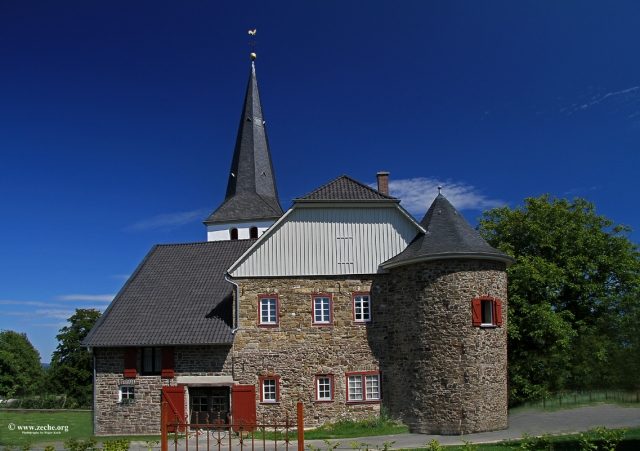
Honrath Castle is the almost completely preserved castle house of a former hilltop castle in North Rhine-Westphalia. It belongs to the city of Lohmar and is located in the Rhein-Sieg district. The castle house stands in the middle of the village of Honrath, a district of Lohmar, on a ridge gently sloping towards the Agger valley at an altitude of 162 meters above sea level.

Together with the neighboring Protestant church, Honrath Castle represents the oldest building in the village. The knight's seat is first mentioned in a donation from 1117, in which God(e)fried transfers his allod "Hagenroth" to Siegburg Monastery. It later passes from Theoderich von Hengebach to Arnold von Hückeswagen. In 1209, the latter donates the patronage of St. Margaretha Church, which stands next to the castle - it becomes Protestant in the 17th century - to the Benedictine convent in Gräfrath near Solingen, but retains the castle for himself, which in 1259, along with the entire parish, is sold by the Hückeswagen heirs to the Counts of Sayn. As an inheritance, the castle then passes to the Lords of Loen-Heinsberg.

In 1363, the Counts of Berg acquire possession, in 1393 the Düsseldorf Collegiate Foundation, and in 1550, a Joist Lüninck is named as owner. The following centuries see several more changes of ownership, until at the beginning of the 18th century the Lords of Proff zu Menden and in 1825 the Barons von La Valette St. George acquire the estate, along with 198 Morgen of land. From 1930 onwards, the property finally comes into bourgeois hands.

... and stories+

It is said of Lünigk von Niederpleis, mentioned in the mid-16th century, that he was a terrible drunkard and womanizer, fond of good wine and beautiful women, but unwilling to marry. Lord von Etzbach, the father of a girl on whom Lünigk had set his sights, finally managed to marry his daughter to him by a trick. He served an excellent Malvasier wine, which Lünigk naturally preferred to drink. But von Etzbach served him an inferior variety on a hot summer day and only poured Lünigk the good wine after much urging, when the latter had promised him in writing to marry his daughter Giesel in return. The union of the two was happy and the Malvasier became a special treasure in the castle's wine cellar.

Layout+

The still existing castle house, which with its towers of quarry stone masonry conveys a fortified impression, was built in the 16th century on Romanesque foundations; the barrel vaults in the cellar and part of the east wall of the present farm building bear witness to this predecessor building. The Romanesque church tower was originally a defensive and residential tower. It was rebuilt several times and later served as a freestanding keep, which was connected to the castle by an arcade on the upper floor.

The castle complex, which is still inhabited, cannot be visited, but can only be viewed from the nearby road. The access road, garden and adjacent agricultural buildings are privately owned. The building is a protected monument. Nevertheless, the grounds can be entered, as the residents of the castle also sell agricultural products there.

Take Mobile History with you

You are reading this text for free. Premium adds what matters on the road: descriptions read aloud, sites found through your camera, whole regions taken offline.

  • Every description, including the ~17,700 Premium sites
  • Audio guide: have descriptions read to you on location
  • AR finder: see sites through your camera, with distance and bearing
  • Unlimited saved sites

14 days free, then from €2.99 a month. Cancel anytime.

Source: Wikipedia · Licence: CC BY-SA 4.0 · Image: http://www.zeche.org/

This description draws on the facts documented in the linked Wikipedia article; Wikipedia content is licensed under CC BY-SA 4.0. Wording and editing: Mobile History.

Location: 50.9069, 7.2547