To be privately owned
Klevenow Castle

Klevenow Castle is a manor house in the Klevenow district of the municipality of Süderholz in the Vorpommern-Rügen district. It is located southeast of Grimmen near the Poggendorfer Trebel.
Klevenow Castle was built as a border fortress against the neighboring Duchy of Mecklenburg. The village and castle of Clevenow were first mentioned in a document in 1387. The fortified house, documented until the 17th century, was built as a moated castle with the associated moats and ramparts. In 1480, Duke Bogislaw X of Pomerania enfeoffed the castle captain and bailiff of Grimmen and Tribsees, Hans von Wakenitz, with Klevenow Castle, which remained in the possession of the von Wakenitz family until the beginning of the 19th century.
In 1627, Carl von Wakenitz had extensive construction work carried out on the castle complex. During the Thirty Years' War, there were battles for the castle. In the Swedish land survey of Vorpommern, it was still recorded as destroyed in 1697. Significant parts of the wall remains of the south wing with the remains of two towers had been preserved.
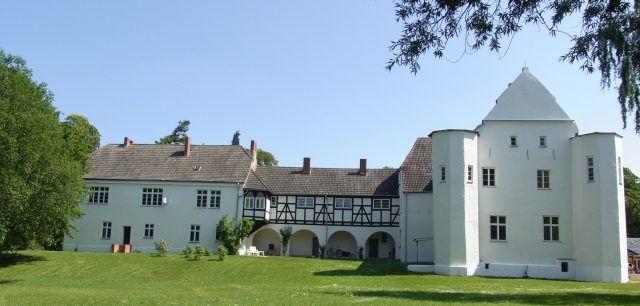
In 1816, Klevenow Castle came into the possession of Carl Friedrich von der Lancken from the Boldevitz house on Rügen, who was in Swedish service and added the name Wakenitz to his name, through marriage. In 1848, a manor house in the style of a neo-Gothic castle was built on the remains of the castle. To the east, it was extended by an annex. A north wing is designed as a half-timbered building and has arcades on the western ground floor. In the same year, Friedrich von der Lancken-Wakenitz had a landscape park of about 15 hectares laid out on the old ramparts. For this purpose, he had the ramparts leveled and the moats filled in. In the park, which extends to the Poggendorfer Trebel in the west, there is a pond with two islands. A wall was built towards the village road to the north. The castle chapel is also located there. The manor house on the eastern edge of the park, damaged by a fire in 1848, was also renewed.
Further alterations were made after the First World War. The last noble owner of the estate, which was ultimately about 500 hectares in size, was Malte Freiherr von der Lancken-Wakenitz until his expropriation and expulsion by the communists in 1945. After the war, displaced persons were initially accommodated in the house. During GDR times, the manor house was used by the municipality, which also had a doctor's station, post office, and consumer sales outlet there. Large parts of the park were cleared or became overgrown. In addition to a sports field, a kindergarten was also built in the park.
Between 1987 and 1989, a first partial renovation of the park took place. A more comprehensive renovation, which also included desilting the pond, took place between 1993 and 1995. Since 2003, Klevenow Castle has been back in private ownership.
Take Mobile History with you
You are reading this text for free. Premium adds what matters on the road: descriptions read aloud, sites found through your camera, whole regions taken offline.
- Every description, including the ~17,700 Premium sites
- Audio guide: have descriptions read to you on location
- AR finder: see sites through your camera, with distance and bearing
- Unlimited saved sites
14 days free, then from €2.99 a month. Cancel anytime.
Source: Wikipedia · Licence: CC BY-SA 4.0 · Image: https://commons.wikimedia.org/wiki/File:Schloss_Klevenow_Westseite.jpg
This description draws on the facts documented in the linked Wikipedia article; Wikipedia content is licensed under CC BY-SA 4.0. Wording and editing: Mobile History.
Location: 54.0831, 13.0876