The Castle can be visited
CastleWadi Al-Nadara
Krak des Chevaliers Castle (قلعة الحصن, Qal'at al-Husn)
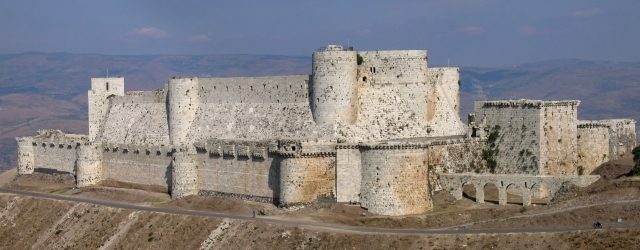
In Syria, the Krak des Chevaliers castle, also known as Qal'at al-Husn, is a Crusader castle. It is on an outlier of the Alawite Mountains, dominating the valley between them and the Lebanon Mountains, a strategically important trade route connecting the coast and the interior. The fortress is an example of medieval military architecture and is now a UNESCO World Heritage site.
History+
The origins of the fortification date back to 1031, when the Emir of Homs had an initial structure, named Hisn al-Akrād, the Kurdish Castle, built on the mountain. In 1099, the army of the First Crusade under Raymond of Saint-Gilles briefly occupied the castle on its way to Jerusalem. After their departure, the castle fell back into Muslim hands. It was not until 1110 that the Norman commander Tancred of Tiberias succeeded in conquering Hisn al-Akrād. Through the marriage of his widow to Pons, the son of Bertrand of Saint-Gilles, the castle came into the possession of the County of Tripoli in 1112 and was administered by vassals. Since Count Raymond of Tripoli could no longer finance the garrison, he ceded the castle to the Knights Hospitaller in 1142. Following earthquakes in 1157 and 1170, the castle underwent extensive reconstruction starting in 1170. A Crusader castle emerged, featuring a main tower, chapel, gatehouse, and a curtain wall with a surrounding hall. A unique feature was the moat on three sides of the hilltop castle. Sultan Saladin besieged the castle unsuccessfully for a month in 1188. After further earthquake damage around 1201/02, an expansion took place with reinforced towers, a talus for earthquake protection, and an outer enceinte wall. In the 13th century, the Hospitaller rule reached its peak, reflected in the hall building in the High Gothic style. In 1271, Sultan Baibars besieged the castle and captured it on April 8 after the capitulation of the Hospitallers. The damage was quickly repaired, and the fortress was used militarily until the early 19th century. In the late 19th century, locals settled in the complex, but these structures were removed during restoration by France in the 1920s. In 1947, France returned the castle to Syria.
Location+
The Krak des Chevaliers castle is located at an elevation of approximately 680 meters above sea level in Wadi Al-Nadara, near Talkalakh, in the Homs district of Syria.
Take Mobile History with you
You are reading this text for free. Premium adds what matters on the road: descriptions read aloud, sites found through your camera, whole regions taken offline.
- Every description, including the ~17,700 Premium sites
- Audio guide: have descriptions read to you on location
- AR finder: see sites through your camera, with distance and bearing
- Unlimited saved sites
14 days free, then from €2.99 a month. Cancel anytime.
Source: Wikipedia · Licence: CC BY-SA 4.0
This description draws on the facts documented in the linked Wikipedia article; Wikipedia content is licensed under CC BY-SA 4.0. Wording and editing: Mobile History.
Location: 34.7569, 36.2944