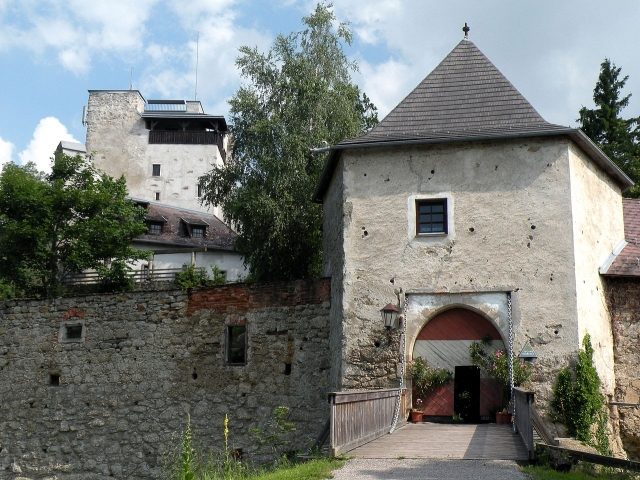
CastleBad Kreuzen

Kreuzen Castle

Kreuzen Castle

Youth hostel
Cultural center

Kreuzen Castle is a castle complex near the spa town of Bad Kreuzen in the Perg district of Upper Austria.

It is considered the second-largest castle complex in Upper Austria and is said to have been built around 900 as a refuge castle. In 1880, a fire devastated most of the remaining structures of the castle, particularly the roof truss. Since 1965, the municipality or the Bad Kreuzen tourism association has been the owner, and since 1983, a youth hostel and a cultural center have been housed there; more recently, a hotel operation was opened in the castle by "Burg Kreuzen Betriebs GmbH," which brought about a profound intervention in the building fabric of the historic building.

The castle is said to have existed as early as 900 and served as a refuge. Pilgrim von Creutzen was first mentioned as the owner in a document from 1125. In 1209, it belonged to Hermann von Creutzen. Afterwards, the Volkensdorfer family inhabited the castle, which was a princely fief in 1282. The complex then consisted of two parts, the front and rear castles. The division took place between the brothers Hans and Alber Volkensdorfer. When the last Volkensdorfer died around 1489, the castle passed to the brothers Siegmund and Heinrich von Prüschenk, who had already acquired parts of it six years earlier. Adam Schweinböck followed as owner in 1518, buying the front castle. Ten years later, he sold it to Helfrich von Meggau and bought the rear castle. In 1532, Helfrich von Meggau also acquired the rear castle and united the two castles. In 1533, the feudal lordship was abolished, and the castle became free property.

During the Turkish threat around 1594, Kreuzen was one of the defensive castles in Machland and served as a refuge for the population. In 1644, the Meggau family died out. As early as 1619, the castle came into the family of Count Gottfried Breuner through the marriage of Anna Meggau to her second husband. In 1655, the castle passed to Siegmund von Dietrichstein, who also owned Greinburg Castle. Until the mid-20th century, the castle remained closely associated with Greinburg. Emperor Leopold II fled from the plague in Vienna to Kreuzen in 1682. Around 1716, the castle came to Count Johann Cavriani, and in 1754 to the Counts Salburg, who had part of the castle demolished in 1776 and 1783. In 1810, Prince Josef Karl von Dietrichstein was the owner of Kreuzen, and in 1823, Duke Ernst I of Saxe-Coburg and Gotha bought the castle, meaning that around 1876, Queen Victoria of Great Britain, as the Duke's daughter, owned half of the castle.

In 1880, a fire destroyed large parts of the castle, turning it into a ruin. In 1965, the Saxe-Coburg and Gotha family sold the ruin to the farmer Ferdinand Riegler (also known as Starzhofer), who was also the mayor of the municipality of Bad Kreuzen at the time. In 1974, ownership passed to the Bad Kreuzen tourism association, which had the complex renovated and partially rebuilt in 1983. Since 1983, the castle has served as a youth hostel and cultural center.

By 2013, with public funding, the castle is to be expanded and preserved for the future, and a new youth hostel is to be built in the immediate vicinity of the castle, designed for around 15,000 overnight stays annually. This is intended to attract young guests to Bad Kreuzen and the Strudengau region.

Complex+

The castle is situated on a wooded ridge that drops steeply on three sides. In terms of its size, the castle was only surpassed in Upper Austria by the Schaunberg castle ruin. Its surrounding wall once had a height of five meters, which is still visible at the gate entrance. A drawbridge used to be in front of the gate tower, which was replaced by a stone bridge during the renovation work in 1983; this was in turn replaced by a wooden bridge on pillars in 2007, as the masonry of the stone bridge became dilapidated. The adjoining gatekeeper's house features a cross-rib vault. From the gate, the path leads uphill to the castle courtyard.

Today, only an arcade wing, which used to connect the two castles, can be seen in the castle courtyard. The interiors of the arcade wing have barrel vaults. A sundial from 1523 also shows the Meggauer coat of arms. To the west stands a chapel that projects from the line of the wall. The other buildings that bordered the courtyard have now disappeared. In particular, the buildings of the front castle, which were most severely damaged by the fire, were demolished.

The draw well in the courtyard was formerly 42 meters deep. In 1974, the square residential tower, originally from the 13th century, was rebuilt. The wall thickness of the 10 x 10 meter tower measures 2.5 meters, and it now serves as an observation tower. The interior rooms are used for exhibitions. The youth hostel uses parts of the former palas. Foundations of two round towers are recognizable in the north and northeast.

Origin of the Name+

According to a legend, a pilgrim staying here once brought a piece of Jesus' cross from the Holy Land, which gave the castle its name.

Take Mobile History with you

You are reading this text for free. Premium adds what matters on the road: descriptions read aloud, sites found through your camera, whole regions taken offline.

  • Every description, including the ~17,700 Premium sites
  • Audio guide: have descriptions read to you on location
  • AR finder: see sites through your camera, with distance and bearing
  • Unlimited saved sites

14 days free, then from €2.99 a month. Cancel anytime.

Source: Wikipedia · Licence: CC BY-SA 4.0 · Image: http://commons.wikimedia.org/wiki/File:Burg_Kreuzen.jpg

This description draws on the facts documented in the linked Wikipedia article; Wikipedia content is licensed under CC BY-SA 4.0. Wording and editing: Mobile History.

Location: 48.2591, 14.8202