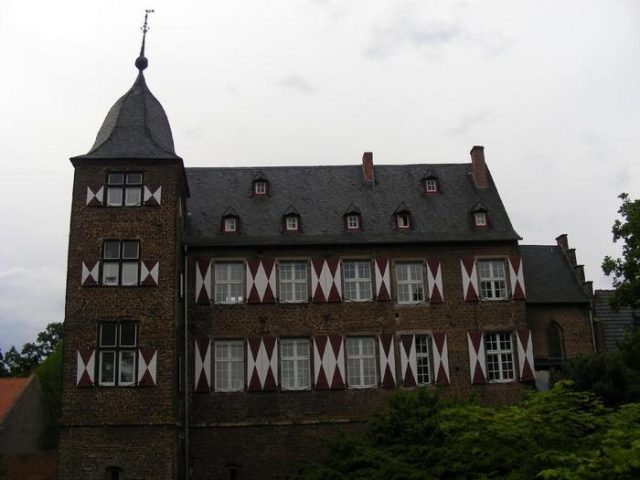
CastleWeilerswist

Kühlseggen Castle

Kühlseggen Castle

To be privately owned

Kühlseggen Castle is located near Weilerswist (Euskirchen district) between the Swist and Erft rivers, directly on the A61 federal motorway, and is one of the most impressive moated castles in the region. At 108 m above sea level, the castle is at the lowest point in the Euskirchen district.

In 1312, a Cologne ministerialis named "Gobelin von Cudilsheggin", who named himself after his residence, was first mentioned in a document. It is therefore assumed that he was the first owner of Kühlseggen Castle (Lit.: Herzog, 1990). One of his successors was Arnold von Umbescheiden, who was also called "von Cudelzecgen" in 1351.

In 1368, Walfraff von Scheiffart von Merode is mentioned as the owner of the castle, which was probably already fortified at that time. The Scheiffart von Merode family owned Kühlseggen until the beginning of the 16th century and developed it into a knight's seat eligible for the Landtag. The estate then passed by marriage to Goswin Brent von Vernich.

Before that, however, inheritance disputes over the rights to the castle had already broken out. These were fully awarded to the Raitz von Frentz family by the Imperial Chamber Court in Speyer in 1613. Its members sold the now dilapidated and war-damaged property in 1616 to the Cologne mayor Johann Monumet (also known as von Bolandt).

Further changes of ownership followed until the Cologne Jesuits acquired Kühlseggen in 1746 and renovated the buildings. When the Jesuit order was dissolved in 1773, its property fell to the Archdiocese of Cologne, which transferred the castle a few years later to the University of Bonn, founded in 1777.

In 1781, the buildings with 500 acres of surrounding land were auctioned off and thus came into the possession of Baron Heereman von Zuydtwyck. His daughter Josepha married Clemens Wenzeslaus Freiherr von Eltz-Rübenach in 1836 and brought the castle into the marriage. It is still owned and inhabited by this family today. The outer bailey is used for agriculture.

Building History+

Until well into the 19th century, the buildings of the castle complex stood on two islands: a high-mounded one with the manor house and a second island on which the outer bailey stood. The appearance of the first castle complex is no longer traceable today, but historians suspect that it may have been a motte with a residential tower on the main island. It is also unclear whether the walls of the slightly sloped substructure of Kühlseggen Castle were built under Arnold von Umbescheiden, or whether they date from earlier times.

The Scheiffart von Merode family carried out various extensions and alterations during their time. Remains of "their castle" are still present in the walls of the manor house today.

When the castle came into the possession of Johann Monumet in 1616, he had the existing buildings fundamentally renewed. New beamed ceilings were installed, the completion date of which in 1617 is documented by the wall anchors on the residential building. In addition, the main building received new mullioned windows. The round-arched gate of the outer bailey and the two gate pillars at the main castle were also erected during this time. The latter bear witness, through the still existing devices, that the two castle islands were then connected by a drawbridge.

However, the multiple changes of ownership in the following 130 years were not beneficial to the building fabric. When the Jesuits took over the castle complex in 1746, the buildings were again severely dilapidated. The order then had all dilapidated parts demolished. Apart from a few outer walls, only the oldest residential building from the Middle Ages and its attached corner tower remained. A small extension on the north wing was converted into a historicizing Gothic chapel.

From 1781, Heereman von Zuydtwyck had the dilapidated outer bailey renovated and extended. In the 19th century, its moats were filled in, as they had lost their defensive function. Thus, only the main castle was still located on an island.

In the second half of the 19th century, some parts of the main castle were already so badly damaged that a stepped gable and the vault of the chapel collapsed. However, these were restored with the support of the provincial conservator.

Kühlseggen Castle only saw better times again from 1962 onwards. Until this time, it was uninhabited and its building fabric severely damaged. Max Freiherr von Eltz-Rübenach had the entire complex extensively renovated and rebuilt to use it as a private residence. In the process, the roof trusses and the interior fittings that existed until then had to be almost completely replaced and are therefore no longer in their original condition.

Visiting+

Kühlseggen Castle is privately owned and inhabited. It cannot therefore be visited from the inside. An external viewing outside the moat is possible on a circular path.

Take Mobile History with you

You are reading this text for free. Premium adds what matters on the road: descriptions read aloud, sites found through your camera, whole regions taken offline.

  • Every description, including the ~17,700 Premium sites
  • Audio guide: have descriptions read to you on location
  • AR finder: see sites through your camera, with distance and bearing
  • Unlimited saved sites

14 days free, then from €2.99 a month. Cancel anytime.

Source: Wikipedia · Licence: CC BY-SA 4.0 · Image: http://www.wehrbauten.de/thread.php?threadid=568

This description draws on the facts documented in the linked Wikipedia article; Wikipedia content is licensed under CC BY-SA 4.0. Wording and editing: Mobile History.

Location: 50.7673, 6.8392