To be privately owned
Landesburg Castle (Lechenich)

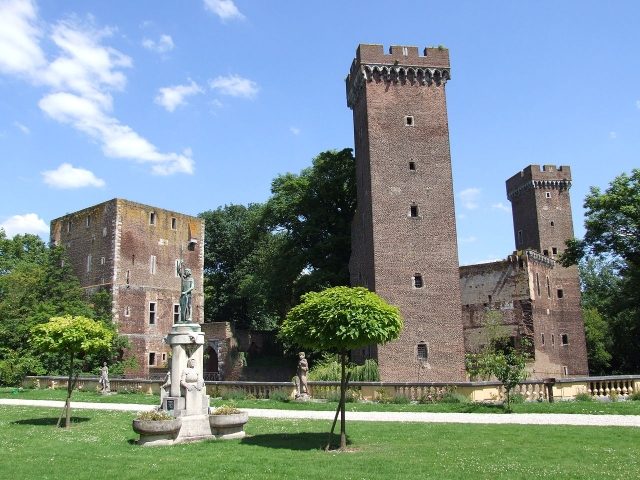
The former Lechenich state castle of the Archbishops and Electors of Cologne is now located in the semi-circle of parklands in the northeast corner of the old town of Lechenich. Built in brick at the beginning of the 14th century and protected by moats, the water castle was also referred to as a palace from the 16th century onwards. The state castle was one of the most powerful castle complexes in the Rhineland.
The state castle had a predecessor in the southwest of the city, which was destroyed in 1301.
The First State Castle+
First mentioned as a curia in 1138, the castle was located in the southwest of today's old town on an area of about one and a half hectares. In 1185, Archbishop Philipp von Heinsberg reclaimed the Lechenich Vogtship with its rights and duties, which the Counts of Hengebach had previously held as a fief, and transferred administration and jurisdiction to archiepiscopal officials. An Amtmann / Schultheiß (1290 Schultheiß Hermann) took over the administration and, together with the aldermen, the jurisdiction in the castle, which was also the administrative and judicial seat of the Lechenich office.
The old castle complex was built on a motte with a residential tower, which was surrounded by wide moats fed by the Rotbach, now called the Mühlenbach. The buildings of the outer bailey were also surrounded by further protective moats. This mighty defensive structure, later called the old castle, was additionally surrounded by an earthen rampart.
Lechenich was also affected by the territorial struggles of the 13th century between the Archbishops of Cologne and the Dukes of Brabant, as well as the Counts of Jülich. During this period, the old castle, the castrum Lechenich, was besieged several times but could not be captured. In the dispute between Archbishop Konrad von Hochstaden and the city of Cologne, the castle also held significance for the Archbishop, who abducted Cologne patricians to Lechenich and imprisoned them in the castle.
In 1289, after the Battle of Worringen, the castle was pledged as security to the Count of Berg, who held it until 1292. After the city of Cologne complained to King Albrecht about the Rhine tolls levied by Archbishop Wikbold, the King appointed Count Gerhard von Jülich as peace bailiff, who, by order of the King, conquered and demolished the castle in 1301 together with his allies. In 1302, King Albrecht prohibited its reconstruction.
On the area of the current owners, the former moat is still faintly visible. On the Tranchot map of 1810, the moats are still open.
Construction and Fortification of the New State Castle+
In 1306, the Archbishop of Cologne Heinrich II von Virneburg (1305-1332), with the permission of King Albrecht, began the construction of a new castle within the city. The residential tower, described by Paul Clemen as a keep, was built between 1306 and 1317. During the terms of office of Archbishops Walram von Jülich (1332-1349) and his successor Wilhelm von Gennep (1349-1362), they had the castle expanded into a fortress-like structure. Two wide moats secured the complex. The outer moat surrounded the entire area, while the inner moat enclosed the main castle. Further protection was provided by the city, fortified with walls and moats.
Construction with field-fired bricks was a new technique at the time, reintroduced to Germany (after the Roman era) from Italy by the Staufer dynasty. The state castle was probably the first large-scale construction using this technique. Nevertheless, trachyte from the Drachenfels was used for the corners and window frames. In the outer and main bailey, after the Jewish persecutions of 1349, tombstones from the abandoned Jewish cemetery were re-carved and used as spolia.
Externally, the five-story keep is 15 meters long and 13 meters wide. The walls are 2.50 meters thick at the bottom, decreasing by 20 cm from floor to floor. The high castle (Palas) occupies the entire east side of the complex with a length of 33 meters and a width of 12 meters. This is flanked by two seven-story towers.
Residence+
The castle was one of the residences that served the respective archbishops, with their entire court, for representation in their capacity as territorial lords. The temporary stays of Archbishops Walram von Jülich and Wilhelm von Gennep, as well as their successors in Lechenich, are documented in numerous charters. The residence hall was excellently suited for receiving homages, making enfeoffments and appointments, pronouncing arbitral awards, and receiving diplomats. Between 1351 and 1381, meetings of the sworn members of the Landfrieden (peace treaty) between the Rhine and Meuse frequently took place here.
Guests of the State Castle
The recorded history of the 15th and 16th centuries reports several social events of castle life. During this time, the Electors were also hosts to important guests at their castle in Lechenich:
- King Sigismund with his retinue in 1414 during his ride to his coronation in Aachen, and on his return to Bonn.
- King Frederick III with his retinue on June 13, 1442, during his coronation journey from Bonn to Aachen.
- Emperor Charles also stopped in Lechenich in 1543 on the occasion of his campaign to Düren.
The Outer Bailey+
The economic buildings belonging to the castle were located in the outer bailey. The castle courtyard of the state castle was a Tafelgut (demesne) of the Archbishop. The income generated from the associated lands partly served to supply the archiepiscopal kitchen. From the 16th century onwards, the castle lands were leased out.
Profits from cattle breeding through the sale of fattened oxen and sheep's wool were used for the castle household.
A relatively small permanent castle garrison of 16 people lived in the castle. Besides the Amtmann, there were the Kellner (rent master), the Unterkellner, and the Burgrave, a gatekeeper, several guards, and servants. Furthermore, the Amtmann maintained 6-8 mounted men.
Administrative Center and Court Seat+
The castle, as the administrative castle of the territorial lord, formed the administrative center of the Lechenich office. Administration was the responsibility of the Amtmann, who resided in the Amtshaus of the outer bailey until the mid-16th century. His task was to safeguard the rights of the territorial lord, such as the protection of the castle, city, and office of Lechenich, the protection of the territorial roads, and the administration of justice to protect the inhabitants and uphold the territorial sovereignty.
The Kellner, another official, was responsible for accounting reports on received income and expenses, the structural maintenance of the castle and economic buildings, and the remuneration of employees.
The state castle was the seat of justice for the Lechenich office. Four times a year, the Amtmann, as representative of the territorial lord, held the Herrengericht (lord's court), which the inhabitants were obliged to attend. Their rights and duties, recorded in the Weistum (peasant book), were explained to them, and complaints were resolved. In several-day Brüchtenverhöre (interrogations for fines), the Amtmann, together with the Brüchtenmeister, Schultheiß, and aldermen, imposed fines for violations of applicable law or orders of the Elector.
The Schultheiß and aldermen, who had their own court seal since 1325, exercised judicial rights in the great hall of the Amtshaus or Kellnereihaus, such as issuing notarial documents, passing judgments in lawsuits, and punishing wrongdoers, with imprisonment for more serious offenses. They also possessed high judicial rights. They imposed the death penalty for serious offenses and during the witch trials from 1626 to 1632. The sentences were carried out by the executioner, who traveled from Cologne, at the execution site outside the city near the former Roman road. The path there is still marked as "die Galgendricht" on the Tranchot map.
Development in Modern Times+
After the Archbishops and Electors established their permanent residence in Bonn, they only rarely stayed in Lechenich. Stays for hunting in the Ville or overnight stays several times a year in the rooms of the Kellnereihaus on the journey to and from the Diocese of Liège, whose prince-bishops they also were, are documented. After 1657, no more overnight stays are recorded.
During the siege of Lechenich from April 17 to May 26, 1642, by mercenary troops under the command of General Guébriant, the contested castle was not captured, but the city suffered great damage.
In the wars of Louis XIV of France, whose policy the Cologne Elector Max Heinrich and his coadjutor Wilhelm von Fürstenberg supported, the city and castle were captured without a fight by imperial troops under Montecucolli in 1673 and occupied until 1679. The French troops, quartered in the castle again as before 1673, set it on fire on April 21, 1689, upon their withdrawal before the approaching Brandenburgers allied with the Emperor. The complex had thus lost its strategic importance and had become uninteresting for Electoral Cologne politics. After the fire, the castle was uninhabitable. The burnt-down roof truss of the main castle and the keep were hastily repaired. The rooms, including the former great residence hall, were used as a grain magazine.
In the 18th century, the castle increasingly fell into disrepair. Only the prison tower, the Demeritenhaus, and the castle chapel in the southern wing remained.
The Oberkellner (rent master) lived in the former Amtshaus in the outer bailey, called the Kellnereihaus. After the city fire of 1702, the Kellnerei was repaired; after the great city fire of 1722, the reconstruction of the outer bailey with the Kellnereihaus, barn, and stables was necessary.
Castle Owners after Secularization
In the course of secularization, the expropriation of church property under Napoleon, all castle buildings with the associated area were confiscated as electoral property and auctioned in 1805. They were acquired by Andreas Borlatti, the son of the last Oberkellner Josef Borlatti. Some buildings, including the remains of the south wing with the castle chapel, were completely demolished. They are partly known from paintings by A. Reuter (1795 and 1797 respectively).
After Borlatti's death, his heirs sold the castle complex, which has since been in changing private ownership. Of the subsequent owners, the most significant lord of the castle was Baron Georg von Bleichröder, the son of the Berlin banker Gerson von Bleichröder, who bought the castle with the associated area in 1894. In the same year, he additionally acquired a farm and lands on the Cologne-Zülpicher Straße (Roman road) and founded a stud farm there, the "v. Bleichroedersche Gestüts Direction Römerhof bei Lechenich". Baron von Bleichröder died in 1902 from injuries he sustained in an accident with his automobile.
Since 2003, the owners are Heinrich Ico Prinz Reuß and Corinna Prinzessin Reuß, the heiress of the von Elmendorf/Schmidt Elmendorff family.
Current Complex
Of the buildings in the outer bailey, the former Amtshaus was converted into the private residence of the castle owner. The adjoining buildings were partly rented out. Residential houses and garages were built on the sold grounds of the former castle nursery.
With financial support from the Landschaftsverband, several restorations were carried out in the 20th century, securing the existence of the castle ruin. Considered uses, such as concert events, have not yet been realized.
Even as a ruin, the state castle still conveys an impression of its former importance as a strongly fortified administrative castle of the territorial lord and illustrates the difference to the numerous noble residences in the Rhein-Erft district.
Take Mobile History with you
You are reading this text for free. Premium adds what matters on the road: descriptions read aloud, sites found through your camera, whole regions taken offline.
- Every description, including the ~17,700 Premium sites
- Audio guide: have descriptions read to you on location
- AR finder: see sites through your camera, with distance and bearing
- Unlimited saved sites
14 days free, then from €2.99 a month. Cancel anytime.
Source: Wikipedia · Licence: CC BY-SA 4.0
This description draws on the facts documented in the linked Wikipedia article; Wikipedia content is licensed under CC BY-SA 4.0. Wording and editing: Mobile History.
Location: 50.8019, 6.7685