Hotel
Lauenstein Castle

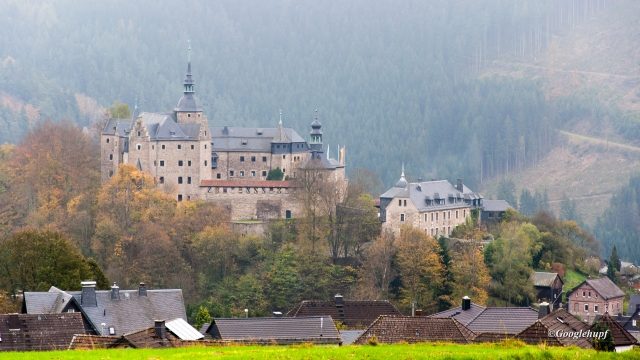
Lauenstein Castle is a medieval hilltop castle at 550 m above sea level, overlooking the Upper Franconian village of Lauenstein, a district of the city of Ludwigsstadt, located to the southeast. With its location in the north of the Kronach district, the castle, whose oldest parts can be dated to the 12th century, is the northernmost castle in Bavaria.
The oldest parts of the castle date back to the mid-12th century; it was first mentioned in a document as "Castro Lewinstein" in 1242. The castle had great strategic importance due to its advanced position in the northern border area of Franconia. It was owned, among others, by the Counts of Merania and the Counts of Orlamünde. In 1427, the castle came under the feudal lordship of Margrave Frederick I of Brandenburg from the noble house of Hohenzollern.
In 1506, Knight Heinrich von Thüna († 1513) was enfeoffed with the lordship and Lauenstein Castle. Christoph von Thüna owned the lordship of Lauenstein between 1535 and 1585, which included the forests around Ludwigsstadt, Ebersdorf, Lauenstein, Tettau, and Langenau. Christoph von Thüna had the current main wing, in the Renaissance style with its diagonally placed four corner towers, built from 1551 to 1554.
In 1622, Margrave Christian of Brandenburg-Bayreuth acquired the castle. In 1791, it fell to Prussia as part of Margrave Carl Alexander's secret treaty, and then on June 30, 1803, as part of a border and land exchange treaty, to the Electorate of Bavaria. From 1815, it came into private hands and fell into disrepair. In 1896, the private individual Erhard Messmer renovated the dilapidated building and refitted it for use as a hotel. This fundamental restoration was carried out under the influence of Historicism and Art Nouveau in the style of Wartburg Castle.
During the First World War, the castle was twice the venue for the so-called Lauenstein Conferences, from May 29 to 31 and from September 29 to October 3, 1917. Initiated by the publisher Eugen Diederichs, these conferences brought together important scholars, writers, future politicians, and other intellectuals of the time for an open exchange about Germany's future after the war. Participants in these conferences, which united people from various political camps, included, for example, the sociologist Max Weber, the later revolutionary and expressionist dramatist Ernst Toller, the poet and women's rights activist Berta Lask, the economist Edgar Jaffé, and the later first Federal President of the Federal Republic, Theodor Heuss.
During the Second World War, the castle housed a department of the military intelligence service Amt Ausland/Abwehr within the High Command of the Wehrmacht. This department was a research facility for forging passports, secret inks, micro-cameras, etc. From March to June 1944, Admiral Wilhelm Canaris, head of the Abwehr from 1935 to 1944, was under house arrest at Lauenstein Castle.
In 1962, the Free State of Bavaria acquired the castle and renovated the entire complex between 1966 and 1976. This involved, among other things, dismantling and renewing parts of the masonry, completely restoring the rooms, and reconstructing the roof truss and ceilings of the individual floors.
The Bavarian Administration of State Palaces, Gardens and Lakes designed an extensive museum in numerous rooms of the main castle with furnished showrooms and special collections, for example, for weapons, wrought iron, lamps, folk art, and instruments.
Castle Hotel
Parts of Lauenstein Castle were first used as a hotel from 1898, after the private individual Erhard Messmer had acquired and renovated the complex, which had been left to decay for years, two years earlier. Guests who stayed in the rooms of the main castle in the late 19th and early 20th centuries included writers Ernst von Wolzogen and Joachim Ringelnatz, Tsar Ferdinand I of Bulgaria, and the later Federal President Theodor Heuss.
After the castle complex came into the possession of the Free State of Bavaria, a castle tavern with a hotel was established in the former official's residence in the outer bailey. Guests included the English rock band Deep Purple and the pianist, conductor, and television presenter Justus Frantz. In 2007, the establishment was closed, and only the main castle continued to be used as a museum.
In April 2011, it was announced that a Kronach entrepreneur intended to extensively renovate and reopen the hotel. However, negotiations with the Free State of Bavaria, which had been ongoing since 2009, stalled and threatened to fail, as the entrepreneur sought to purchase the entire complex, while the Free State, as owner, favored a hereditary lease solution. It was not until early November 2012 that the two parties agreed on a renovation concept, under which the Free State of Bavaria would have remained the owner and leased the castle to the entrepreneur. The signing of the corresponding contract should have taken place by the end of 2013. However, in mid-2013, the project stalled again, as the Bavarian State Office for Monument Preservation expressed fundamental concerns about several planned extensions to the listed castle complex. Since no agreement could be reached between the parties involved, the Kronach entrepreneur announced his withdrawal from the project at the end of November 2013. Already in September 2012, the Free State of Bavaria had declared its intention to renovate the castle complex itself in this case. In February 2014, a feasibility study was commissioned, in which four architectural firms developed possibilities for the expansion of the castle complex. Since April 2014, the Free State has been looking for a private investor to undertake the renovation and expansion of the hotel based on this study.
Legends+
Mantelburg (Cloak Castle)
In popular parlance, Lauenstein Castle is often referred to as Mantelburg. This name is based on the castle's founding legend, which states that it was built around 915 by King Conrad I to secure the northern borders of his empire. Originally, the structure was to be built on the Schwarzen Berg, located southeast of Lauenstein, but this failed due to the intervention of dark forces: every night, the walls built the day before were destroyed again. Construction only succeeded when Conrad followed the advice of a wise hermit, moved the construction site to the castle's current location, and surrounded it with his royal cloak, cut into strips, to protect against the dark forces.
Cook's Grave
Near the castle, on the signposted Lauenstein Fairy Tale Path, is the Cook's Grave. An information board informs hikers that, according to tradition, a cook from Lauenstein Castle was impaled alive and buried at this spot in the 16th century, during the rule of the Knights of Thüna, for infanticide. The conviction was said to have been carried out according to the laws of the Sachsenspiegel. Today, only a few small boulders, whose historical origin is not proven, serve as a reminder.
Take Mobile History with you
You are reading this text for free. Premium adds what matters on the road: descriptions read aloud, sites found through your camera, whole regions taken offline.
- Every description, including the ~17,700 Premium sites
- Audio guide: have descriptions read to you on location
- AR finder: see sites through your camera, with distance and bearing
- Unlimited saved sites
14 days free, then from €2.99 a month. Cancel anytime.
Source: Wikipedia · Licence: CC BY-SA 4.0 · Image: Google Hupf
This description draws on the facts documented in the linked Wikipedia article; Wikipedia content is licensed under CC BY-SA 4.0. Wording and editing: Mobile History.
Location: 50.5133, 11.3697