Hotel
Lenzen Castle

As the oldest town in the Prignitz, Lenzen looks back on a history spanning over a thousand years. Presumably in the 8th century, Slavs from the Linonen tribe settled in the Elbe glacial valley. They erected a circular fortification at the site of today's Lenzen Castle - the Lunkini Castle.
As the main seat of the Linonen, Lunkini, known as the "Slavic Royal Castle," became the scene of warlike conflicts for centuries at the border between the Frankish-German Empire and the Slavic settlement area.
Lunkini Castle was first mentioned in writing in 929, when King Henry I, irritated by the rebellious Slavs, sent his troops across the Elbe to capture the "Slavic Royal Castle" Lunkini.
The Battle of Lenzen in 929 was of such great historical importance that it was documented in the monastic writings of Widukind of Corvey:
Henry I, King of the East Frankish-German Empire, swore bloody revenge on the rebellious Slavs. With a mighty army, infantry and cavalry, strengthened by the king's command, Counts Bernhard and Thietmar crossed the Elbe to besiege and capture Lunkini Castle. This happened on September 1, 929.
Hindered by incessant rain and heavy fog, a mighty battle erupted. After four days of unsuccessful siege, the Wends seemingly withdrew. On the morning of September 5, 929 – "the sky shone in bright blue after the night's rain" – "the Saxons, although they had been under arms all night, prepared for the attack ... Foremost, surrounded only by a small group, stormed Margrave Bernhard".
A fierce battle was fought for Lunkini Castle. The Wends, who knew their land precisely, were repeatedly at an advantage. The swamp and the moors fought for them. Only a flanking attack by 50 armored horsemen finally succeeded in deciding the battle for the Germans. "The fight against the Slavs was conducted with cruel severity; no quarter was given, only servitude and annihilation".
The artist Max Brauer immortalized the "Battle of Lenzen" in 1941 in a tin figure diorama, which can now be seen "freshly renovated" in the Lenzen Castle Museum. With approximately eight thousand tin figures, it is one of the largest dioramas in Northern Germany.
Despite the victory over the Slavs in 929, it took almost two more centuries and many more battles before the Prignitz could be colonized and Christianized. With the great Wendish Crusade in 1147, Slavic rule in the Prignitz ended.
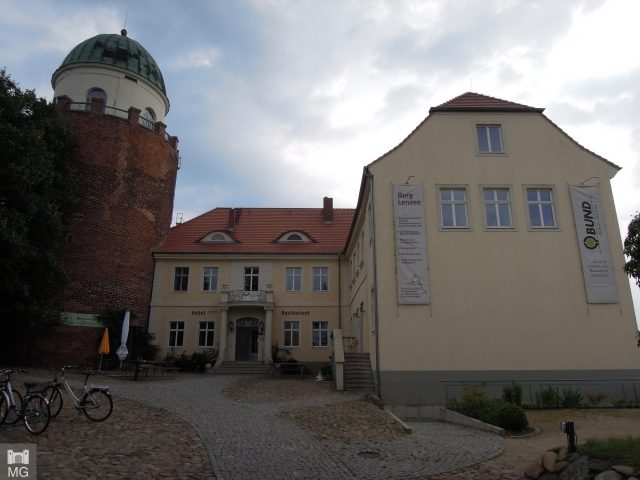
After that, the castle came into the possession of the German noble family Edle Gans zu Putlitz. An early German castle was built on the Slavic rampart. The existing castle tower with its over three-meter-thick walls dates from this 13th century period, its entrance was eight meters high and accessible via a leaning ladder - offering refuge from besiegers. Danish King Waldemar is also said to have been imprisoned here in 1223.
Of Robber Knights and their Dungeon
The Middle Ages was the time of bailiffs and robber knights at Lenzen Castle. Very successful robber knight activities were demonstrated by the von Quitzows, who controlled both the Elbe and inland routes around 1375. Their ransom demands for their captured victims were downright outrageous. This phase in the history of Lenzen Castle and the Prignitz is today referred to as the "Quitzow Era".
In 1398, Duke Albrecht of Mecklenburg ended the robber knight activities, although his army also destroyed the castle.
Throughout the 15th century, Lenzen and the castle continued to change ownership – often as collateral – repeatedly.
During the 16th century, Lenzen was Brandenburg's most important Elbe customs post. At that time, the tolls were so high that they threatened to stifle trade. Lenzen was also not spared from other scourges of that time, such as fire and plague.
In the 17th century, the Thirty Years' War took its toll in Lenzen as well: the population dropped from 3,000 to 300, the castle was severely damaged, battlements and oriels had to be removed.
A Dutchman Becomes Lenzen's Bailiff
In 1648, Arnold Gysel van Lier, a Dutchman, became bailiff of Lenzen. Van Lier drained and colonized the Lenzerwische, had the dikes renovated, managed sustainably, and promoted schools and arts.
In 1767, the Lenzen district was dissolved, and the castle was sold by Frederick the Great. A period of changing hereditary leases and private ownership began in the history of Lenzen Castle.
Lenzen Castle in the 20th Century
Around 1920, the then owner, Mr. Isermann, had the entire ensemble with park and garden restored and a first museum established. At that time, "Lenzen Castle" had 27 modern rooms with utility rooms, extra buildings, and a gatehouse.
In this first-class condition, the castle changed hands in 1931 to the architect family Renner. With tennis courts, riding and hunting opportunities, and horticulture in modern greenhouses, the historic complex was intended to become known throughout Europe as an exclusive "boarding school for 'higher daughters on the Elbe'".
After the war, in 1953, the castle and property were confiscated from the Renner family by expropriation decree of the GDR authorities. The family had left Lenzen and fled to West Berlin. Lenzen Castle became a retirement home. The establishment of the party veterans' home "Edwin Hörnle" ensured the most necessary preservation of the building fabric. Nevertheless, supply bottlenecks and material shortages endangered the preservation of the historic castle complex.
After the fall of the Wall, Mrs. Kreckel, née Renner, received Lenzen Castle back as family property. In 1993, she donated the castle to the Bund für Umwelt und Naturschutz Deutschland, BUND (German Federation for Environment and Nature Conservation), with the express wish that they preserve and use the castle in the spirit of environmental and nature protection.
Take Mobile History with you
You are reading this text for free. Premium adds what matters on the road: descriptions read aloud, sites found through your camera, whole regions taken offline.
- Every description, including the ~17,700 Premium sites
- Audio guide: have descriptions read to you on location
- AR finder: see sites through your camera, with distance and bearing
- Unlimited saved sites
14 days free, then from €2.99 a month. Cancel anytime.
Source: Wikipedia · Licence: CC BY-SA 4.0 · Image: Mobile Geschichte
This description draws on the facts documented in the linked Wikipedia article; Wikipedia content is licensed under CC BY-SA 4.0. Wording and editing: Mobile History.
Location: 53.0900, 11.4769