To be privately owned
Lichtenfels Castle (Dalwigksthal)

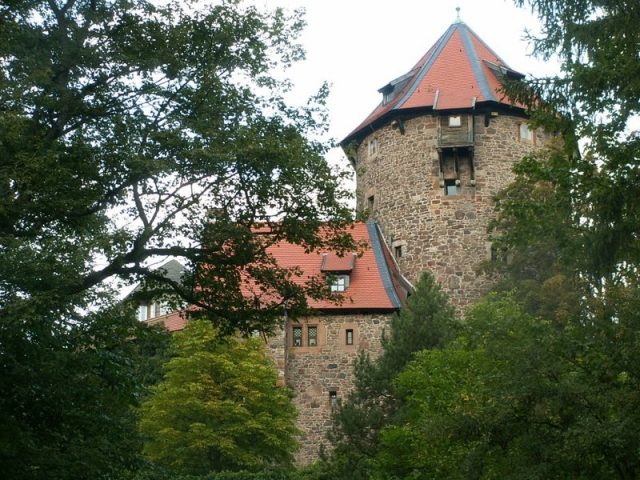
Lichtenfels Castle is a castle in the municipality of Lichtenfels in the district of Waldeck-Frankenberg in Hesse (Germany).
Lichtenfels Castle is located about 700 m east-southeast of the Lichtenfels district of Dalwigksthal, above the wooded and winding valley of the western Eder tributary Orke, which is fed by the Wilde Aa ("Aar") in Dalwigksthal. It is situated on the high northern spur of the Eisenberg.
Lichtenfels Castle was built in 1189 by the Corvey abbot Witukind von Spiegel zum Desenberg as a hilltop castle, shortly thereafter destroyed and rebuilt between 1223 and 1230 by Abbot Hermann I von Holte. On July 21, 1267, Corvey pledged Lichtenfels Castle, among other things, to Count Adolf I of Waldeck. After fierce feuds, Corvey had to definitively concede possession of the castle to Count Otto I of Waldeck in 1297. The castle then served for a long time as the seat of a branch of the Lords of Dalwigk, vassals of the Waldeck counts.
In the Middle Ages, the castle included a valley settlement with a church. In 1598, there is mention of "Ensenbecke" and in the 14th century and at the end of the 18th century of "Eisenbeck". The present village of Dalwigksthal was only established in 1851.
The Archbishops of Cologne, as Dukes of Westphalia, repeatedly laid claim to the towns of Münden, Neukirchen, and Rhadern, located in the Amt Lichtenfels, which led to lengthy lawsuits and conflicts in the 16th and 17th centuries. In the course of these disputes, the castle was probably destroyed again at the beginning of the 17th century. A partial reconstruction took place in 1631, followed by a comprehensive one between 1908 and 1914.
Current Use+
In the 1960s, the completely renovated castle served as a recreation home for Ankerwerke from Bielefeld. In the late 1980s, entrepreneur Tan Siekmann, founder of the company Biodata, and his parents bought the castle, which was again in need of repair, and extensively restored it, after which it temporarily served as the company headquarters of Biodata, which went bankrupt in 2001. Since 2004, the castle has been the seat of Safe-com, a company again managed by Siekmann.
Source Text: Wikipedia
Take Mobile History with you
You are reading this text for free. Premium adds what matters on the road: descriptions read aloud, sites found through your camera, whole regions taken offline.
- Every description, including the ~17,700 Premium sites
- Audio guide: have descriptions read to you on location
- AR finder: see sites through your camera, with distance and bearing
- Unlimited saved sites
14 days free, then from €2.99 a month. Cancel anytime.
Source: Wikipedia · Licence: CC BY-SA 4.0
This description draws on the facts documented in the linked Wikipedia article; Wikipedia content is licensed under CC BY-SA 4.0. Wording and editing: Mobile History.
Location: 51.1481, 8.8017