Restaurant
Liebenstein Castle

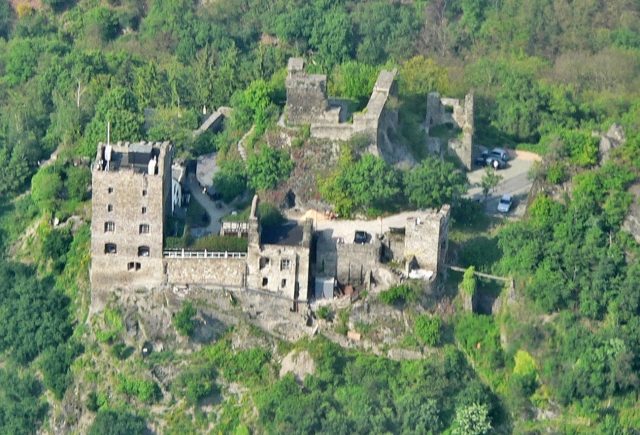
Liebenstein Castle, also known as Levenstein, is the ruin of a hilltop castle. Together with Sterrenberg Castle, located 200 meters away, it forms the so-called "Hostile Brothers" on the right bank of the Rhine near Kamp-Bornhofen in the Middle Rhine Valley in Rhineland-Palatinate. The Rheinsteig hiking trail on the right bank of the Rhine passes over Liebenstein Castle. From there, there is a good view of the Rhine Valley with Bad Salzig.
Since 2002, Liebenstein Castle has been part of the UNESCO World Heritage Upper Middle Rhine Valley, and it is also a protected cultural property under the Hague Convention. Liebenstein Castle is the highest castle on the Middle Rhine.
The castle was probably built in the 13th century as an outer bailey to Sterrenberg Castle. Both castles were fiefs of the Lords of Bolanden (later Sponheim-Dannenfels). Albrecht von Löwenstein, husband of Luccardis von Bolanden, had this outer bailey expanded between 1284 and 1290 against her uncle Werner VI von Bolanden at Sterrenberg Castle, who wanted to dispute this possession with his niece.
In 1294, the castle had to be sold to the knights Siegfried Schenk von Sterrenberg and Ludwig von Sterrenberg, who resided in the neighboring castle. They now called themselves "von Liebenstein". While Sterrenberg Castle was taken by Kurtrier, Liebenstein Castle remained in family ownership as a Ganerbenburg (jointly inherited castle). Further expansions followed (1363 gate tower, around 1380 defensive tower). In the 14th or 15th century, the main residential tower was also built. Subsequently, up to ten co-heirs lived in the castle, all of whom built their own defensive towers and residential buildings. This structure is still recognizable today.
In the 14th century, the second shield wall, known as the "battle wall," was built at Sterrenberg Castle by Kurtrier, probably directed against Liebenstein Castle – this is the historical core of the legend of the "Hostile Brothers."
By 1529, the castle had fallen into such disrepair that it was uninhabitable. Among the important feudal lords was Franz Friedrich von Liebenstein, Hofmeister, Oberamtmann, and supreme commander of the city and castle of Saarbrücken, who was buried in 1596 after his death in Osterspai in the collegiate church of Sankt Arnual. In 1637, after the Liebenstein line died out, it passed to the Mainz Chancellor Gerhard von Waldenburg. When Karl Frhr. v. Waldenburg gen. Schenkern remained childless, Georg Ernst Ludwig von Preuschen von und zu Liebenstein, "princely Oranien-Nassau privy councilor and government president" in Dillenburg, was enfeoffed in 1783 by the princely house of Nassau with the imperial immediate castle of Liebenstein and the village of Osterspai. Rudolf Frhr. von Preuschen von und zu Liebenstein had extensive restoration work carried out in 1977 and 1978. The main residential tower and its annex are now used as a restaurant and hotel.
Legend+
There are several versions of the legend of the "Hostile Brothers." It is considered certain that there was never an armed conflict here. The legend is the subject of Heinrich Heine's poem "Zwei Brüder" (Two Brothers) in his "Buch der Lieder" (Book of Songs).
Current Layout+
One enters the castle, accessible via a narrow, steep drive with only a few parking spaces in front of the entrance, from the south; to the west (Rhine side) are the remains of a defensive tower, to the east the ruin of a smaller residential tower (in private ownership), surrounded by a massive curtain wall.
The dominant structure is the 17-meter-high residential tower (14th or 15th century) on the north side of the complex, to which a gabled house was added in the 17th or 18th century. The tower has an almost square floor plan and seven stories. This complex now houses the restaurant with a castle garden and observation terrace, as well as the hotel with rooms facing the Rhine, newly furnished with period furniture in the 21st century.
Inside the castle complex, a walkable slate rock block protrudes centrally, on which the ruin of the rectangular keep rises.
Walls with a moat in front and a small remnant of another residential tower delimit the castle courtyard on the Rhine side. In the Middle Ages, there was also a fortification with a wall and moat towards the neighboring castle. In front of the north wall are the remains of a gun emplacement.
Take Mobile History with you
You are reading this text for free. Premium adds what matters on the road: descriptions read aloud, sites found through your camera, whole regions taken offline.
- Every description, including the ~17,700 Premium sites
- Audio guide: have descriptions read to you on location
- AR finder: see sites through your camera, with distance and bearing
- Unlimited saved sites
14 days free, then from €2.99 a month. Cancel anytime.
Source: Wikipedia · Licence: CC BY-SA 4.0 · Image: http://de.wikipedia.org/wiki/Datei:BurgLiebenstein02.jpg
This description draws on the facts documented in the linked Wikipedia article; Wikipedia content is licensed under CC BY-SA 4.0. Wording and editing: Mobile History.
Location: 50.2123, 7.6354