CastleLinz am Rhein

Linz Castle

Linz Castle

Museum
Restaurant


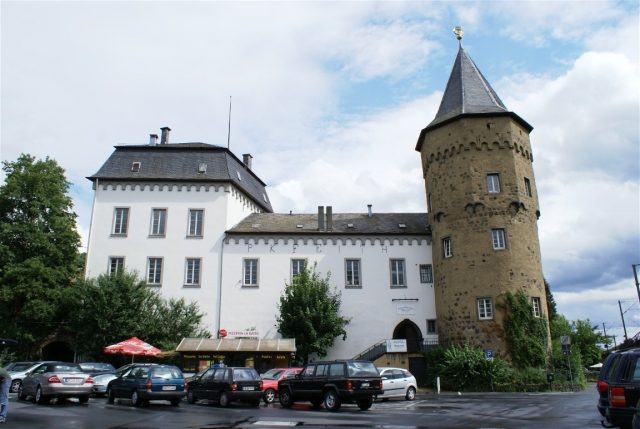
The Electoral Castle of Linz, also known as the Archbishops' Castle, is a town castle in Linz am Rhein in the north of Rhineland-Palatinate. It was built shortly after Linz was granted town rights by the Elector and Archbishop of Cologne as a bulwark of his possessions on the right bank of the Rhine (fortress) and as a customs castle.

The moated castle is located within the city limits of Linz am Rhein, north of the "Rheintor" (Rhine Gate) preserved from the city fortifications, in the immediate vicinity of the Rhine and Federal Highway 42, approximately halfway between Cologne and Koblenz.

At the beginning of the first half of the 14th century, the town of Linz, which was already mentioned in documents in 874, received town rights from the Archbishop of Cologne Heinrich von Virneburg between 1304 and 1332. A successor to this archbishop, Engelbert von der Mark, who was also Elector of Cologne, began construction of Linz Castle a few years later (1365). Due to a rebellion of the Andernach citizens against the Elector in 1359, the sovereign revoked Andernach's customs rights and moved them to Linz. The construction of the castle cost the Elector 30,000 Cologne Marks. He had to borrow this money, which led to him pledging the castle to the Archdiocese of Trier for eight years after its completion.

It can be assumed that initially the northwest tower of the wall was combined with a castle house on the west side to form the castle, serving as a keep. Only gradually did additional buildings expand the complex. In 1456, a division contract lists a gatehouse, castle gate with bridge, well, prison, and castle square with moat. The Linz regional castle was the seat of the bailiff of the Electoral Cologne office of Linz, the representative of the Elector, and the cellarer, who collected taxes and duties and managed the electoral possessions and revenues.

In 1475, Linz was besieged for more than two months by imperial troops in the so-called "Neuss War," during which the "strong fortress" suffered great damage.

In 1547, the Archbishop of Cologne Hermann V von Wied sought refuge in Linz Castle and tried in vain from there to avert his excommunication and deposition. Later, he retreated to his ancestral castle Altwied.

In 1707, the Elector moved the administration of the Electoral Cologne Oberamt from the Altenwied Fortress (near Neustadt) to Linz. This required an almost complete reconstruction of the castle. Only the foundations and the northwest tower of the late Gothic building remained. Four wings now enclosed a square inner courtyard. A moat surrounded the castle complex on the south and east sides. In the 18th century, the castle was also called "Linz Palace."

When princely Nassau-Usingen administrative and judicial officials moved into the buildings after the secularization in 1803, it consisted "of the wing facing the Rhine, which is intended for living; the press houses and fruit lofts, in which the office and repository (archive) are located, a coach house, directly opposite, which is used as a horse and wood stable and connects the dwelling with the press houses, as well as the entrance doors and some annexes, which close the fourth side."

After Linz fell to Prussia in 1816, the castle lost its "sovereign significance." The Prussian treasury sold it in 1821 for 4,050 Reichstalers to the Rhine customs inspector Anton Feith. The state ceded the moat to the city, which filled it in and created the "Burgplatz" (Castle Square) from it. In the first half of the 20th century, "Feith's Castle" fell into disrepair more and more; in 1951, it became the property of the city, which initially housed social housing there.

In 1973, during an exterior renovation, the half-timbering in the southern gable walls was exposed; in 1985, the city sold the castle. The castle, now back in private ownership, underwent extensive renovation by the "new castle lords" and has since been considered a tourist attraction.

Layout+

Linz Castle was built on the outskirts of the city within the city walls in the northwest of the city and was part of the city fortifications. It was also secured towards the city with walls and a moat. The lowland castle consists of four building wings that enclose a square inner courtyard. The two- and three-story wings are partly half-timbered and have been rebuilt several times up to the 19th century. From the time of its foundation, the corner tower, which is round in its lower two-thirds and octagonal in the upper part, with a steep Gothic roof hood, has been preserved. From the castle forecourt, nothing of the former fortifications can be seen. A double-flight staircase leads to the south portal. Another entrance is located in the east wing.

Current Use+

Also due to its central location in the old town of Linz, the castle is used as a tourist attraction. Among other things, it offers:

  • Electoral castle gastronomy in a recreated knight's hall
  • Torture chamber from the knightly era in the castle dungeon
  • Roman glassworks

Take Mobile History with you

You are reading this text for free. Premium adds what matters on the road: descriptions read aloud, sites found through your camera, whole regions taken offline.

  • Every description, including the ~17,700 Premium sites
  • Audio guide: have descriptions read to you on location
  • AR finder: see sites through your camera, with distance and bearing
  • Unlimited saved sites

14 days free, then from €2.99 a month. Cancel anytime.

Source: Wikipedia · Licence: CC BY-SA 4.0 · Image: Roland Neubert, Halle (Saale)

This description draws on the facts documented in the linked Wikipedia article; Wikipedia content is licensed under CC BY-SA 4.0. Wording and editing: Mobile History.

Location: 50.5660, 7.2786