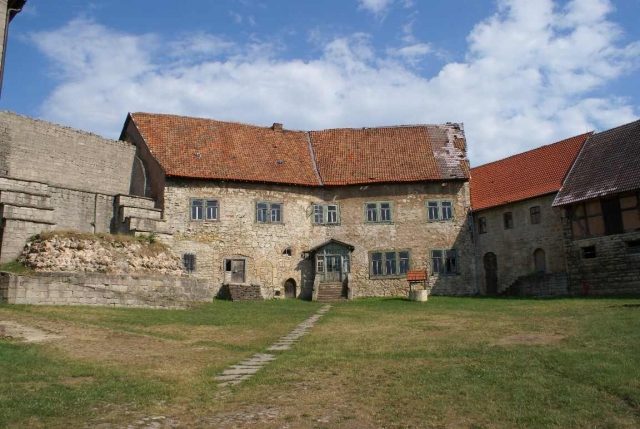
The Castle can be visited
Lohra Castle

Lohra Castle, also known as Groß Lohra, Großlohra, Schlossberg, Löhra, is a castle ruin in Großlohra in the Thuringian district of Nordhausen. It is a count's castle from the 12th century and is almost completely preserved with a high proportion of medieval buildings. Its double chapel from the Staufer period is particularly significant.
The hilltop castle was built in the 11th century on a mountain spur at an altitude of 410 m. The first reliable mention of the castle occurred in 1116. In that year, a noble family, in the person of Berengar, Count of Lare, was first documented. However, it is presumed that the castle is of much older origin.
Throughout the 12th century, the noble family was closely associated with the Staufer dynasty. The counts held various royal offices, which enabled them to expand the castle in a generous style in the second half of the 12th century. Under Count Ludwig III, a large keep was erected. The type of stonework on the tower suggests that a construction workshop was active here, which was influenced by the Hirsau building tradition. Another special building is the double chapel. It is a two-story chapel whose floors were connected by an opening in the middle. The upper floor served the nobility and the lower floor served the other castle residents as a place of worship. The architectural decoration of the chapel points to stonemasons who also worked in nearby Königslutter.
Remains of a palas and an exceptionally strong ring wall confirm the impression that the counts planned to build a representative castle that did not need to shy away from comparison with the nearby Thuringian landgrave castles Runneburg and Neuenburg.
At the beginning of the 13th century, the history of the Counts of Lohra breaks off. Count Ludwig IV had gone on a crusade to the Holy Land together with Landgrave Ludwig IV and had probably perished there. The Counts of Lohra are no longer mentioned after this time.
The Counts of Beichlingen took over the lordship and the castle around 1227. In 1320, they had to sell parts of the lordship to the Counts of Hohnstein. The latter resided at the castle until their extinction in 1593. Under the Hohnsteins, fortifications were reinforced several times, especially at the beginning of the 15th century.
During the Thirty Years' War, the castle was destroyed and rebuilt several times. Afterwards, it came into the possession of Johann VIII von Sayn-Wittgenstein-Hohenstein, and then to the House of Hardenberg.
Since 1712, the castle was a Prussian domain. A multitude of alterations were carried out, during which the core castle often served as a quarry.
From the 1960s to the 1990s, Clara Döring, born in 1908 and also known by the nickname "Burgfräulein" (Castle Maiden), primarily took care of the entire site. With the help of many volunteers, Döring, who also worked as an archaeological monument conservator, carried out [] . She also guided numerous tourists around the site and published essays about the castle. In 1992, Federal President Richard von Weizsäcker awarded her the Federal Cross of Merit for her monument preservation activities. Clara Döring passed away on July 2, 1994.
Only recently have renovation works been carried out.
Since 1992, the Weimar association "Offene Häuser e. V.", partly in cooperation with the Arbeitskreis Denkmalpflege (Working Group for Monument Preservation), has been dedicated to the preservation of Lohra Castle and offers affordable overnight accommodation for up to 80 people there. The castle chapel was renovated in 2000 with funding from the German Foundation for Monument Protection.
Take Mobile History with you
You are reading this text for free. Premium adds what matters on the road: descriptions read aloud, sites found through your camera, whole regions taken offline.
- Every description, including the ~17,700 Premium sites
- Audio guide: have descriptions read to you on location
- AR finder: see sites through your camera, with distance and bearing
- Unlimited saved sites
14 days free, then from €2.99 a month. Cancel anytime.
Source: Wikipedia · Licence: CC BY-SA 4.0 · Image: Roland Neubert, Halle (Saale)
This description draws on the facts documented in the linked Wikipedia article; Wikipedia content is licensed under CC BY-SA 4.0. Wording and editing: Mobile History.
Location: 51.4137, 10.6299