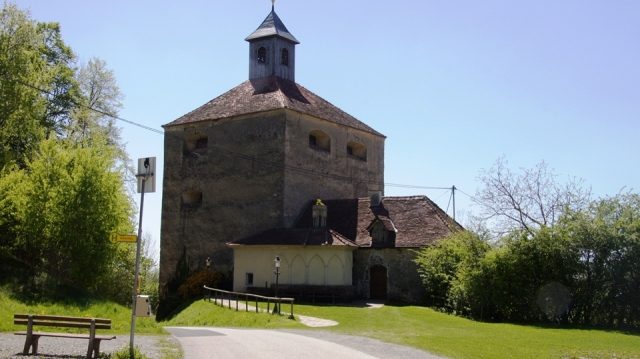
CastleLöffelbach

Neuberg Castle

Neuberg Castle

To be privately owned

Neuberg Castle (also Schloss Neuberg or Neuburg) is one of the most significant preserved fortifications in Styria. It is located west of the district capital Hartberg at an altitude of 520 meters above sea level on the foothills of the Ringkogel above the village of Löffelbach. Neuberg Castle is a Styrian hilltop castle, whose medieval core was incorporated into a modern fortress.

This medieval hilltop castle was built in the 12th century by Gottschalk Schirling (from 1166 of Neitberg/Neuberg), son of Wulfing of Stubenberg, as a border fortress or "combat castle" against the feared Hungarian armies and against all sorts of "heathen rabble" from the East. At the same time, the fortress became a clearing center. Its name is derived from Nitperg or Neitberg, which means combat or defiance castle. The Neitbergers were relatives of the Lords of Stubenberg and were among the most distinguished Styrian noble families. When the Neitbergers died out in the 15th century, Emperor Frederick III seized the lordship in 1483. In 1507, Emperor Maximilian I granted Neuberg, including the castle guard and all appurtenances, to Wilhelm von Graben and his descendants for administration. But already in 1518, it was passed on as an imperial fief to the Herberstein family, who owned it, with an interruption between 1603 and 1660, until the second half of the 20th century. In the meantime, it belonged to the Counts of Saurau. Neuberg was extensively expanded and modernized by the Herbersteins during the Renaissance period according to the rules of the Italian bastion system.

Structure+

A square, approximately 36-meter-high keep with the palas is the oldest part of the complex. The lower area is Romanesque and dates from around 1160. In its layout, the castle forms an irregular pentagon around a narrow, unadorned inner courtyard.

Furnishings+

Since the Herbersteins used the castle as an economic center but soon no longer inhabited it, only a remnant of the old furnishings has been preserved. In the southeast bastion is the large hunting and banquet hall, whose ceiling is equipped with a wooden coffered ceiling consisting of 36 fields from the second quarter of the 16th century. The individual fields are painted in tempera colors and depict scenes from noble country life, hunting pictures, and harbor views. A large, artistically valuable Renaissance ceiling was also located in the southwest bastion, but this was transferred to Herberstein Castle in 1860. The door to the banquet hall wing is dated 1669. In the inner courtyard there is a baroque wall fountain from the 17th century. A bastille is built in front of the south side of the castle. Southeast of the main castle extends an extensive outer bailey, which is bordered by storage buildings, the outer gatehouse, and the remains of the former defensive wall. Impressive is the mighty three-story cannon tower next to the outer gate. The castle chapel is located on its ground floor. On the east side of the tower, in front of the entrance to the Aegidius Chapel, a baroque Grab-Christi Chapel is attached, which probably dates back to the third quarter of the 17th century.

Visits are only possible from the outside, as the castle is privately owned.

Chapel+

Since 1660, the almost square castle chapel has been located on the ground floor of the cannon tower. The chapel was consecrated in 1661. The high altar in the auricular style was donated in 1661 by Johann Georg Graf Herberstein. The altarpiece shows Saint Aegidius, the patron saint of the church. The rest of the furnishings also date from the second half of the 17th century. The 14 Holy Helpers are depicted in the castle chapel. However, only eleven of the 14 Holy Helper paintings from the 18th century are still preserved. A small Grab-Christi Chapel was added.

The church is now a curacy benefice of the city parish of Hartberg and belongs to the deanery of Hartberg. This institution was already mentioned around 1250 and was re-established in 1617.

Take Mobile History with you

You are reading this text for free. Premium adds what matters on the road: descriptions read aloud, sites found through your camera, whole regions taken offline.

  • Every description, including the ~17,700 Premium sites
  • Audio guide: have descriptions read to you on location
  • AR finder: see sites through your camera, with distance and bearing
  • Unlimited saved sites

14 days free, then from €2.99 a month. Cancel anytime.

Source: Wikipedia · Licence: CC BY-SA 4.0 · Image: http://www.wehrbauten.at

This description draws on the facts documented in the linked Wikipedia article; Wikipedia content is licensed under CC BY-SA 4.0. Wording and editing: Mobile History.

Location: 47.2868, 15.9367