To be privately owned
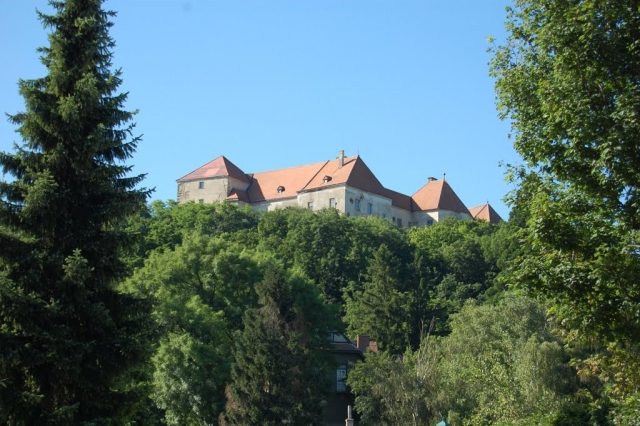
Neulengbach Castle
The Lords of Lengenbach built their first fortified house in Altlengbach, on the site of today's parish church. It was not until around 1191 that they moved to the more easily defensible Neulengbach. In 1197, an Otto von Lengenbach is mentioned for the first time in a document. The Lengenbachers were cathedral vogts of Regensburg, but died out with the death of Otto V in 1236. After that, the castle became princely property.
The next lords of the castle were ministeriales, who also called themselves "von Lengenbach". They initiated an expansion of the castle. After a noble uprising in 1309, the sovereign had the castle administered by stewards or even pledged. In 1573, Rudolf Khuen von Belasy succeeded in acquiring the lordship by purchase. Around 1577, he had the medieval buildings transformed into a Renaissance castle.
The Khuen family owned Neulengbach until 1646, after which it passed into the ownership of the Counts Pálffy von Erdödy. From 1696, the Barons von Bartolotti-Partenfeld were the new castle owners. They were followed by the Princes Lubomirski from 1740 to 1778. Wetzlar Freiherr von Plankenstern, who owned the lordship from 1778 to 1797, rented the castle to the Kerpen Regiment, which had a detrimental effect on the building fabric. It was not until the banker Count Moritz von Fries, to whom Neulengbach belonged for the next 26 years, that more favorable times dawned for the castle.
For almost a hundred years, the Princes of Liechtenstein were the castle owners. They used Neulengbach as a hunting lodge. Later, a sanatorium was located in the castle. In 1912, a fire destroyed the roof truss and damaged large parts of the west wing. During the First World War, captured Russian officers were housed in the still usable buildings.
In 1920, Neulengbach came to the City of Vienna, which renewed the roofs and adapted the castle as a recreation home for young women. During the Second World War, it housed a Wehrmacht training facility and later a military hospital. Shortly before the end of the war, the buildings were severely damaged. From 1952 to 1960, the Neulengbach Castle Association took care of the castle, after which it passed into private ownership. Since 1962, the Wakonig family from Graz has been the owner.
Take Mobile History with you
You are reading this text for free. Premium adds what matters on the road: descriptions read aloud, sites found through your camera, whole regions taken offline.
- Every description, including the ~17,700 Premium sites
- Audio guide: have descriptions read to you on location
- AR finder: see sites through your camera, with distance and bearing
- Unlimited saved sites
14 days free, then from €2.99 a month. Cancel anytime.
Source: Wikipedia · Licence: CC BY-SA 4.0 · Image: Maciek Wegrzyn
This description draws on the facts documented in the linked Wikipedia article; Wikipedia content is licensed under CC BY-SA 4.0. Wording and editing: Mobile History.
Location: 48.1980, 15.9102