Hotel
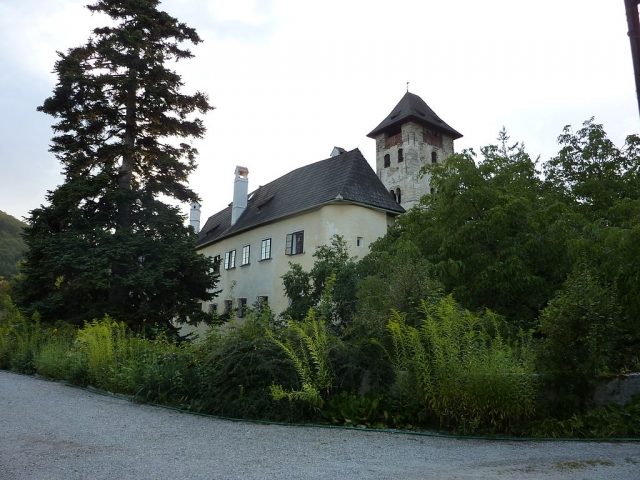
Oberranna Castle

Oberranna Castle (also sometimes listed as Ranna Castle) is located on the border of the Wachau and Waldviertel regions near Oberranna, a cadastral community of Mühldorf in Lower Austria.
Overview+
Its special feature lies in the combination of a fortified church with a castle. At the time of its construction, the fortified church stood protectively in front of the much smaller castle and thus completely took over the defensive function. Ranna was originally intended to monitor the Griesteig (the connection from Hinterhaus to Fohraberg). Through the expansion of the fortifications in turbulent times, the castle was never conquered.
Its origin is unknown. However, it must have existed before 1070, because in that year the Lords of Grie bought the castle and the area of Ranna. The new lords also called themselves "von Ranna or Rannah" and bore a golden griffin on a black field in their coat of arms. They had come in the retinue of the powerful Counts of Formbach from Rotgau in Bavaria. Their first known representative by name is Pilgrim von Grie-Rauhnah. Successor Waldo von Reun, during a serious illness, stipulated in his will that his estates should fall to the sovereign Margrave Leopold III, the Saint, after his death. Contrary to expectations, however, he soon recovered and, after his marriage, changed the will in favor of his wife and daughter. Leopold III then convened a court hearing in his residence, Gars Castle, and the dispute turned out in his favor. After Waldo's death, Leopold handed over part of his estates to his sister Gerbirg, whereupon she moved her residence to Ranna and Purk in 1120. Next to Ranna Castle, she had a freestanding Romanesque fortified church built. In 1120, another court assembly took place at Gars Castle, where Pilgrim II, the son of Pilgrim I, got back part of the property. Subsequently, there is a historical gap of over 100 years.
The marriage of Agnes von Ranna to Ulrich von Neidegg in 1370 is documented. The union of the two noble families also brought a new coat of arms: top left and bottom right the golden griffin on a black background (the coat of arms of Ranna-Grie) and top right and bottom left three red scallop shells on a silver background (the coat of arms of the Neidegger). With the assumption of his inheritance, her son, Hans von Neidegg, in 1397, marked the beginning of the Neidegger rule over Ranna, which lasted until the 16th century. In 1560, Georg von Neidegg had the castle expanded to its present form and size.
20th Century
In 1901, Göttweig Abbey acquired shares of the property, while Baron Hammerstein acquired the castle in 1905. His wife, the actress Anny Diekens, had to sell the furnishings piece by piece after his death; most recently, she pawned the altar of the castle church at the Dorotheum in Vienna. Finally, the castle was put up for auction. In 1930, Laurent Deleglise acquired it. He redeemed the altar and began extensive renovation work, during which the crypt was discovered. He was buried in the cemetery of Niederanna, and his widow lived alone in the castle until 1982. Since 1982, the castle has been in private ownership and has been restored with high craftsmanship and with the advice of the Federal Monuments Office. Today, the castle is used, among other things, as a hotel with 12 guest rooms.
Description+
The fresco painting above the entrance gate from the Renaissance extended over the entire facade. It is assumed that the frescoes above the entrance depict the three most important castle residents at the time: Georg von Neidegg, his wife Siguna, née von Kirchberg, and Georg's brother Roland von Neidegg, Vogt over the Pauline monastery at the foot of the castle hill. The entire courtyard is likely to have been painted with the same decorative system.
Anteroom
This room was only added under Georg von Neidegg in 1560. Before this time, the entrance gate was located here. These fresco paintings are the typical product of an inaccurate restoration in the 1950s, because the original painting had been cleaned so thoroughly that it was almost completely destroyed and then carelessly painted over. The exact time of the restoration is known because electrical wires were found under the paintings during the renovation work.
Castle Courtyard
This wing was also built under Georg von Neidegg (1560); the part from the construction joint was erected at a later time, it is not known exactly when. The castle cemetery south of the church served as a burial place for the castle lords until the founding of the Pauline monastery by Hans v. Neidegg. Other deceased were buried in the crypt or brought to St. Michael a. d. Donau. From then on, the Neidegger family members were buried in the monastery church.
Church
The church is strategically located at the highest point of the village. Its axis runs parallel to the mountain axis and is therefore not exactly east-west oriented, but rotated slightly NE-SW. This building, which was originally equipped with two towers, is a scaled-down copy of Romanesque cathedrals. This style was brought to Austria by the "shadow monks" from Normandy via Regensburg. The castle, separated from the church, was connected in the Middle Ages by a wooden walkway, which could be retracted in an emergency, near the 1st floor. Otherwise, it was only connected to the castle by common defensive walls.
Interior
Although Georg du Clauban is only mentioned as pastor of Oberranna in 1360, the church must have always had parish rights, which were transferred to the Pauline monastery in 1424. Parish churches that form a defensive unit with a castle are rather rare. The single-nave Romanesque church had two transept towers and a western crypt, similar to the church of St. Emmeram in Regensburg, and represents a rare type of building. During the restoration of the church by the previous owner, Mr. Laurent Deleglise, the interior of the church was divided by four walls, thus providing space for 13 rooms. The western part of the church was completely built into the castle, and the lower part of the western transept was filled in.
When Johann von Greifenfels auf Viehofen bought the Oberranna lordship in 1650, he had an altar erected in the church next to the sacristy, above which an inscription refers to him and his wife. The side altar is painted in Hungarian peasant baroque. The frescoes on the ceiling show the sacrificial lamb in the center, surrounded by the symbols of the four evangelists. From the church, one enters the crypt through a round-arched entrance. This western crypt is an almost square room, 5 m long and 4.8 m wide. It is divided by four columns into nine round-arched cross vaults, which are spanned between longitudinal and transverse ribs. A narrow, inwardly widening wall slit on the south side of the crypt served, when the westwork was still free-standing, as a lookout or as a loophole for archers, because at this point of the crypt the old access to the castle once passed, and the enemy passing by here had to turn his right, shield-uncovered chest side towards the defender. The Romanesque window also served for defense in conjunction with the west tower. The division of the room into small, almost always square bays is characteristic of the hall crypt. The figural capital of the crypt columns crowns the southwest column, which was closest to the old entrance – the entrant should notice this capital first. On one side of the capital there is an animal depiction, interpreted as a lamb or a dog. The long tail, reaching almost to the ground, argues against the depiction of a lamb. The following image is considered an donkey, which is rare in the Waldviertel. In a similar depiction on the north portal of the Romanesque church in Gögging, the horned animal is interpreted as a scapegoat. On the west side of the capital appears a male head with only a little visible upper body. He blows into a horn, which suggests a hunting scene. Although the blowing of trumpets of Jericho, which is considered a model for the Last Judgment, can also be meant.
Take Mobile History with you
You are reading this text for free. Premium adds what matters on the road: descriptions read aloud, sites found through your camera, whole regions taken offline.
- Every description, including the ~17,700 Premium sites
- Audio guide: have descriptions read to you on location
- AR finder: see sites through your camera, with distance and bearing
- Unlimited saved sites
14 days free, then from €2.99 a month. Cancel anytime.
Source: Wikipedia · Licence: CC BY-SA 4.0 · Image: http://commons.wikimedia.org/wiki/File:Oberranna_Burg1.jpg?uselang=de
This description draws on the facts documented in the linked Wikipedia article; Wikipedia content is licensed under CC BY-SA 4.0. Wording and editing: Mobile History.
Location: 48.3799, 15.3393