Cultural Events
Odenkirchen Castle (Mönchengladbach)

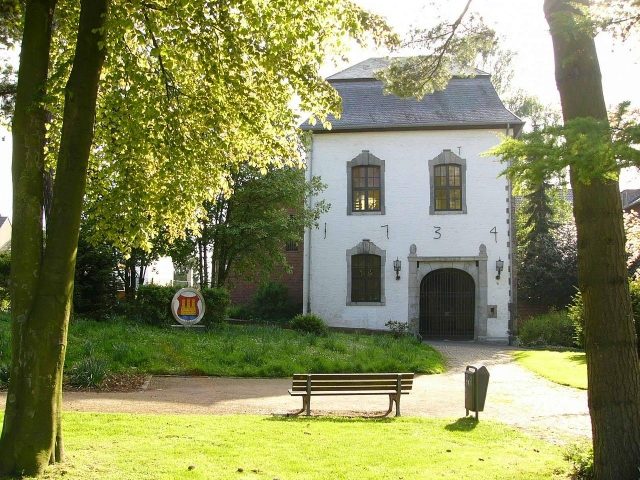
Odenkirchen Castle was a castle in the Odenkirchen district of Mönchengladbach in North Rhine-Westphalia.
The settlement of Odenkirchen, which began no later than the 12th century, originated from the castle of the Lords of Odenkirchen. The initial complex consisted of a wooden castle, built on an earth mound (motte) in a water and swamp area. Gradually, over the following centuries, it transformed into a massive stone castle.
Odenkirchen Castle was first mentioned in 1153 in a document by Emperor Frederick Barbarossa, in which he confirmed the ownership rights of Odenkirchen Castle to Archbishop Arnold II of Cologne, i.e., the Electorate of Cologne. Odenkirchen was an independent subordinate lordship of the Electorate of Cologne. Such a subordinate lordship was also called a "Herrlichkeit" (lordship).
In 1689, the castle and chancellery were incinerated by bombardment during the Franco-Dutch War. In 1701, a fire followed in Odenkirchen, laying the castle complex and the entire town in ruins. The castle was never rebuilt to its old state. In 1734, the von Merode-Westerloo family had the still-standing archway renewed and the buildings, which served to manage the extensive lands, rebuilt.
Lengthy lawsuits over the allocation of the castle had devoured more than 300,000 Reichstalers and completely ruined the finances of the von Merode family. In 1730, they had to mortgage the castle to the Dutch diplomat and composer Count Unico von Wassenaer for 64,968 Reichstalers. When the von Merode family was later unable to repay the mortgage sum, Johann Wilhelm Augustin, Imperial Count of Merode, ceded his rights to Odenkirchen to Unico von Wassenaer. In 1745, the latter sold the castle for 94,000 Reichstalers to the Elector and Archbishop of Cologne, Clemens August. He appointed bailiffs for the administration of Odenkirchen. The last bailiffs were Klemens August Bernhard von Bouget, a court chamber councilor from Aachen who also acted as a tenant of Haus Zoppenbroich, and his son-in-law Christian Joseph Aldenhoven from Zons.
In 1789, the French Revolution broke out, and the revolutionary army also occupied Odenkirchen. As part of the secularization, all church property was confiscated. The castle was sold: in 1803, Benedicta von Bouget acquired the castle with all its lands and sold it in 1811 to the merchant Jean Lüttringhausen from Elberfeld. In 1872, it became the property of the Odenkirchen Castle Association; in 1920, the Catholic parish of St. Laurentius acquired it.
The west wing of the castle along Hoemenstrasse was demolished at the end of the 19th century, and the remaining structure was destroyed by bombs in 1943. The burned-out castle tower was restored in 1950/51. In 1988, the Odenkirchen local history association took over the building from the parish of St. Laurentius on a 30-year hereditary lease with the condition of restoration. This lease agreement still exists today and applies to all rooms of the castle with the exception of the two lower rooms, which were made available to the altar servers by the parish. These rooms were prepared by the altar servers through active self-help. Here, the altar server leadership team has the opportunity to meet on weekends or hold their meetings and maintains both the rooms and the anteroom with the archway and the castle garden.
Take Mobile History with you
You are reading this text for free. Premium adds what matters on the road: descriptions read aloud, sites found through your camera, whole regions taken offline.
- Every description, including the ~17,700 Premium sites
- Audio guide: have descriptions read to you on location
- AR finder: see sites through your camera, with distance and bearing
- Unlimited saved sites
14 days free, then from €2.99 a month. Cancel anytime.
Source: Wikipedia · Licence: CC BY-SA 4.0
This description draws on the facts documented in the linked Wikipedia article; Wikipedia content is licensed under CC BY-SA 4.0. Wording and editing: Mobile History.
Location: 51.1338, 6.4501