Apartments
Orsbach Castle

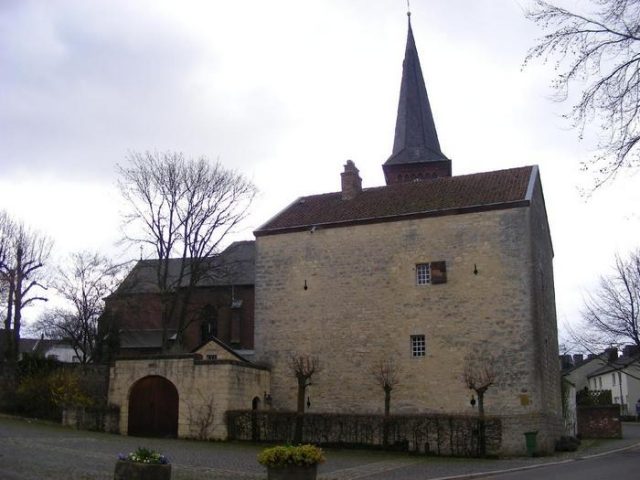
Orsbach Castle is a medieval castle complex in the Orsbach district near Aachen, whose origins probably date back to the Carolingian era.
About five kilometers west of the old city center of Aachen, a high plateau rises north of the old military road from Aachen to the river ports of Maastricht. In the Middle Ages, royal estates were located there, from whose respective owners the scholastics of the Aachen Marienstift received the tithe. A part of these estates was transferred as a hereditary fief to the ministerial family van Orlosberg (Orlousberghe), who are traceable there from the 13th century. For the purpose of monitoring the important economic route from Aachen to Maastricht, which was clearly visible from here and over which a large part of trade and troop convoys passed, a castle-like fortification was built at the beginning of the 15th century next to the farm buildings and a small Romanesque church. The tower of this castle now served as one of the eight reporting and surveillance towers of the Aachen Empire, between which acoustic and optical communication took place within the imperial territory and with the city center itself. In this way, the castle also became part of the Landwehr of the Aachen Landgraben, established near Orsbach in 1453, that border fortification of the Aachen Empire, which was built between 1419 and 1568 according to a contract between the Duchy of Jülich and the Free Imperial City of Aachen and here in Orsbach advanced furthest to the west. The family van Orlosberg, as the Aachen city accounts of 1376 show, experienced a name addition, in that Aurelii or Amelii van O. (readability in the city accounts ambiguous) is referred to as Millis de O. His descendants adopted the designation Millis as a family name. The designation is derived from Amelii (a derivation of "miles" = knight) and from the function of the family = milites (ministerials), here meaning imperial knights. Later, the designation Millis became the family name Milles.
The castle complex continued to serve as a watchtower until the invasion of the French in 1792 and the associated end of the Aachen Empire. Although the French demolished the small chapel in 1803, the castle complex itself was spared by them. Constantly changing owners, multiple structural changes, finally the repurposing into an inn with an attached dance hall, but also several years of vacancy were not conducive to the historical preservation of the castle, and it visibly decayed and was even to be finally demolished. The complex, which was still owned by the city of Aachen at that time, was only fundamentally restored after its sale in 1968 to an architect and returned by him to as original a state as possible. Today it again serves as living space and has in the meantime been placed under protection according to the monument protection law of North Rhine-Westphalia.
Description+
The currently preserved parts of Orsbach Castle, whose masonry of quarry stone is more than 1.20 meters thick in some places, were built in the 15th century. As part of the core renovation of the almost square building at the end of the 20th century, the large window openings broken out of the wall in the 19th century were rebuilt into smaller medieval windows, and the old original loopholes were restored according to the model of a remaining loophole. Inside, the tower, consisting of local marlstone, was converted back into living quarters by installing stairs, doors, and windows, and by building a whitewashed brick oven on the ground floor, so that the original spatial effect of the two very high rooms stacked one above the other remained comprehensible.
Behind thick walls, there is a garden and an inner courtyard where espalier fruit grows, as well as an old, also restored shed, whose ceiling has a cross-rib vault similar to a Gothic crypt.
The former historical significance of the entire complex now becomes clear again to an observer when viewed in connection with the neighboring cemetery enclosure, an attached, also old residential house, and the new parish church built in 1863 in place of the destroyed Romanesque chapel.
Take Mobile History with you
You are reading this text for free. Premium adds what matters on the road: descriptions read aloud, sites found through your camera, whole regions taken offline.
- Every description, including the ~17,700 Premium sites
- Audio guide: have descriptions read to you on location
- AR finder: see sites through your camera, with distance and bearing
- Unlimited saved sites
14 days free, then from €2.99 a month. Cancel anytime.
Source: Wikipedia · Licence: CC BY-SA 4.0 · Image: http://www.wehrbauten.de/thread.php?threadid=845
This description draws on the facts documented in the linked Wikipedia article; Wikipedia content is licensed under CC BY-SA 4.0. Wording and editing: Mobile History.
Location: 50.7985, 5.9963