CastleRastenfeld-Ottenstein

Ottenstein Castle
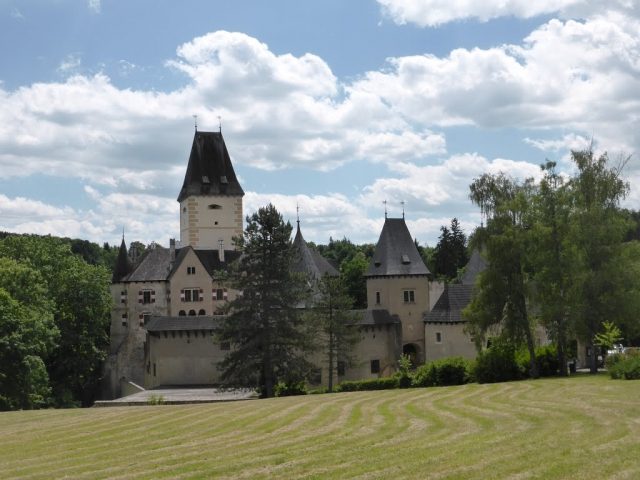
Ottenstein Castle

The Castle can be visited

Ottenstein Castle is located in the Waldviertel region of Lower Austria and stands on a hill above the Ottenstein reservoir.

One of the Ottensteins was Hugo de Ottenstaine, who was first mentioned in a document in 1177. The castle itself, however, is likely older. The Ottensteins were related to the Lords of Rauheneck near Baden. The castle remained in their possession until the first half of the 15th century.

A Tobias von Rohr followed as owner, but due to his transgressions, he was captured in 1448 after a siege of the castle. Later, the Lords of Rohr served Matthias Corvinus. In 1516, the castle came into the possession of Paul Stodoligk. Under his son Eustach, numerous alterations, such as the outer bailey, were carried out. In 1536, it was sold to the Lamberg family and remained in their possession for over 400 years. The Lambergs were elevated to the rank of baron in 1544 and took the name Barons of Ortenegg and Ottenstein. In 1667, they became counts.

The castle was besieged twice during the Thirty Years' War, both times, in 1622 and 1640, unsuccessfully.

From 1679 onwards, numerous baroque alterations were made, which are still visible today. The chapel, dedicated to St. Florian, was richly decorated with stucco by Lorando Aliprandi. In the so-called Popes' Room, portraits of 241 popes hang.

The art collection, which was established by the Lambergs, was donated by Franz Adam von Lamberg in 1822 to the resulting gallery of the Academy of Fine Arts in Vienna.

Like many other castles, it was romanticized between 1867 and 1878 and received conical and tent roofs and red-white-red shutters.

Among the oldest parts of the castle is the castle chapel with frescoes from the second half of the 12th century, which were only uncovered in 1975.

Around 1940, the area around the castle was depopulated due to the establishment of the Döllersheim military training area. The castle was sold to the German Reich. Thus, as former German property, it was placed under USIA administration by the Soviet occupation forces after World War II and used as officers' quarters, suffering considerable damage. The castle, leased by EVN since 1958, is owned by the Windhag'sche Stipendiumstiftung.

For tourist use, a castle restaurant was set up in the outer bailey. In 2001, in cooperation with the nearby Waldreichs Castle, a state exhibition with the theme "Being and Meaning, Castle and Man" took place.

Take Mobile History with you

You are reading this text for free. Premium adds what matters on the road: descriptions read aloud, sites found through your camera, whole regions taken offline.

  • Every description, including the ~17,700 Premium sites
  • Audio guide: have descriptions read to you on location
  • AR finder: see sites through your camera, with distance and bearing
  • Unlimited saved sites

14 days free, then from €2.99 a month. Cancel anytime.

Source: Wikipedia · Licence: CC BY-SA 4.0 · Image: http://www.panoramio.com/photo/108469375

This description draws on the facts documented in the linked Wikipedia article; Wikipedia content is licensed under CC BY-SA 4.0. Wording and editing: Mobile History.

Location: 48.5964, 15.3356