CastleBorschemich

Palant Castle (Borschemich)
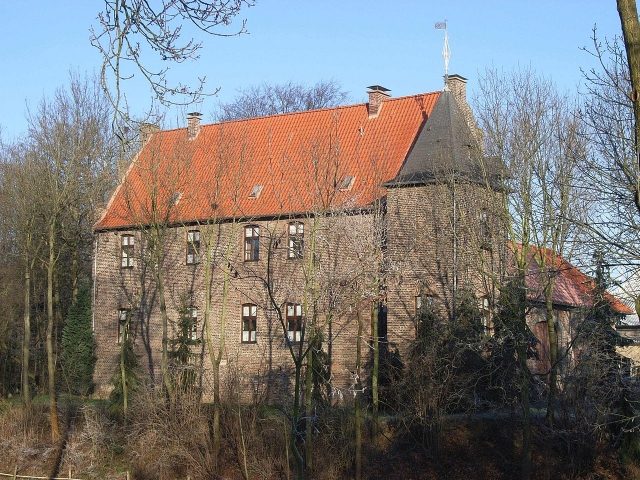
Palant Castle (Borschemich)

To be privately owned

Haus Paland (from Pfahlland, as houses in this marshland were built on piles) is located in the Borschemich district of Erkelenz. Situated behind the gardens of the Catholic parish church of St. Martinus, the former moated castle consists of an outer bailey and a main house. The moat system was formerly fed by the Köhm; part of the moats is still preserved. Haus Paland, along with the village, will have to make way for the Garzweiler II open-pit lignite mine in the coming years.

In 1296, a knight Gottschalk, a vassal of the Millendonk lordship, was in possession of "Haus Birsmich". In 1363, the abbess of St. Maria im Kapitol in Cologne leased the tithe of Borschemich to a descendant of this knight Gottschalk, the squire Gottschalk (the son of Arnold von Birsmich). In 1388, Tilgin von Lieventhal was enfeoffed with Birsmich by Archbishop Friedrich III. In 1391, Heinrich Oysse von Walhusen, a nephew of Arnold von Birsmich, received the enfeoffment. More than 50 years later, in 1444, Johann von Valderode was the owner of the castle. Later, it changed owners again and came into the possession of Johann Klaitz through marriage. At the beginning of the next century, in 1511, the von Harff family appeared for the first time as owners of Haus Birsmich on the knight's roll. Despite the turmoil of the times, the property was enlarged and the castle fortified, so that it formed a strong support for the surrounding land. A von Harff married Christoph von Palant zu Breidenbach near Linnich in 1584, who thereby became co-owner of the house. However, part of the estate was still in the possession of Johann von Blittersdorf, through the inheritance of the Klaitz family.

The Rhenish Palant family subsequently gave the castle its name. The Palants were formerly spread out in numerous branches and also appear as aldermen and mayors in Erkelenz. The Palant coat of arms shows a shield, divided six times, black and yellow, with a six-pointed star, gold and silver, in the uppermost section, heraldically to the right.

The house remained in the possession of the Palant family for two centuries.

In 1586, during the Eighty Years' War, it was captured twice by Spanish and Cologne troops, and the outer bailey was burned down the second time, its location clearly visible on old site plans. Perhaps following this conquest and destruction, the present building probably originated around 1600.

In 1783, Haus Palant came to Maria Anna von Palant, who was married to E.W. von Graß zu Geyen, and the following year, 1784, to her two brothers-in-law Gerhard Caspar von Olmissen and Th.A. von Houve. From these, it was inherited by the Raitz von Frentz family. In 1837, Edmund Raitz von Frentz zu Kellenberg sold the house to the Lörkens family, in whose possession it still is today after approximately 170 years.

Outer Bailey and Main Castle+

No structural remains of the rectangular outer bailey, which was burned down in 1586, are still present. However, its location can be clearly determined based on the still partially preserved moats. As a site plan shows, the moats of the outer bailey formed a continuation of the main moats and were connected to them. In times of danger, both the main castle and the outer bailey could be completely cut off from the outside world by raising the drawbridge. Today, a shed stands on the terrain of the outer bailey. According to a view of Haus Palant in the Codex Welser from 1723, described as inaccurate by Paul Clemen, the main castle had two towers, and the outer bailey had three. The outer bailey was open towards the main castle and connected to it by a drawbridge. The entrance to the outer bailey was probably on the side opposite the current entrance.

Current Building Stock+

The still existing, rectangular main castle from around 1600, surrounded by deep moats, contains on its south side the two-story manor house with a stepped and curved gable. To the east, a rectangular tower adjoins it. This tower has a four-sided pyramid roof, whose weather vane shows the Palant coat of arms. The windows were completely rebuilt in the last century. On the north side of the inner courtyard, which is surrounded by agricultural buildings, i.e., opposite the manor house, there is still a smaller, perhaps older residential building with a stepped gable to the west. The connecting building on the west side dates from more recent times. The rest of the buildings on the east side are simple and were built in the 17th century. It also contains the large basket-arch gate with the marital coat of arms above the keystone. Next to the gate, on the outside of the manor house, a beautiful sandstone fireplace is built into the wall. On it are four ancestral coats of arms with the names: Batenborg, Pallant, Leraet (Lerodt), Wylich and the inscription: Anno 1624 C.(hristoph) H. v. P.(alant) Obrister. Tandem bona causa triumphat (German: "Finally the good cause triumphs"). The first Palant who acquired Haus Birsmich through marriage with a von Harff was also named Christoph. This refers to this Palant. The inscription probably refers to the happy outcome of a long-standing legal or inheritance dispute.

In front of the old church tower, there used to be an almost worn-out tombstone with the double coats of arms of Palant and Graß and the remnant of an inscription: zur Geyen. This slab once covered the grave of Maria Anna von Palant, who died in 1784, married to E.W. von Graß zu Geyen. This tombstone is also built into the wall at Haus Palant in front of the entrance. In the small, almost square inner courtyard, remnants of an 18th-century wooden gallery with a protective roof are still preserved.

Take Mobile History with you

You are reading this text for free. Premium adds what matters on the road: descriptions read aloud, sites found through your camera, whole regions taken offline.

  • Every description, including the ~17,700 Premium sites
  • Audio guide: have descriptions read to you on location
  • AR finder: see sites through your camera, with distance and bearing
  • Unlimited saved sites

14 days free, then from €2.99 a month. Cancel anytime.

Source: Wikipedia · Licence: CC BY-SA 4.0

This description draws on the facts documented in the linked Wikipedia article; Wikipedia content is licensed under CC BY-SA 4.0. Wording and editing: Mobile History.

Location: 51.0801, 6.4346