CastlePerchtoldsdorf

Perchtoldsdorf Castle
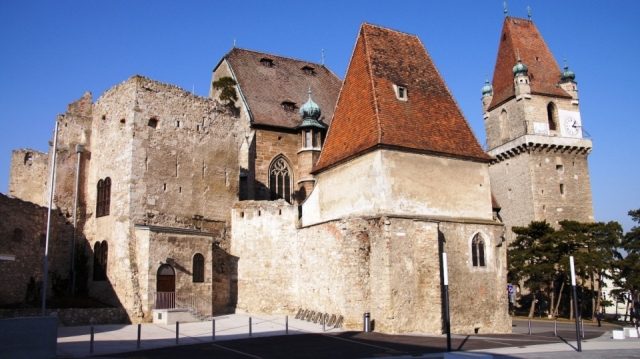
Perchtoldsdorf Castle

Cultural Events

Perchtoldsdorf Castle is a tower castle located within the town of Perchtoldsdorf in the Mödling district of Lower Austria, directly on the border with Vienna. The castle is situated in the center of Perchtoldsdorf on the slopes of the Vienna Woods.

The origins of the castle likely date back to before the year 1000, and it was built as part of the numerous castles on the eastern edge of the Vienna Woods to protect the Babenbergs from the constantly invading Hungarians.

The castle originally consisted only of a stone tower and some wooden structures, protected by a palisade and a moat. However, as it soon became too small, it was only inhabited for defensive purposes. The first lord of the castle, Heinricus de Pertoldesdorf, is mentioned in 1138. Under his successor, the wooden structures were replaced by stone ones, and an outer bailey with a wall was built. In this state, it was once again habitable. The south tower, which still stands today, was also built as a keep. The castle chapel on the second floor of the castle was elevated to a parish church in 1217 under Bishop Ulrich II of Passau. The free allodial property of Otto I of Perchtoldsdorf was transferred to Melk Abbey in 1232, from which he received it back as a fief. Otto I was also involved in the noble uprising against Frederick the Quarrelsome. Therefore, the castle was destroyed by him during a punitive expedition, leaving only the plinth and part of the south wall.

The ruin was converted into a church, while Otto likely resided in his new castle, Kammerstein. However, a new town castle, primarily serving administrative purposes, was built not far from the castle, at the southeastern corner of the present-day market square. Otto II, who later also fought alongside Rudolf of Habsburg in the Battle of Dürnkrut and Jedenspeigen, had the ancestral castle rebuilt. By around 1270, the ancestral castle is believed to have been completed again.

But Otto III of Perchtoldsdorf also participated in the noble uprising, so all three castles, i.e., the ancestral castle, the town castle, and Kammerstein, were destroyed again by Duke Albrecht I around 1290. Otto presumably died in prison.

With the death of Otto III's brother, Heinrich IV, the Perchtoldsdorf line died out, and the castle reverted to Melk Abbey, which then enfeoffed it to the Duke of Austria. The castle was rebuilt and made habitable. Gothic architecture was favored as the contemporary building style. A separate well was dug within the castle, and the so-called Ducal Chapel was built as an annex to the parish church, reserved exclusively for the family.

The castle subsequently became the dower house for Austrian duchesses. The first lady of the castle was Elisabeth von Virneburg, the widow of Duke Heinrich. In the following decades, numerous duchesses resided in the castle, including Duchess Beatrix, who had the hospital and the still-existing hospital church built in Perchtoldsdorf.

In the conflicts between Emperor Frederick III and his brother Albrecht VI, both the castle and the town suffered, as did in the subsequent invasions by the Hungarians. When the Hungarians were finally expelled in 1490, the castle was also completely destroyed, so Archduke Maximilian lost interest and sold it to Manngen von Höhenberg.

Due to the looming Turkish invasions, the inhabitants of Perchtoldsdorf and the surrounding villages restored it as a defensive structure. Windows were replaced by loopholes, and a ring wall was built around the exterior. While the market was burned down during the First Turkish Siege, the inhabitants were able to repel the attack on the castle. A cemetery was established in the former second castle courtyard.

In 1605, the castle again had to provide protection when Stephan Bocskai advanced with the Hajduks. However, against the Turks during the second siege in 1683, the castle was not as well maintained, so it was burned down again. In 1794, the inner castle wall was torn down, and no one cared for the buildings. Later, there was even a consideration to demolish the entire castle to gain agricultural land.

In 1871, the south tower was restored and dedicated as a workplace for Joseph Hyrtl. After his death, these rooms were used as a museum for several years. The cemetery was closed in 1883 after the establishment of the present-day Perchtoldsdorf cemetery. In 1928, the armory was renovated and, after a regional trade fair, made available to the scouts as a club premises.

Current Use+

In 1958, an emergency roof was built over the palace hall, and in 1964, the former residential wing was converted into a cultural center.

Since 1976, the castle courtyard has been used annually for summer theater. After further renovations in 2008, the theater season was canceled. In June 2010, the castle was reopened, with the old building fabric remaining untouched, but a new, underground event hall and a new foyer, as the old foyer had to make way for a kitchen with modern sliding doors. However, there are now accessible ramps and an elevator. Instead of the buffet on the upper floor, there is now a modern glass and steel construction that replaced the historic walls. The historic exit to the castle courtyard was walled up, and the gate of the historic armory into the castle courtyard was rendered unusable, as the steel and glass construction in front of it is not passable. In favor of the transition from the old castle to the new festival hall, the historic wall between them was opened by a reinforced concrete passage.

Take Mobile History with you

You are reading this text for free. Premium adds what matters on the road: descriptions read aloud, sites found through your camera, whole regions taken offline.

  • Every description, including the ~17,700 Premium sites
  • Audio guide: have descriptions read to you on location
  • AR finder: see sites through your camera, with distance and bearing
  • Unlimited saved sites

14 days free, then from €2.99 a month. Cancel anytime.

Source: Wikipedia · Licence: CC BY-SA 4.0 · Image: http://www.wehrbauten.at/noe/niederoesterreich.html

This description draws on the facts documented in the linked Wikipedia article; Wikipedia content is licensed under CC BY-SA 4.0. Wording and editing: Mobile History.

Location: 48.1197, 16.2642