Cultural center
Piberstein Castle

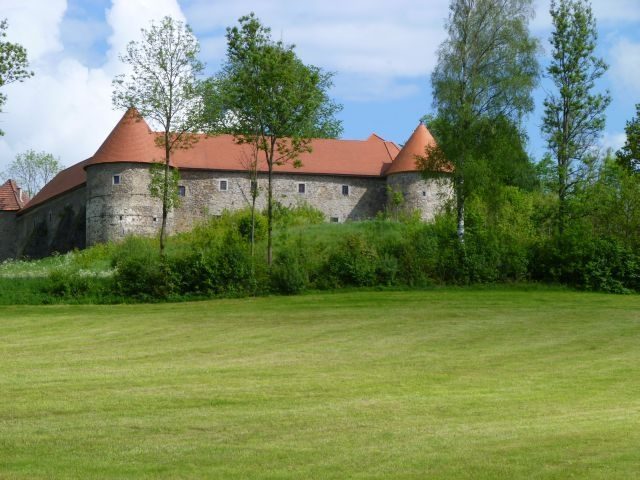
Piberstein Castle is located in the Piberstein district of the municipality of Ahorn in the Mühlviertel region of Upper Austria. The rock castle was built in the 13th century, expanded around 1620, and over time fell into ruin. Since 1964, it has been renovated and now serves as a regional cultural center.
Piberstein was probably built between 1200 and 1250 by the brothers Ruga and Arnold von Piberstein from the Piber family. The brothers were vassals of the Lords of Griesbach and Waxenberg. The exact time of construction is not known. Around 1285, Rüdiger and Ottokar von Piberstein are documented as owners. The castle served as the center for clearing the surrounding forest. After the Pibersteiners died out, Ulrich von Tann acquired the castle, which was now a princely fief. In 1350, Walchum Haderer became the owner. Duke Rudolf IV granted it to Zacharias Haderer in 1362. From 1386, many different owners followed in quick succession: in 1386 Heinrich Aichberger and Wolfgang Aschauer, in 1393 Friedrich von Stahaleck, in 1403 Heinrich von Puchberg, in 1407 Jobst Haderer, and in 1412 Heinrich III von Falkenstein. Under Hans von Rohrbach, Hussites unsuccessfully besieged the castle in 1427. In 1428, the brothers Kaspar and Balthasar von Schallenberg bought it, as their seat in St. Ulrich had been destroyed by the Hussites, and they kept the castle for a longer period.
In 1594, Piberstein was one of the strongholds against the Turkish threat in the Mühlviertel. Around 1620, the castle was expanded in the Renaissance style under Georg Christian von Schallenberg. The two courtyards were clad with artificial marble and the walls decorated with sgraffito paintings. In 1625, imperial troops occupied the castle. In 1645, the fief was converted into free property. In 1675, Christoph Ehrenreich von Schallenberg sold the castle to Elias von Seeau. In 1702, the castle was united with Helfenberg Castle and a fideicommissum was established. A planned renovation in 1752 did not materialize, and over time the uninhabited castle fell into disrepair. In 1893, the Counts Revertera-Salandra bought the castle. In the 1930s, the castle was operated as a hotel with a restaurant, but continued to decay.
For the now ruined castle, restoration work began in 1964 by restorer Harald Seyrl. From 1971, Hubert Taxenecker continued this work. In 2002, a fire occurred, but it caused little damage to the castle. Today, the castle is a regional cultural center for concerts, exhibitions, and readings, as well as music festivals.
Description+
The castle is an extensive complex, with its core castle measuring 784 square meters and the outer bailey 2730 square meters. The entire complex is surrounded by a four to six meter high wall, reinforced with four three-quarter round defensive towers and a square gate tower. Of the medieval defensive structures, only the loopholes are still visible. To the left of the gate tower stands a chapel from 1730. According to oral tradition, an escape tunnel leads from the castle into the neighboring forest.
On the inside, there are some outbuildings; the left part of the castle courtyard is undeveloped. The core castle has two latrine bay windows on the outside and is protected by a two-meter thick and 15-meter high wall. The portal of the castle gate was walled up around 1620, when the entrance to the main castle was moved to the northwest side. The middle courtyard is accessed through a high gate arch.
On the ground floor of the adjoining building is a hall connected to the courtyard by two arcaded passages. Opposite, a staircase from 1620 leads to an arcaded passage, which leads to the knight's hall reconstructed in 1992. The palas stands amidst the rocks. Nothing remains today of the former square residential tower. The approximately 7.5 by 7.5 meter tower was already a ruin in 1752 and formerly served as the living quarters of the Piber family.
Since 1975, the castle has been saved from further decay. Through the commitment of the owner, the municipalities and associations in Ahorn and Helfenberg, as well as the support of the Upper Austrian provincial government, a wide range of cultural activities are offered, making the castle today a cultural center of the district.
Take Mobile History with you
You are reading this text for free. Premium adds what matters on the road: descriptions read aloud, sites found through your camera, whole regions taken offline.
- Every description, including the ~17,700 Premium sites
- Audio guide: have descriptions read to you on location
- AR finder: see sites through your camera, with distance and bearing
- Unlimited saved sites
14 days free, then from €2.99 a month. Cancel anytime.
Source: Wikipedia · Licence: CC BY-SA 4.0 · Image: http://commons.wikimedia.org/wiki/File:Burg_Piberstein-neu.jpg
This description draws on the facts documented in the linked Wikipedia article; Wikipedia content is licensed under CC BY-SA 4.0. Wording and editing: Mobile History.
Location: 48.5306, 14.1558