To be privately owned
Plankenwarth Castle

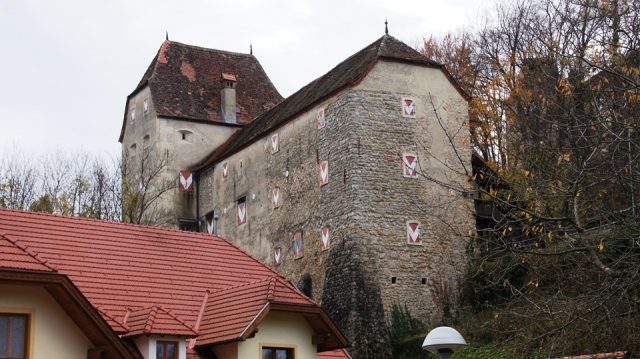
Plankenwarth Castle or Schloss Plankenwarth is a castle converted into a palace in Sankt Oswald bei Plankenwarth in Styria. Its history can be traced back to the 13th century. Slightly below the main castle is Ludwigsburg, which was built by Ludwig Stürgkh in the 16th century and later served as an outer bailey and farmstead.
Today it is privately owned. The owner makes some rooms available for exhibitions and concerts. Luxury apartments have been set up in the outer bailey.
The castle was built on the summit of the Jägerberg, which slopes steeply on all sides and offered a good view. It served to monitor the road from Judendorf-Straßengel to Sankt Oswald which passed the castle. On the northern slope of the castle hill, slightly below the main castle, is Ludwigsburg.
Design+
The layout of Plankenwarth Castle resembles a trapezoid and has walls up to three meters thick. On the western part of the wall is a round tower, and on the northern part a semi-circular tower. The square keep stands on the east side of the castle and is built into the courtyard side. The inner courtyard has the shape of a triangle and features column arcades built in the Late Renaissance style. The castle was expanded and extended into a Baroque palace in 1754 by Karl Leopold von Herberstein. The interior was designed by the Baroque master Joseph Hueber. Today, only parts of the original Baroque furnishings remain. Furthermore, remnants of the stone door frames from 1656 and beamed ceilings in Renaissance style are preserved. The original interior is no longer present.
The tower-like Ludwigsburg was built in the Renaissance style and is surrounded by a defensive wall with square towers. The wooden battlement is still preserved. It also has a gatehouse with two round towers.
The main castle has a castle chapel dedicated to Saint George, which has been documented since 1594. It was baroque-ized around 1680 and adorned with a stucco ceiling with fresco medallions. The current altar dates from the mid-17th century.
The castle is first mentioned in a document in 1265. It was probably a free property of the Lords of Plankenwarth, who served the regional princes as ministeriales and have been documented since 1179. In the 14th century, the Plankenwarther were replaced as castle lords by the Timmersdorfer and the Pranckhs, who were related to them. Around 1430, the castle passed by inheritance to the Lords of Ungnad, who were allowed to bear the coat of arms of the now extinct Plankenwarther from 1456. The Lords of Ungnad had the estate managed by appointed caretakers. In 1532, Andre von Ungnad sold the neglected castle to the Graz merchant Georg Stürgkh. Stürgkh's son Ludwig was disinherited and therefore, with the consent of his brothers, had the Ludwigsburg, named after him, built slightly below the main castle. After Ludwig's death, his sons had to sell Ludwigsburg to his brother Christof due to high debts. It later served as an outer bailey and farmstead.
Towards the end of the 16th century, a beacon fire was set up at the castle. In 1699, the estate passed to Johann Georg Graf Saurau, who was related to the Stürgkh family by marriage. In the following years, the property frequently changed hands before coming into the possession of Johann Seifried von Herberstein in 1739. Under his brother Karl Leopold, the castle was expanded into a Baroque palace in 1754. From 1791 to 1826, the palace was again owned by the Stürgkh family. Frequent changes of ownership then occurred again, before Dr. Ignaz von Scarpatetti bought the heavily dilapidated palace in 1913. He had the estate completely renovated and modernized to use it as a sanatorium until 1954. During the Second World War, parts of Ludwigsburg collapsed and had to be restored. Ludwigsburg therefore received a new foundation in 1956. Today, the palace is privately owned by a lawyer.
Legend+
According to a legend, the name of the castle derives from an unpopular lord who was beaten to death with planks by his subjects. In reality, however, the name comes from the Old High German "planch", which means "shining" and refers to the originally generous furnishings of the castle.
Take Mobile History with you
You are reading this text for free. Premium adds what matters on the road: descriptions read aloud, sites found through your camera, whole regions taken offline.
- Every description, including the ~17,700 Premium sites
- Audio guide: have descriptions read to you on location
- AR finder: see sites through your camera, with distance and bearing
- Unlimited saved sites
14 days free, then from €2.99 a month. Cancel anytime.
Source: Wikipedia · Licence: CC BY-SA 4.0 · Image: http://www.wehrbauten.at
This description draws on the facts documented in the linked Wikipedia article; Wikipedia content is licensed under CC BY-SA 4.0. Wording and editing: Mobile History.
Location: 47.0887, 15.3098