CastlePosterstein

Posterstein Castle

Posterstein Castle

The Castle can be visited

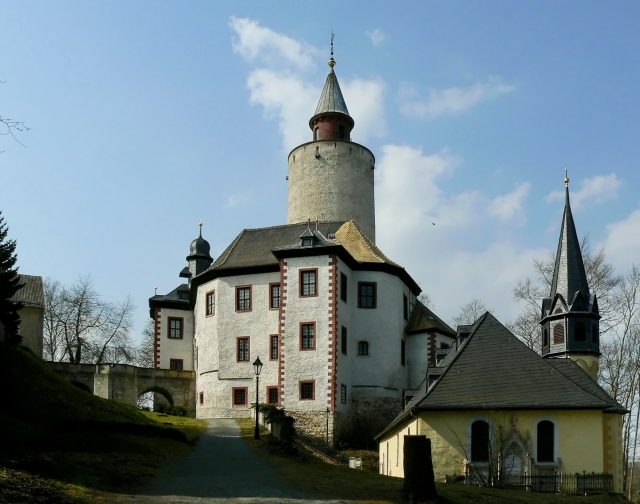
Posterstein Castle, also known as Stein, is a hilltop castle on a rocky outcrop above the right bank of the Sprotte in Posterstein in the Altenburger Land district of Thuringia. The hilltop castle emerged from a small ministerial castle from the late 12th century, which was rebuilt during the Renaissance period.

Through the Roman-German King Conrad III and Emperor Frederick I Barbarossa, the high medieval land development east of the Saale-Elbe line was promoted in the second half of the 12th century. During this time, a multitude of small lordships emerged, occupied by ministerials, some of whom were unfree servants. In 1143, a document from King Conrad III for the Benedictine monastery of Chemnitz mentions a Gerhardus de Nubudiz (Nöbdenitz) as a witness, along with other rulers from the Pleißenland, who appears several more times in documents in the following years. In 1191, he is mentioned in a document from the Bishop of Naumburg along with his mother Mechthild de Steinne (von Stein). The village of Nöbdenitz is about two kilometers from Posterstein. Older research, based on this mention, mostly assumed a fortified seat of power for the ministerial Gerhard in the lowlands near Nöbdenitz, which was supposedly abandoned a few years later in favor of a newly built hilltop castle. However, according to more recent archaeological and historical research, such lowland castles probably only emerged in the 13th and 14th centuries, so Posterstein Castle is likely the oldest seat of the family.

From 1222, the ministerials called themselves only "de lapide" (von Stein). The still-preserved curtain walls and the 12-meter-high round keep date from this period. A zwinger was later added to the eastern side of the curtain wall.

At the end of the 13th century, the Vögte of Weida succeeded in gaining feudal lordship over Posterstein. When the Reuss ancestral house split in 1305 into Reuss Elder Line (Plauen) and Reuss Younger Line (Greiz), Posterstein remained under the rule of the Younger Line. The Reuss thus opposed the efforts of the Wettin Margraves of Meissen to expand their rule in the Pleißenland. To counter the pressure from the Margraves, the Vögte offered the lordship of Posterstein as a fief to the King of Bohemia. Margrave Frederick the Serious then complained to the Emperor. The feudal lordship remained disputed until the 17th century. In the period after the Vogtland War (1354–1359), a large part of the Posterstein estates came under Meissen rule, while Posterstein itself remained a Vogt (Reuss) fief.

In 1442, Nickel Puster bought the lordship of Posterstein for 800 Schock Freiberg coins (In the "Altenburgische Kirchengalerie", the family "Puster zum Stein" is already mentioned as lords of Posterstein in 1329, when Heinrich the Elder, Vogt of Plauen, received the lordship of Posterstein as a fief from the Bohemian king). The family expanded the lordship through extensive clearings. Reconstruction work began on the castle to make it a more habitable complex. The eastern zwinger was built over with a residential building. The family gave the castle, known only as "Stein" until the 16th century, its current name.

In 1528, the Pflugk family bought the lordship of Posterstein. Under their rule, the medieval castle underwent a comprehensive transformation into a Renaissance residential palace. A visible sign of this construction phase is the spiral staircase from 1575. The curtain wall was demolished to the height of the current ground floor, the area in the core castle was filled in, and the new buildings were erected on this level.

Further renovations were carried out from 1684 to 1701. The upper floor was demolished and replaced by a half-timbered floor. The inner courtyard was vaulted and the baroque staircase was built. Furthermore, the facade was renewed with new windows, the stone bridge and the portal were created, so that the castle corresponded to the contemporary baroque style. At the same time (1689), the neighboring castle church was also decorated with magnificent baroque carvings. This work is attributed to Johannis Hopf, who was able to mitigate a criminal sentence with it. Little is known about his exact identity. From 1717 to 1724, the north wing was built.

After several changes of ownership – the castle belonged, among others, to the Brothers von Werder and the Imperial Count family von Flemming – the bourgeois Herrmann family acquired the Posterstein manor in 1833. Under them, the use of the castle for residential purposes was abandoned. In 1850, after negotiations between farmers and manor owners, corvée services were replaced by monetary payments. At the end of the 19th century, Posterstein became an important seed breeding and model estate in the Thuringian region. In this context, major renovations took place again around 1880. The writer Rudolf Ditzen, known as Hans Fallada, began an agricultural apprenticeship here in 1913. In 1937, renovation and securing work was carried out again.

In the course of the land reform in the Soviet occupation zone, the 192-hectare Posterstein manor was expropriated in 1946. Appeals by the last owner Herrmann and the residents remained unsuccessful. The order was given to divide it within 24 hours. The lordship of Posterstein ceased to exist. 20 new farmsteads were created. The castle and manor house housed up to 300 refugees from the eastern territories from the end of the war. At the end of the 1940s, the large manor barn and the modern cowshed were demolished. Using the salvaged demolition material, 20 new farmsteads were built, 13 of them on the castle hill. The manor house later became a consumer school, and from 1956 to 1992, a children's home. The stable became a residential building.

In 1951, the intact north wing was demolished, also for "obtaining building material". The roof and ground floor were removed, the basement with its cross vault was filled in. The remaining structure received a new, very weather-sensitive gable wall. After 1980, the cross vault collapsed, and since then the basement has also been a ruin. In 1952, a museum was established in the castle, but structural damage forced its closure in 1977. Only from 1984 to 1991 could the castle be extensively renovated. In 1999, the rubble was removed from the former cellar rooms and the remaining masonry was then secured.

The castle is freely accessible from the outside and can be visited. Exhibitions on the history of the region are shown in the baroque rooms. Here you will meet well-known personalities such as Thumbshirn, Seckendorff or Bernhard von Lindenau, but also farmers, castle lords and pioneers of industrialization.

A special exhibition complex is the exposition on the history of the Muse Court of Duchess Dorothea of Courland. This salon in the nearby Löbichau Castle was one of the most interesting of its kind around 1800. In 2011, for the 250th birthday of the Duchess of Courland, the exhibition >"Her appearance is very engaging and she dresses with taste." - The Duchess of Courland in the mirror of her contemporaries. European Salon Culture around 1800< will open. "The exhibition and the accompanying publication aim to show how women at the beginning of the 19th century succeeded in establishing social, political and cultural networks and using them to gain their own influence on the course of events. Using the example of Duchess Anna Dorothea of Courland, the emancipation efforts and the possibilities for women to participate in social life beyond the legal barriers of the time are to be highlighted. A focus is on the role of the female sex in shaping national and international relations during the Napoleonic era."

The museum visit includes the castle dungeon and the ascent of the 25-meter-high keep of the castle. From the platform of the tower, a fantastic view of the Altenburger Land is offered in all weathers. In addition, there are changing exhibitions several times a year in the museum's gallery.

Absolutely worth seeing is the late Gothic castle church with the unique baroque carvings by Johannis Hopf from 1689.

Take Mobile History with you

You are reading this text for free. Premium adds what matters on the road: descriptions read aloud, sites found through your camera, whole regions taken offline.

  • Every description, including the ~17,700 Premium sites
  • Audio guide: have descriptions read to you on location
  • AR finder: see sites through your camera, with distance and bearing
  • Unlimited saved sites

14 days free, then from €2.99 a month. Cancel anytime.

Source: Wikipedia · Licence: CC BY-SA 4.0 · Image: Thomas Eichler

This description draws on the facts documented in the linked Wikipedia article; Wikipedia content is licensed under CC BY-SA 4.0. Wording and editing: Mobile History.

Location: 50.8631, 12.2528