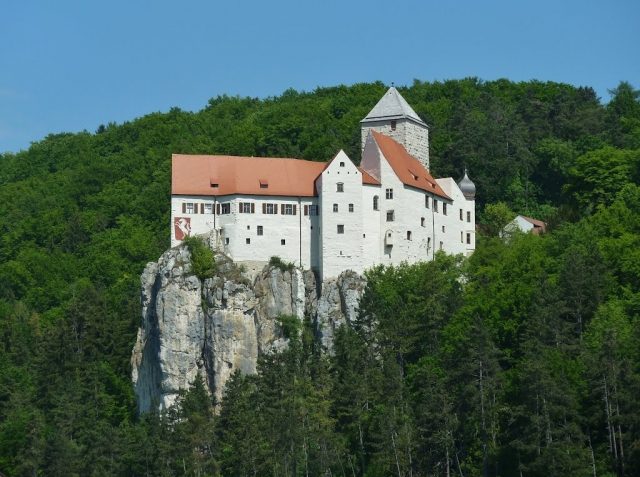
The Castle can be visited
Prunn Castle

Prunn Castle stands on a steeply sloping Jurassic limestone rock, about four kilometers southeast of the Lower Bavarian town of Riedenburg in the district of Kelheim.
The castle complex can be visited for a fee. From its courtyard, there is a good view over the Altmühl Valley with the Main-Danube Canal.
The oldest known owner was Wernherus de Prunne, who was first mentioned in a document along with his castle in 1037. In 1147, the castle passed to the Lords of Laaber from the Praiteneck side line, who initiated numerous construction activities. The oldest surviving building fabric, consisting of the keep and palas, dates back to them.
In 1288, the castle was sold to Duke Ludwig II of Bavaria, who returned it to the seller Wernherr von Praiteneck as a fief.
The mention of a Fraunberger zu Prunn house in 1311 suggests that Prunn Castle had changed hands in the early 14th century. In 1338, the complex was sold to the Fraunberger vom Haag family. They had the still visible "Gurrenwappen" (Gurren coat of arms) affixed to the southern facade facing the valley. Hans VI von Fraunberg had the complex extended in the late Gothic style between 1426 and 1476. When Wolf Fraunberger joined the Löwlerbund, Bavarian Duke Albrecht IV is said to have taken this as an opportunity to have his troops storm the castle in December 1491. If the storming actually took place, it must have happened without damage or even demolition of the castle, as there are no reports of reconstruction in the subsequent period.
In the 15th century, Prunn Castle was temporarily owned by the Gumppenberg family, but returned to the possession of the Fraunbergers. With the extinction of the House of Fraunberg vom Haag zu Prunn, the castle reverted to the Bavarian Duke, who sold it as early as 1570 for 18,000 guilders to Karl Köckh zu Mauerstetten and Bodenmais.
In 1567 or 1569, Wiguleus Hund, humanist and historian to Duke Albrecht V of Bavaria, found a manuscript of the Nibelungenlied, the so-called Prunn Codex, at the castle and presented it to his employer in 1575. The manuscript (BSB-Hss Cgm 31) is located in the Bavarian State Library in Munich.
The first surviving depiction of the castle complex dates from around 1600. Its south side can be seen on a border map of the Duchy of Pfalz-Neuburg. The Köckhs zu Mauerstetten extended the castle from 1604 with a new palace-like annex that connected the palas with the keep. The Romanesque curtain wall was used as the eastern outer wall of the new building.
Further renovation work followed in 1631 in the Renaissance style, with less emphasis on authenticity and more on comfort. An inscription and the alliance coat of arms of Christoph von Köckh zu Prunn and his wife Maria on the Gothic residential building bear witness to these works, which were mainly carried out internally. Prunn Castle increasingly took on a palace character during this period. Therefore, the name Prunn Palace is often used today, although the complex is clearly a castle due to its medieval origins and original building fabric.
The Thirty Years' War put an end to the financial prosperity of the Köckh family, and so the indebted Hofmark passed into the possession of Field Marshal Lieutenant Georg von Truckmiller in 1646, who had the damaged buildings repaired.
As early as 1672, another change of ownership took place: the Jesuits from Ingolstadt bought "castle and Hofmark". The order carried out further alterations and extensions to the existing buildings. After the dissolution of the Jesuit order in 1773, Prunn Castle was handed over to the Knights Hospitaller. However, their commandery was dissolved in 1822, whereupon the castle once again reverted to the Crown of Bavaria.
In 1827, King Ludwig I of Bavaria, in the era of Romanticism, championed the preservation of the castle complex as a historical monument by having safety work carried out. Further renovation measures followed at the end of the 19th century. Nevertheless, the complex fell into disrepair.
In 1919, a scout meeting took place, which, through the Prunn Vow of the New Scouts, became formative for the entire scout movement in Germany.
In 1946, the castle came into the possession of the Bavarian Administration of State Palaces, Gardens and Lakes. They had restoration work carried out in 1950/51. Late Gothic features were restored, and numerous architectural elements from the 19th century were removed. Occasionally, traces of plaster with imitated mortar joints were discovered.
Description+
The castle stands on a rock plateau, separated from the mountain on the north side by a 20-meter wide and 9-meter deep neck ditch. On the opposite side, there used to be an outer bailey. To protect against attacks from the elevated mountain side, the Romanesque keep from the 13th century served in the north of the complex. It rises on a square floor plan with a side length of six meters and is 31 meters high. Its floors are topped by a shingle-covered tent roof, which was added to the tower later and replaced the former battlements. The ashlar walls of limestone have a thickness of three meters in the lower area and taper upwards to 2.5 meters. On the west side, the former high entrance of the keep can still be seen on the second floor.
The arrangement of the other buildings of the castle is dictated by the layout of the narrow rock plateau and is therefore very irregular. West of the keep, there is a gatehouse with a guardroom on the ground floor and a women's chamber as well as the so-called women's kitchen on the upper floor. East of the keep stands a small building with the so-called drinking room on the upper floor. Like the gatehouse, it has a small oriel turret at the corner with window and door frames made of green sandstone and a curved hood as a roof.
The inner courtyard of the castle, with its draw well carved into the rock, is enclosed on the west by a wall that was formerly considerably higher and was only removed in the 19th century. In the northwestern corner of the courtyard stands a polygonal stair tower from the early 17th century. Its stone spiral staircase inside provides access to the upper floor of the Köckh gatehouse. In its lintel are the coats of arms of the Köckh and Lerchenfeld families.
On its southeastern side, the originally Romanesque palas with a large Gothic hall on the ground floor borders the castle courtyard. In a tower-like structure projecting from the outer wall, there is another guardroom, where fragments of frescoes and oxblood paintings on the ceiling beams from the 14th century can be seen. In the northern part of the palas is the Prunn Castle Chapel, which the Jesuit order had redesigned in the Rococo style around 1700. It probably goes back to a Romanesque predecessor at the same location. This is presumed to be in the vault under the present chapel. The eastern outer wall of the rectangular room is formed by the former curtain wall. There, flanked by two high round-arched windows, stands the altar, whose Baroque structure is adorned with opulent carving of acanthus ornaments. In addition to two carved figures of Saint James and Saint Christopher, the predella of the altar features six small relief figures from around 1500. They probably come from the altar of the predecessor chapel. The current room has a stuccoed flat ceiling and a gallery on the western narrow side.
Miscellaneous+
Climbing is permitted on the rock below the castle. There are twelve routes in the rock, some with somewhat challenging protection, up to difficulty level 9 (UIAA). Due to bird breeding, the rock is closed annually from February 1st to June 30th.
The youth film TKKG - Drachenauge was filmed at the castle in 1992. In the film, the castle served as the backdrop for Knight Albrecht von Zehrenstein's "Schreckensburg" (Castle of Terror).
Take Mobile History with you
You are reading this text for free. Premium adds what matters on the road: descriptions read aloud, sites found through your camera, whole regions taken offline.
- Every description, including the ~17,700 Premium sites
- Audio guide: have descriptions read to you on location
- AR finder: see sites through your camera, with distance and bearing
- Unlimited saved sites
14 days free, then from €2.99 a month. Cancel anytime.
Source: Wikipedia · Licence: CC BY-SA 4.0 · Image: Reinhold Schulz
This description draws on the facts documented in the linked Wikipedia article; Wikipedia content is licensed under CC BY-SA 4.0. Wording and editing: Mobile History.
Location: 48.9503, 11.7396