CastleRappottenstein

Rappottenstein Castle
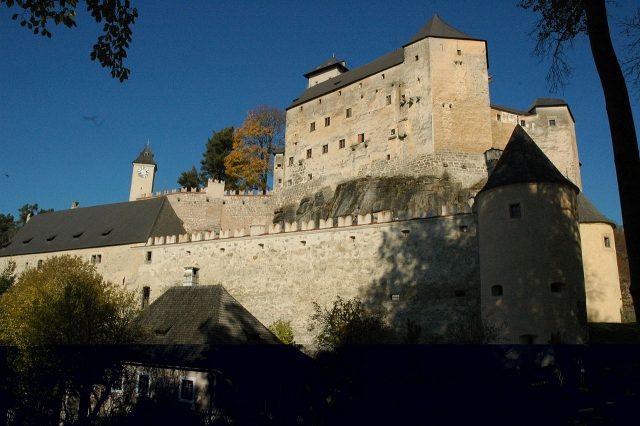
Rappottenstein Castle

To be privately owned


Rappottenstein Castle is a medieval castle in Rappottenstein in the northwest of Lower Austria. The castle was never conquered and is therefore one of the best-preserved castles in Austria.

Around 1150, Rapoto von Kuenring founded a series of castles in the Waldviertel to secure the Kuenring family's possessions, the most powerful of which was Rappottenstein.

Rappottenstein Castle was of great importance from the very beginning. On the one hand, it lay in the middle of the extensive possessions of the Kuenring family – making it a stable center in a turbulent time. On the other hand, it also protected an ancient side branch of the Peheimsteig, still traceable in the municipality today, which led from the Danube through the Nordwald into Bohemian lands. Furthermore, Rappottenstein Castle formed one of the strongest links in the chain of fortifications along the Kamp river, whose task was to protect the land from Bohemian invasions and thus also provide flank protection for the Babenberg March.

After the fall of the Kuenring family, the castle passed to the Lords of Dachsberg in 1305, to the Starhemberg family in 1423, and to the Lords of Landau in 1546. Rebellious peasants besieged the castle in 1597 but could not capture it. Swedish troops also besieged the castle in vain in 1645.

Finally, in 1664, the castle was acquired by purchase by the current owners, the Counts Abensperg-Traun, whose current possessions are located around Rappottenstein, near Wolkersdorf, near Maissau, in the Weinviertel, in the Waldviertel, and in the Industrieviertel, with Maissau and Petronell being particularly noteworthy here.

Architecture+

The castle is one of the few that was never conquered and therefore never destroyed. It is a unique testament to medieval fortifications with architectural elements from the Romanesque, Gothic, and Renaissance periods:

  • Romanesque: Tower in the south
  • Gothic: Parts of the east wing, castle chapel, Knights' Hall in the east wing, Knights' Kitchen, and archive room
  • Renaissance: Brewhouse, arcades in the west wing, two towers at the entrance gate. These two towers feature a double defensive oriel as a rarity. Most of the castle's gates were once secured by drawbridges.

The brewhouse in the first courtyard features several windows with sgraffito surrounds. The second gate was the main entrance until 1548. In the third courtyard are the farm building, a cistern, and the legendary dungeon with the "Hunger Tower." The inner courtyard is bordered on the west by three-story Renaissance arcades, on the east and south by the Knights' Hall, and on the north by the Knights' Kitchen. In the east of the courtyard, on the first floor, are two late Gothic windows. The "Archive" has a Gothic star vault and frescoes from the "Danube School."

To the north of the castle is a garden terrace with the clock tower featuring a pendulum clock. The striking feature of this clock is that it only has an hour hand. The weights are wound daily.

Castle Chapel

The Gothic castle chapel was consecrated in 1379. It is two stories high and has walls three meters thick. There are twelve consecration crosses on the walls. The vault ribs rest on beautiful consoles. The winged altar dates from the 15th century and was restored in 1947.

Exhibits in other locations

Some items from Rappottenstein Castle can now be seen in other locations: For example, in the "Luisenzimmer" of Franzensburg in Laxenburg, a ceiling, both door linings, and the doors from Rappottenstein dating from around 1600 are on display.

Current Use+

Under the name Kinderburg Rappottenstein (Children's Castle Rappottenstein), the Red Cross Lower Austria offers support to traumatized families in cases of accidents or bereavement. The premises, as well as the stables for therapy animals, are provided by the owner family Abensperg und Traun.

On Television+

In the show "Die Burg – Prominent im Kettenhemd" (The Castle – Celebrity in Chainmail) on ProSieben, viewers were shown, using the interior of Rappottenstein Castle, how people lived in a castle in the Middle Ages. The show was hosted in 2005 by Sonya Kraus and Elton. Parts of the film "Die Wanderhure" (The Wandering Whore) were filmed at the castle.

Take Mobile History with you

You are reading this text for free. Premium adds what matters on the road: descriptions read aloud, sites found through your camera, whole regions taken offline.

  • Every description, including the ~17,700 Premium sites
  • Audio guide: have descriptions read to you on location
  • AR finder: see sites through your camera, with distance and bearing
  • Unlimited saved sites

14 days free, then from €2.99 a month. Cancel anytime.

Source: Wikipedia · Licence: CC BY-SA 4.0 · Image: http://commons.wikimedia.org/wiki/File:2005-10-18_Rapottenstein.JPG?uselang=de

This description draws on the facts documented in the linked Wikipedia article; Wikipedia content is licensed under CC BY-SA 4.0. Wording and editing: Mobile History.

Location: 48.5119, 15.0881