CastleReipoltskirchen

Reipoltskirchen Castle
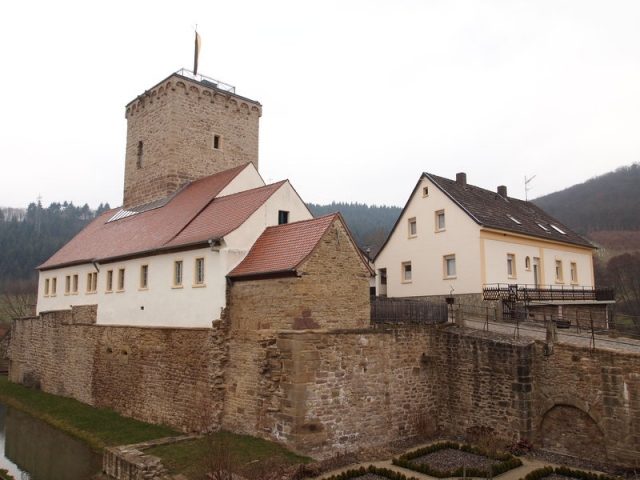
Reipoltskirchen Castle

Paint School

Reipoltskirchen Water Castle is a water castle in the municipality of Reipoltskirchen in the district of Kusel in Rhineland-Palatinate. It is considered the best-preserved water castle in the Palatinate.

The castle is located at 208 meters above sea level in the village on an artificial hill by the Odenbach stream.

As early as 1198, Meffried von Reipoltskirchen is mentioned as the first nobleman, suggesting the castle might have existed at that time. However, the first confirmed mention of a castle in Reipoltskirchen only occurred in a document from 1276, when the castle fell into the hands of Philipp von Hohenfels. The von Hohenfels family originated from a collateral line of the Lords of Bolanden, who later also called themselves "Lords of Reipoltskirchen". When the ancestral castle of the von Hohenfels was destroyed in 1351, they moved their main residence to Reipoltskirchen.

In 1401, Nikolaus Vogt von Hunolstein used the castle, which was in the possession of his wife Ida von Erbach, as a base during a military conflict with Duke Charles of Lorraine. However, the Duke captured the castle.

At the beginning of the 16th century, the castle was expanded by Johann II von Hohenfels to be suitable for firearms. The von Hohenfels family died out with Johann III in 1602. Through inheritance, the complex passed to the Swedish Count von Löwenhaupt.

In 1777, the property was divided between Count Wilhelm Ernst Gottfried von Hillesheim and Princess Karoline von Isenburg, a daughter of the Palatine Elector Karl Theodor. In 1797, the property was expropriated as part of the French occupation. On November 30, 1808, the castle grounds with its buildings were auctioned off to the mayor of Lauterecken, Karl Baumann, the merchant Heinrich Puricelli, and the farmer Johann Bacher. A short time later, in 1836, the buildings were described as ruinous because they were partly used as a quarry. Around 1830, the Speyer district archivist Peter Gayer (1793-1836) recorded the condition at that time in a sepia drawing, the oldest known image of the castle.

The largest part of the core complex was acquired by the district of Kusel in 1988. It was renovated in 2005 with extensive restoration measures. Today, it houses a restaurant, a registry office, and an art school. The keep is freely accessible.

Complex+

Of the sandstone-built castle, the 17-meter-high keep and the curtain walls are still preserved. The rooms, which have been expanded since the 1970s, are now used as an art school.

Take Mobile History with you

You are reading this text for free. Premium adds what matters on the road: descriptions read aloud, sites found through your camera, whole regions taken offline.

  • Every description, including the ~17,700 Premium sites
  • Audio guide: have descriptions read to you on location
  • AR finder: see sites through your camera, with distance and bearing
  • Unlimited saved sites

14 days free, then from €2.99 a month. Cancel anytime.

Source: Wikipedia · Licence: CC BY-SA 4.0 · Image: http://www.wehrbauten.de/thread.php?threadid=1347

This description draws on the facts documented in the linked Wikipedia article; Wikipedia content is licensed under CC BY-SA 4.0. Wording and editing: Mobile History.

Location: 49.6351, 7.6635