CastleRiom

Riom Castle

Riom Castle

The Castle can be visited

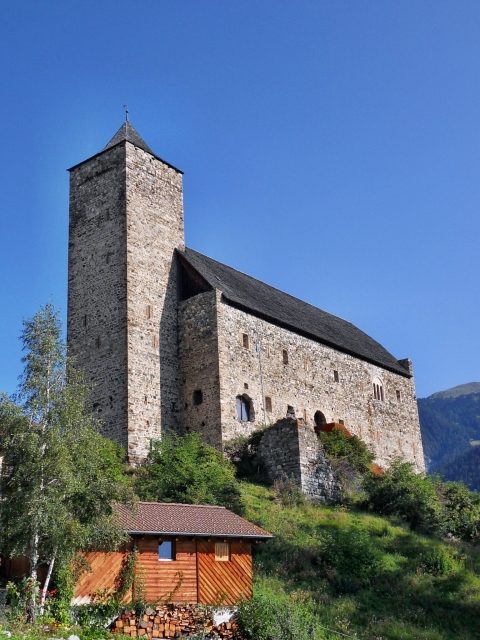
Riom Castle (Rhaeto-Romanic Casti da Riom) stands on an elongated spur below the village of Riom in the municipality of Riom-Parsonz in Oberhalbstein in the canton of Graubünden, Switzerland. Riom is one of the most important castle complexes in Graubünden and is protected by the canton and the Swiss Confederation.

Complex+

The main wing consists of a slender tower and a massive palas. The tower has a square footprint of 7 meters per side, while the palas measures 12 by 34 meters. The 28-meter-high tower is connected to the palas up to the 3rd floor and is lit by narrow arrow slits. Approximately 1 meter below the top of the wall, remnants of a plate cornice can be found. The interior is not habitable; presumably, the tower served only for representational purposes.

The palas of Riom Castle is the largest secular building of the late Middle Ages in Graubünden. It was built with two stories and shortly thereafter extended by one floor. Originally, it was crowned by battlements that overlooked a flat gable roof. The current roof is of more recent date but is a replica of an early modern construction. In front of the old high entrance on the 2nd floor was a 4-meter-long balcony, accessible via an external staircase. Inside, remnants of two fireplace systems, an oven, and two latrine bay windows are preserved. To the south are remnants of a curtain wall. The wall has slipped to the north, where the gate system is also presumed to have been. On the inside, some multi-story buildings were leaned against it.

In the middle of the 9th century, a royal court stood in Riom, which Emperor Arnulf of Carinthia gifted to a certain Ruotpert, who in turn exchanged it with Lorsch Abbey in 904. How the court came into the possession of the Lords of Wangen-Burgeis from Vinschgau is unknown. They are credited with the construction of Riom Castle around 1240 on the former royal court. The Bishopric of Chur would not accept this independent lordship, as it would have cut off the bishop from the route over the Julier Pass and his possessions in the Engadin. In 1258, probably under pressure, Berall von Wangen-Burgeis sold the castle, his possessions in Oberhalbstein and Chur for 300 marks to his cousin, the Bishop of Chur. For this, the bishop presumably borrowed money from the Vaz family and pledged Riom Castle; the pledge was only dissolved in 1275.

From 1258, the castle was in the possession of the Bishopric of Chur and henceforth served as the seat of the bailiffs who exercised high jurisdiction in Oberhalbstein. From the beginning of the 14th century, the Lords of Marmels held the bailiwick, for which they had to keep the castle open to the bishop. In 1410, Riom is listed in the "Buoch der Vestinen" (Book of Fortresses).

In the 14th and 15th centuries, the castle was repeatedly pledged. In 1473, Rigett von Fontana received the castle from the bishop as a fief, after he had paid the redemption sum to the then pledge holder Hans von Sal. In 1492, Bishop Heinrich granted the castle to Benedikt Fontana, the leader of the Graubünden troops in the Battle of Calven.

In 1552, the valley bought itself free from the episcopal sovereign rights. Until the 18th century, the Landsgemeinde (cantonal assembly) still met in the castle, otherwise, it was uninhabited after the 16th century. In 1867, the roof was removed to use the beams to rebuild the burned-down village of Riom, and a year later, the internal floor structures were removed. According to Anton von Castelmur, the documents from the castle's archive served women as lining for their bonnets or were used by children for play. Thereafter, rapid decay set in. Until the 19th century, the castle was still occasionally used as a prison.

Modern Era

In 1936, the Swiss Castle Association under Eugen Probst undertook initial conservation measures. In 1973, the roof was re-covered.

In 2006, Riom Castle was converted into a theater with 220 seats by the Chur architect Marcel Liesch for 1.3 million. All constructions were carried out reversibly and hardly affect the historical substance. All interventions were accompanied by the monument preservation and the archaeological service of the Canton of Graubünden.

Since 2006, the Origen Festival Cultural, one of the largest cultural events in the Rhaeto-Romanic area of the canton, has taken place annually at Riom Castle. Within the castle walls, jackdaws nest in one of the largest colonies in Switzerland.

Take Mobile History with you

You are reading this text for free. Premium adds what matters on the road: descriptions read aloud, sites found through your camera, whole regions taken offline.

  • Every description, including the ~17,700 Premium sites
  • Audio guide: have descriptions read to you on location
  • AR finder: see sites through your camera, with distance and bearing
  • Unlimited saved sites

14 days free, then from €2.99 a month. Cancel anytime.

Source: Wikipedia · Licence: CC BY-SA 4.0

This description draws on the facts documented in the linked Wikipedia article; Wikipedia content is licensed under CC BY-SA 4.0. Wording and editing: Mobile History.

Location: 46.6092, 9.5843