Cultural Events
The Castle can be visited
Rode Castle

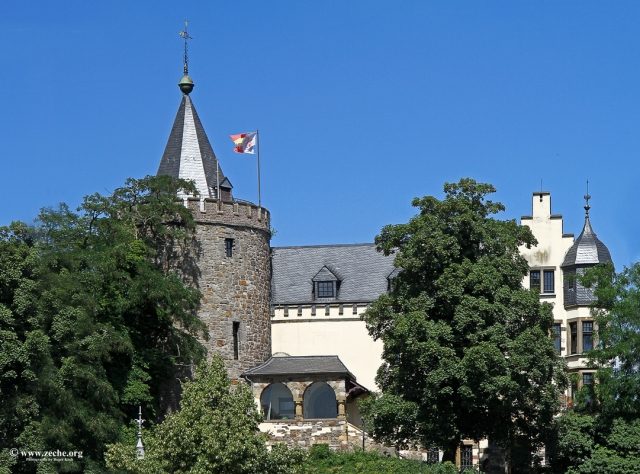
Rode Castle is a hilltop castle in the city center of Herzogenrath in the Aachen city region. It is located only a few hundred meters from the border to the neighboring Dutch town of Kerkrade. The association "Burg Rode Herzogenrath e.V." organizes regular events such as concerts, dialect evenings, exhibitions, and cabaret in the castle. The traditional castle festival takes place in June. Furthermore, castle tours are offered, and the Herzogenrath registry office regularly conducts weddings there.
In 1104, Herzogenrath was first mentioned in a document in the Annales Rodenses of Rolduc Abbey as a castle settlement of the Counts of Saffenberg, "Castrensis Viculis". The castle is both a border fortress and a customs castle. It came into the Duchy of Limburg as a dowry through the marriage of Mathilda von Saffenberg in 1136. The banks of the Wurm river not only formed the imperial border but also the diocesan border. For example, around 1136, the area of the Wurm riverbank on the castle side belonged to the Diocese of Liège, while the parish of Afden in the lower town belonged to the Archdiocese of Cologne. In Roman times, the Via Belgica, which quickly became an important trade route, ran past Herzogenrath at the height of today's town hall. This route ran from Cologne via Herzogenrath, Heerlen, Maastricht, Tongeren to Boulogne sur Mer or Amiens. In the early Middle Ages, the old route via Übach-Palenberg was abandoned and instead rerouted through Herzogenrath.
The importance of the customs post in Herzogenrath can be seen from two factors: firstly, Rolduc Abbey, which is located directly next to the Rode fortress, became the ancestral church of the Dukes of Limburg; secondly, tax lists from the Duchy of Brabant still exist today, providing information about imperial revenues. These also show that over 3300 gold guilders per year were generated in Herzogenrath, which exceeded the other customs posts in the country by more than tenfold.
Especially in view of the Battle of Worringen in 1288, it can be assumed that the customs post in Herzogenrath played a significant role in the Limburg War of Succession. This thesis is mainly advocated by Johannes Becker and Stefan Becker of the Burg Rode Verein, who cite, among other things, the efforts made by the Brabanters to capture Rode Castle in the run-up to the Battle of Worringen as evidence. They attempted to capture Rode Castle several times, most recently in 1283. After all efforts to capture the heavily fortified stronghold itself had failed, the succession dispute over the House of Limburg brought a fortunate turn for the Brabanters. In addition, Johannes and Stefan Becker refer to the aforementioned customs revenues during the Brabant period, which clearly showed how enormously important the customs site was for its respective owner. The expansion stages of the castle into a first-class fortress also speak for the importance of the castle.
In 1282, the name Herzogenrath was first documented under the designation "s'Hertogenrode" ("the Duke's clearing"). After the end of the Duchy of Limburg and the associated Battle of Worringen, Rode Castle passed into the possession of the Dukes of Brabant. The lords and drosts of Herzogenrath were also the lords of Alsdorf Castle.
In 1150, the first knight, Gottfried von Lovenberg, the husband of Adelheidis von Merode, was mentioned in a document. In 1229, Knight Harper von Lovenberg, "dictus Mule castelanus ostri et dapifer de Rode", was burgrave and drost of the Brabant region of Herzogenrath; from 1320 to 1342, a Harper, Mule von Lovenberg.
Temporarily leased to the Duchy of Jülich, the castle belonged to the Habsburg Netherlands for 250 years from 1544 until the French occupation in 1794.
With the drawing of the border by the Congress of Vienna in 1815, Rode Castle fell to Prussia and was separated from Kerkrade and Rolduc Abbey for the first time. Today, the national border, which was originally located on the outskirts of Herzogenrath, runs between the cities of Kerkrade and Herzogenrath.
The castle, which was restored in historicizing forms in the 20th century, served as the town hall of Herzogenrath between 1913 and 1978.
Take Mobile History with you
You are reading this text for free. Premium adds what matters on the road: descriptions read aloud, sites found through your camera, whole regions taken offline.
- Every description, including the ~17,700 Premium sites
- Audio guide: have descriptions read to you on location
- AR finder: see sites through your camera, with distance and bearing
- Unlimited saved sites
14 days free, then from €2.99 a month. Cancel anytime.
Source: Wikipedia · Licence: CC BY-SA 4.0 · Image: http://www.zeche.org/
This description draws on the facts documented in the linked Wikipedia article; Wikipedia content is licensed under CC BY-SA 4.0. Wording and editing: Mobile History.
Location: 50.8669, 6.0900