CastleRogätz

Rogätz Castle

Rogätz Castle

Museum

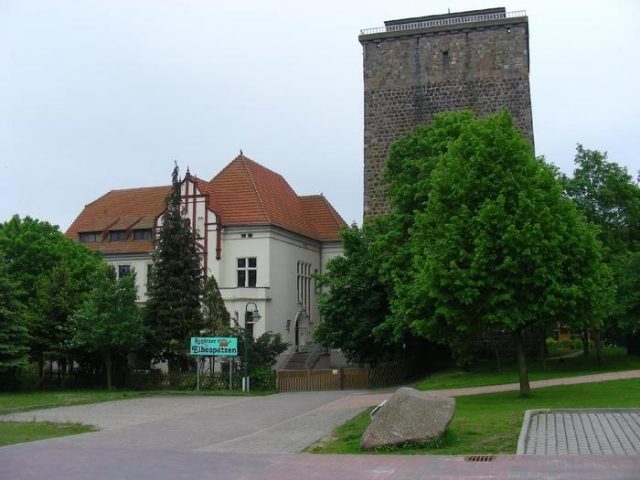
Rogätz Castle in Rogätz in the district of Börde in present-day Saxony-Anhalt was a strategically important location on the western bank of the Elbe between Magdeburg and Tangermünde. It was owned by the von Alvensleben family from 1369 to 1850.

Rogätz is situated on the western steep bank of the Elbe, above the confluence of the Ohre, halfway between Magdeburg and Tangermünde, the former residence of Emperor Charles IV and the first Brandenburg Hohenzollerns. As the only remnant of Rogätz Castle, which arose under the Saxon emperors in the 10th century as a border bulwark against the Slavs, the Klutturm, a primeval monument, now towers over river and land. The first document about the place dates from 1144, in which King Conrad III confirmed that Count Otto of Hillersleben gifted the village of Rogätz to the Bishop of Havelberg. In the following years, sovereignty over the castle remained disputed between the Margraves of Brandenburg and the Archbishops of Magdeburg, until it was finally awarded to the Archbishopric of Magdeburg in the Treaty of Zinna in 1449.

Rogätz under Alvensleben Rule+

In 1369, Archbishop Albrecht sold the castle and lordship to the Alvensleben of the Red Line. The associated feudal possessions lay in and around Magdeburg on both banks of the Elbe and comprised significant parts of the Colbitz-Letzlinger forest districts. In 1516, Rogätz owned property and rights in 54 localities. A customs and staple right belonging to the castle stipulated that every ship had to pay its customs duty at a chain stretched across the Elbe, and furthermore that goods had to be unloaded and offered for sale here. The legend of the golden chain, which is said to entwine the tower foundation, commemorates this. In 1553, the Red Line of the Alvensleben died out and Rogätz fell to the Black Line. A generous expansion of the castle took place, which from 1570–1582, under the humanist Joachim I von Alvensleben, experienced a flourishing period of humanist culture within its walls, similar to the neighboring Erxleben. During the Thirty Years' War in 1625, the Imperial forces conquered the castle, which was then recaptured the following year by the Danes under General Fuchs and Ernst von Mansfeld. In the process, the buildings, except for the Klutturm, went up in flames. The castle was not rebuilt. The administration of the Rogätz lordship, which was mostly in the joint possession of several houses of the von Alvensleben family, was carried out by bailiffs until 1796. In that year, Werner Friedrich Udo von Alvensleben (1775–1807) took over the property as sole heir and, after his marriage in 1797, moved to Rogätz. However, he died at the age of 32, leaving behind two underage sons. The heir sold the estate in 1850 to Count Schwerin-Putzar, who in turn sold it in 1871 to Reinhold Himburg, who was succeeded by his son-in-law Julius Schwechten († 1917). In 1898, a new manor house was built. The last owner from 1918 until the land reform in 1945 was the manufacturer Carl Still. From March 1, 1943, until the end of the war, the married couple Max Planck, who lived in Berlin, found accommodation on the estate – at Still's invitation.

Reconstruction Image+

The destruction of the Thirty Years' War was so extensive that the appearance of the four-winged Renaissance castle and the other castle buildings can no longer be ascertained. It can be assumed with certainty that Rogätz architecturally resembled the neighboring, archiepiscopal Wolmirstedt Castle, which was expanded at approximately the same time and of which a view from 1655 exists. The reconstruction image created in 1935 by Anco Wigboldus depicts the state around 1895 – i.e., without the manor house built in 1898 next to the keep and after its fire in 1893. The background shows the confluence of the Ohre into the Elbe; in the distance, the cities of Burg and Magdeburg: a majestic landscape. The remains of the fortifications on the river side are not visible. The space of the upper and outer bailey is occupied by the farmyards. The tower of the former castle chapel, which became the village's parish church with the introduction of the Reformation in 1558, dates with its Baroque dome from 1700. Inside, gravestones and an elaborate baptismal font commemorate the former lords, who still live on in ghost stories and legends.

Take Mobile History with you

You are reading this text for free. Premium adds what matters on the road: descriptions read aloud, sites found through your camera, whole regions taken offline.

  • Every description, including the ~17,700 Premium sites
  • Audio guide: have descriptions read to you on location
  • AR finder: see sites through your camera, with distance and bearing
  • Unlimited saved sites

14 days free, then from €2.99 a month. Cancel anytime.

Source: Wikipedia · Licence: CC BY-SA 4.0 · Image: http://www.wehrbauten.de/thread.php?threadid=893

This description draws on the facts documented in the linked Wikipedia article; Wikipedia content is licensed under CC BY-SA 4.0. Wording and editing: Mobile History.

Location: 52.3114, 11.7637