Christian Education and Conference Center
CastleRothenfels
Rothenfels Castle
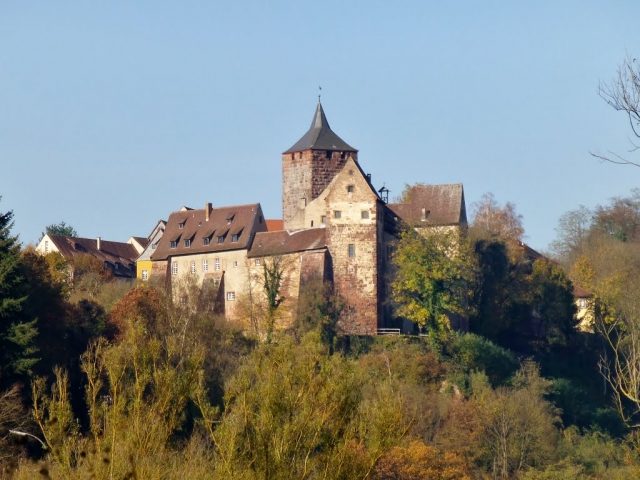
Rothenfels Castle is a youth and adult education center and youth castle above the Lower Franconian town of Rothenfels in the Bavarian district of Main-Spessart in Germany.
The hilltop castle was built over 850 years ago with its mighty keep high above the Main. Today, it is not only a popular excursion destination between Würzburg and Aschaffenburg, but above all a Christian educational and conference center under independent sponsorship.
History+
From 1150 to 1919+
The oldest parts of the castle date back to 1150, founded by Markward II von Grumbach (documented since about 1120, † February 9, 1171). After the original noble family of Grumbach died out in 1243 with Albert von Grumbach, Lord of Rothenfels, Rothenfels Castle passed to the Counts of Rieneck through his daughter Adelheid, who was married to Count Ludwig von Rieneck. They in turn sold the castle in 1328 to the ministerial family of Wolfskeel, who, however, already sold it in 1333 to the Prince-Bishopric of Würzburg (see Amt Rothenfels) and moved to Burggrumbach Castle. The line of the Wolfskeels residing there henceforth called themselves Wolfskeel von Grumbach and later, like the original owners, simply Lords of Grumbach. During the secularization in 1803, the Würzburg office of Rothenfels fell to the princely house of Löwenstein-Wertheim-Rosenberg, in 1806 through mediatization to the Principality of Aschaffenburg, and in 1813 to the Kingdom of Bavaria. The castle remained in the possession of the prince, but was of little use to him, inhabited by some farmers, occupied by cattle stalls, and primarily used as a storage for crops and wine.
Since 1919+
The history of Rothenfels Castle as a Christian educational center began in 1919 with the sale of the castle by the princely house of Löwenstein to the Quickborn. The castle became known beyond the borders of Bavaria through the work of the famous theologian Romano Guardini (1885–1968), who was the castle director from 1927 to 1939. From 1924 to 1940, Rudolf Schwarz worked as the castle architect. Under Guardini's leadership, the castle chapel became the heart of the Liturgical Movement, which anticipated essential ideas of the Second Vatican Council.
After the purchase of Rothenfels Castle by the Quickborn in February 1919, Klemens Neumann and many volunteers prepared the castle for the First German Quickborn Day in August 1919. The Quickborn Days, which then took place annually, made Rothenfels Castle known as a place where boys and girls, young women and men jointly organized work weeks from a Christian spirit and tried out new ways, especially in worship design, scripture reading, community life, music, and dance. The furnishing of the chapel with (still existing today) sacred objects was entrusted under Schwarz's direction to a "working group" of teachers and students from the Aachen School of Applied Arts, namely Fritz Schwerdt for the large sanctuary lamp, Anton Schickel and Fritz Schwerdt for the small crucifix, and Hein Minkenberg for the associated ivory corpus. The designs for the altar, altar candlesticks, and tabernacle – predominantly with nailed silver sheet – came from Rudolf Schwarz himself, while Anton Schickel carried out the execution. The fruitful work for pedagogy, the Liturgical Movement, and the peace movement at Rothenfels Castle, violently interrupted by the confiscation of Rothenfels Castle in August 1939, was continued after the war under the direction of the Munich Oratorian Heinrich Kahlefeld and attracted many people with its Easter and Pentecost conferences, work weeks for young people of all backgrounds, and other events. From 1959, the castle management consisted of Heinrich Fleckenstein, Würzburg; Bernhard Casper, Freiburg; and Bruno Leuschner, Schlüchtern. In the sixties, the castle council was established, an advisory body responsible for the castle's educational work, consisting of nine honorary members. Since then, there has also been a full-time educational officer, including Hanna-Barbara Gerl-Falkovitz (1975 to 1984), Ludger Bradenbrink (1986 to 1995), Joachim Hake (1995 to 2006), Achim Budde (2007 to 2018), and from 2019 Philip Fuhrmann (also head of the VHS-Akademie Burg Rothenfels). Honorary castle chaplains were Rolf Zerfaß, Würzburg, from 1983 to 1991, Gotthard Fuchs, Wiesbaden, from 1996 to 2018, and since Pentecost 2018, Joachim Negel, Fribourg/Switzerland.
Sponsor of the Castle+
As the legal entity of the Quickborn Federation, the Association of Quickborn Friends e. V. was registered in the association register at the Lohr District Court on November 20, 1917. It bought Rothenfels Castle from the Prince of Löwenstein on February 21, 1919. The first chairman was Bernhard Strehler, prefect in Neisse, from 1925 Rector Josef Emonds, Dormagen, from 1927 Rolf Ammann, Cannstatt. Rothenfels Castle was the first youth castle to emerge from the German Youth Movement. Especially the castle director Romano Guardini wanted to clarify through a change of the association's name that Rothenfels Castle wanted to appeal not only to Quickborn members, but to all open-minded Christians. With the statutes of August 27, 1933, the association renamed itself "Association of Friends of Rothenfels Castle e.
Source: Wikipedia · Licence: CC BY-SA 4.0 · Image: Reinhold Schulz
This description is a machine translation of an excerpt from the linked Wikipedia article. The source text was written by its authors, the translation is by Mobile History; like the original it is licensed under CC BY-SA 4.0.
Location: 49.8922, 9.5894