To be privately owned
Vineyard
Schaubeck Castle

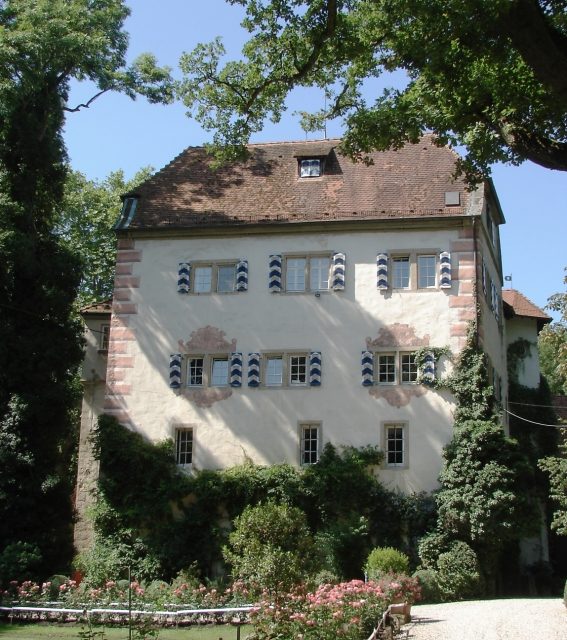
Schaubeck Castle is a hilltop castle built from the 13th century onwards and expanded into a palace, located between Steinheim an der Murr and Kleinbottwar in the Ludwigsburg district of Baden-Württemberg. The castle, privately owned by the Graf Adelmann family, is also the seat of the Graf Adelmann winery.
The first documented mention dates back to 1272, when the ministeriales Bertold and Konrad von Schaubeck, Baden liegemen and marshals of Besigheim am Neckar, began to build the castle on a steep slope on the remains of a Roman country house. Only remnants of walls and foundations of the former tower complex are still visible; a clear depression suggests that there was a moat around the castle.
In 1392, the castle, along with the associated village of Kleinbottwar, was sold to Hans Urbach. Before Georg von Nippenburg took over the castle, the Truchsessen von Stetten were briefly owners of the castle in 1435. After Nippenburg's son-in-law Dietrich von Plieningen was enfeoffed with Schaubeck Castle and half of the court and Vogtship over Kleinbottwar by Count Eberhard V of Württemberg on December 20, 1480, he began the conversions to a palace, which lasted until 1642. Representative purposes and living comfort were presumably at the center of the conversion. A wall from the time before the conversion, which could have belonged to the outer bailey, has been preserved. Only the core castle and the striking stair tower are verifiable and well preserved. Despite the conversions, the defensive character of the castle has been preserved to this day; for example, windows are missing on the lower floors. Inside the complex, the conversion measures created an inner courtyard, framed by ornate half-timbered facades.
In 1645, the male line of the Lords of Plieningen died out. Through the daughters of the Plieningers, the Lords of Gaisberg came into possession of the castle, who resold it to the Lords of Kniestedt zu Heutingsheim and Rübgarten. The striking north and west facades with the painted corner blocks in red and violet were created between 1749 and 1765. Elements of the Renaissance and Baroque characterize the appearance of the palace.
The Kniestedt-Schaubeck family died out with Carl Freiherr von Kniestedt-Schaubeck in 1853, and the castle subsequently fell to Felix Freiherr von Brusselle. Through his daughter Sophie, the castle passed to the Adelmann von Adelmannsfelden family in 1877. In 1914, it was inherited by the Graf Adelmann family. Raban Graf Adelmann extensively renovated it in 1935 and expanded it into a residence. The castle is in a good state of preservation today and is inhabited by the family of the Counts Adelmann. Wine sales in the castle are publicly accessible. The park is only accessible to the public during certain events, such as the biennial Wine and Culture Days.
Viticulture at Schaubeck Castle+
Wine cultivation in Kleinbottwar can be traced back to the year 950. Viticulture at Schaubeck Castle is first mentioned in a document from 1297. Since 1914, the winery at Schaubeck has operated as Weingut Graf Adelmann.
Take Mobile History with you
You are reading this text for free. Premium adds what matters on the road: descriptions read aloud, sites found through your camera, whole regions taken offline.
- Every description, including the ~17,700 Premium sites
- Audio guide: have descriptions read to you on location
- AR finder: see sites through your camera, with distance and bearing
- Unlimited saved sites
14 days free, then from €2.99 a month. Cancel anytime.
Source: Wikipedia · Licence: CC BY-SA 4.0 · Image: http://de.wikipedia.org/wiki/Datei:Schaubeck.jpg
This description draws on the facts documented in the linked Wikipedia article; Wikipedia content is licensed under CC BY-SA 4.0. Wording and editing: Mobile History.
Location: 48.9738, 9.2897