To be privately owned
Scheventorf Castle

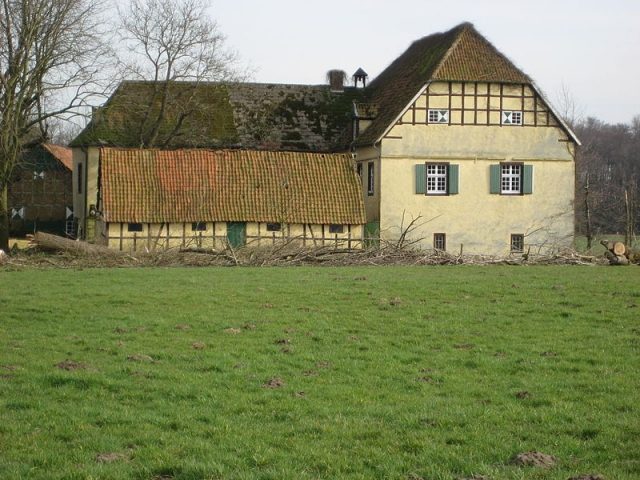
Scheventorf Castle is a former moated castle in the Renaissance style and a former knight's estate in Bad Iburg (Lower Saxony).
A part of the castle complex from the construction period around 1552 is considered the oldest existing half-timbered construction in the Osnabrück region.
According to a legend, the beautiful Anna von Hake was walled alive in the castle during the Thirty Years' War due to an inappropriate liaison. The priest and writer Bernhard Köster set a literary monument to her in a historical novel published in 1924.
Location+
The lowland castle is located south of the center of the former market town of Iburg in today's Glane district, in the area of the former Ostenfelde farming community. It is located east of Federal Highway 51, which leads to Glandorf and is called Münsterstraße in the Bad Iburg urban area. The Glaner Bach flows southeast past Scheventorf Castle. The stream, a tributary of the Ems formed by the confluence of the Kohlbach and Freedenbach at Kleiner Freeden, fed the moat and the mill pond. About one kilometer south was Schleppenburg Castle, which was also a moated castle and a knight's estate. It is not preserved.
Structure+
A site plan from 1716 still shows Scheventorf Castle with its moat and the pond located west of the castle, which drained into the Glaner Bach. This operated the water mill, to which the mill garden belonged. The castle complex consisted of the main building with a forecourt, a stable, the gatehouse, and the outbuilding, which was used as a brewery. The Small Garden, accessible via a dam, extended into the mill pond. Outside the moat were the Large House Garden and the New Garden.
In the rectangular castle complex, the main building faces southwest. The coat of arms of the von Hakes is located at the entrance to the castle. The half-timbered connecting building between the main castle building and the former prison tower, which is considered the oldest half-timbered building in the region, dates from around 1552. The ground floor of the main castle building was accessible via a staircase that led to the hall with access to the upper floor. The hall provided access to the great hall in the northwest, behind which were a parlor and a chamber. From the chamber, the latrine was accessible, which was located as a bay window in front of the building. A chamber and a pantry were connected to the large kitchen in the east. The spinning room, located between the kitchen and the pantry, faced south. Further rooms adjoined a courtyard to the northeast, where another latrine, attached externally as a bay window, was located. The prison was also in the northeast. On the northwest side was the stable. A residential tower is not preserved. Remains of the masonry show traces of fire. The moat was later filled in.
Ancestral Seat of the Scheventorf Family
The Scheventorf family, which gave the castle its name, has been documented in Osnabrück records since the mid-13th century. The knight Wigger von Scevintorpe was mentioned in 1252. In 1305, Wessel von Scheventorf had business relations with the abbot of the Benedictine monastery Iburg, founded in 1080 by Bishop Benno II. The Scheventorfs had their ancestral seat south of the double complex of Iburg Castle and Monastery. In 1338, Johann von Scheventorf became lord of Scheventorf; his brother Heinrich was lord of Krankenburg near Glane. Johann von Scheventorf sold the castle to Lubbert van Budde, who resold it to Ludwig von Hake on May 31, 1365. The family, first mentioned in 1225 with Hermann von Hake, originated from the Haking farm in Glane-Visbeck and served the Bishops of Osnabrück. They belonged to the Iburg castle families, who owned the Hake castle manor in Iburg until November 26, 1478. Even after the purchase of Scheventorf Castle, the name of the moated castle was retained.
Ludwig von Hake's son Lüdeke, who inherited the castle from his father, married Grete von Bar. Their common son, who was named Ludwig like his grandfather, married Leneke von Hoberg and received Scheventorf and the associated estates in 1416. Their sons Ludwig and Ludolf divided the inheritance in 1421; the moated castle remained with Ludwig and passed to his son Reineke, who married Monike von Enniger around 1500. From this marriage came Johann von Hake, who married Sidonie von Dincklage in 1528.
Renaissance Building
Johann von Hake and his wife erected the present Renaissance building in 1552. They were succeeded by their son Reineke von Hake, married since 1556 to Johanna von Ketteler zu Middelburg, then his son Johann von Hake, who married Sybille von Raesfeld and converted to Protestantism. Together with the lord of the neighboring Schleppenburg, he advocated to the Prince-Bishop of Osnabrück, Philipp Sigismund von Braunschweig-Wolfenbüttel, that the vacant parish position in Glane in 1601 be filled by a Protestant clergyman. However, the Prince-Bishop did not prevail against the Osnabrück Cathedral Chapter.
Johann von Hake and his wife Sybille had two daughters; after Johann von Hake's death in 1628, his widow Sybille reverted to Catholicism. Their daughter Agnes Josina von Hake married Bernhard Jakob von Henderson († 1637 during the siege of Breda); Scheventorf Castle fell to him through the marriage. The Scot served as a lieutenant colonel in the service of the Swedish crown. From this marriage came their daughter Anna Sybille, lady-in-waiting to Liselotte von der Pfalz, and their son Bernhard Johann Jakob († 1676 in the Battle of Konzer Brücke), a cavalry captain in the service of Prince-Bishop Ernst August I of Osnabrück.
In 1662, the cavalry captain sold Scheventorf Castle to Georg Christoph von Hammerstein. On January 26, 1664, he exchanged the castle and the now acquired Schleppenburg for the episcopal Gesmold Castle, because Ernst August I wanted to expand his territory near Iburg Castle. His goal was to have more agriculturally usable land so that the court in Iburg could be adequately supplied with food. The flat and fertile land around Scheventorf Castle and Schleppenburg, which transitions into Münsterland, was better suited for agriculture than the hilly regions around Iburg Castle Hill, which are located on the south side of the Teutoburg Forest. With the purchase, Scheventorf Castle and Schleppenburg passed into princely-episcopal possession and became chamber estates. Scheventorf Castle remained in the possession of the Diocese of Osnabrück until secularization in 1803 and was subsequently domain fiscal property.
In 1885, the Scheventorf estate was incorporated into the then rural community of Ostenfelde. The castle is now privately owned; the lands are used for agriculture.
Hakenböckel Estate in Westphalia
The von Hake zu Scheventorf family belonged to the Ravensberg knighthood since at least 1265 and also had interests in the County of Ravensberg. For this reason, they probably owned a part of the knight's estate Böckel for about 200 years. This estate is located within the former borders of the County of Ravensberg, about 50 kilometers east of Bad Iburg, in the Bieren district of Rödinghausen (Herford district).
Presumably, the family already owned the Altenböckel estate in the 15th century, which was later called Hakenböckel after them, as a fief of Herford Abbey. The possession was also associated with half of the forest countship in the Kilver Mark. The family later also held Niedermeyer's Hof in Schwenningdorf near Rödinghausen as a fief from Iburg Monastery.
The von Hake family engaged in various activities in the region. Around 1500, Ludolf von Hake was enfeoffed by the abbess of Herford with the office of Hebemeister (Villicus) of the Villikation Lutterhausen, in which the Bieren farming community was located. The Ravensberg Urbar, which the officials of the Count of Ravensburg had already begun in 1535, was completed in 1556. According to this Urbar, about 15 independent farmers belonged to Hakenböckel. Johann von Hake zu Scheventorf und Böckel is named as the landlord and liege lord of these farmers at that time. He also served as vicar in the main parish of St. Bartholomäus in Rödinghausen from 1535 until after 1548.
At that time, the knight's estate Böckel was divided. Johann von Hake owned the part of the estate that, like the Bieren farming community, was parished to Rödinghausen. The other part of the estate, which was predominantly in the parish of Bünde, was owned by the von Quernheim family, who had acquired this part of the estate from the von dem Bussche-Gesmold family before 1495.
After the death of the last Johann von Hake zu Scheventorf in 1628, the property fell to his son-in-law Kobolt von Tambach, Drost zu Fürstenau. After the von Hake family died out in the male line, the estate was predominantly managed by tenants and administrators. Kobolt von Tambach sold Hakenböckel, the fiefdom in Schwenningdorf, with the consent of Iburg Monastery, as well as half of the forest countship in the Kilver Mark, to Heinrich von Voss in 1661. Other sources state 1689 for the sale. The von Voss family already owned the formerly Quernheim part of the estate through inheritance, which was then also called Vossböckel after them. After the purchase, both parts of the estate were united. The buildings that formerly belonged to Hakenböckel are not preserved.
Anna von Hake
The so-called "Annekenloch" (Anna's hole), a chamber in the area of the former kitchen, discovered during renovations in 1858, commemorates the tragic fate of Anna von Hake. A chair leg, pottery shards, and remnants of human bones were found in the chamber. According to legend, the daughter of the lord of the castle was walled alive here by her father in the first half of the 17th century because she was said to have loved a forester or a servant. Her fate remained alive in the collective memory of the population of Glane and Iburg. The priest and writer Bernhard Köster took up the legend and published the historical novel "Die schöne Anna von Hake auf Scheventorf" (The Beautiful Anna von Hake at Scheventorf) in 1924, which appeared in its third edition in 1977.
Take Mobile History with you
You are reading this text for free. Premium adds what matters on the road: descriptions read aloud, sites found through your camera, whole regions taken offline.
- Every description, including the ~17,700 Premium sites
- Audio guide: have descriptions read to you on location
- AR finder: see sites through your camera, with distance and bearing
- Unlimited saved sites
14 days free, then from €2.99 a month. Cancel anytime.
Source: Wikipedia · Licence: CC BY-SA 4.0 · Image: https://de.wikipedia.org/wiki/Datei:BadIburgBurgScheventorfMaerz2008.jpg
This description draws on the facts documented in the linked Wikipedia article; Wikipedia content is licensed under CC BY-SA 4.0. Wording and editing: Mobile History.
Location: 52.1370, 8.0356