The remains of the Castle can be visited
CastleSzymbark (Schönberg)
Schönberg Castle
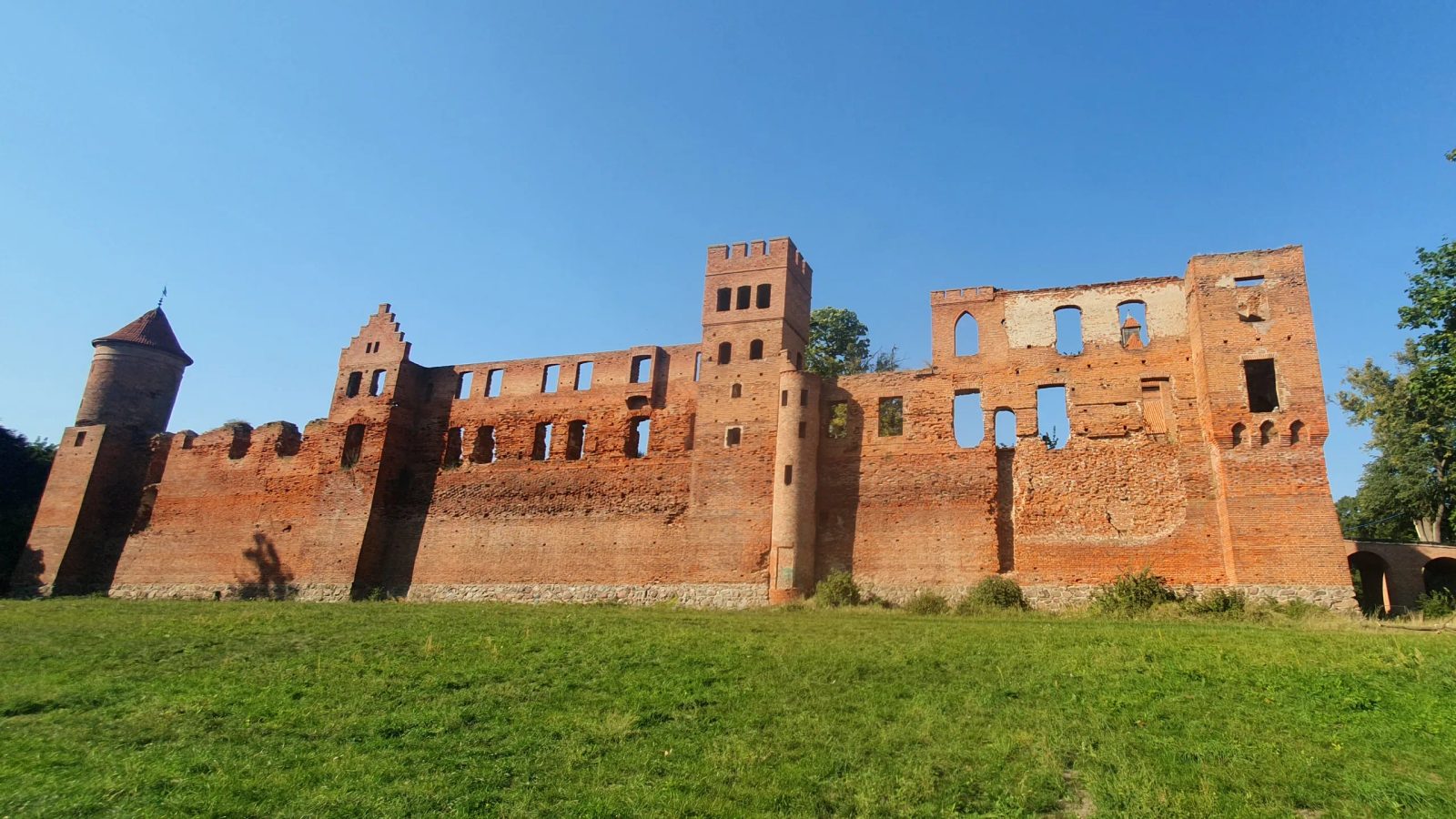
Schönberg Castle is the ruin of a Teutonic Order castle in the then East Prussian village of Schönberg, today Szymbark in Poland.
History+
The Schönberg estates belonged to the cathedral chapter of Marienwerder, with a provost presiding over Schönberg. The castle was built between 1301 and 1386 on the shore of the Haussee to secure the estate. It was captured and partially destroyed by the Prussian Confederation in the Thirteen Years' War, but remained with the Order in the Peace of Thorn. In 1520, the castle is said to have been handed over to the Polish king through the betrayal of the commandant Nicolaus Schönhorn. After the founding of the Duchy of Prussia, Schönberg Castle was handed over by Albrecht I to the now Protestant Bishop of Pomesania at Marienwerder Castle, who had previously held the castle. Then it came to the Bishop of Samland, Georg von Polentz, who appropriated it as family property.
Between 1570 and 1590, the castle was rebuilt in the Renaissance style. In 1653, the family sold the estate to Baron zu Eulenburg-Prassen, who in turn sold it to Count von Schlieben-Birkenfeld. In 1699, finally, Chamberlain Ernst Sigismund Finck von Finckenstein, known as the "rich shepherd", who had already owned the Deutsch-Eylau lordship since 1690, bought the castle and the manor. This included about 9000 hectares of land with the villages of Sommerau, Steinersdorf, Stärkenau, Schepkau, Albrechtau and Falkenauer Krug. In the 18th century, Raudnitz with the castle newly built in 1735 and the Stradem estate also belonged to the Schönberg property. As a result of the burdens of the Napoleonic Wars and the Stein-Hardenberg reforms, the huge estate disintegrated and was largely foreclosed. However, the Schönberg estate with the old Teutonic Order castle remained with the family as a fideicommiss until 1945.
In the 18th century, the interior was changed in the Baroque style and an orangery was built, in the 19th century the castle was partly "regothicized" and was considered the "little sister of Marienburg". During the Second World War, the castle was taken over by SS troops, after which the building was converted into a provisional headquarters by the Red Army. The retreating Soviet soldiers burned down the castle, whereby the interior was also lost. In the 1960s, only limited restoration work was carried out, during which some buildings were cleared and roofed. In 1988, the Sight of Music Foundation took over the ruins, announced their reconstruction and set up a center for blind children. Due to lack of funds, however, it had to abandon the plan. After that, the castle was repeatedly bought and sold and is now private property. Volker Schlöndorff filmed "The Ogre" here with John Malkovich in the leading role. Since 1997, the property has been in the hands of a private owner. On March 7, 2018, a bailiff's offer was made to him.
Take Mobile History with you
You are reading this text for free. Premium adds what matters on the road: descriptions read aloud, sites found through your camera, whole regions taken offline.
- Every description, including the ~17,700 Premium sites
- Audio guide: have descriptions read to you on location
- AR finder: see sites through your camera, with distance and bearing
- Unlimited saved sites
14 days free, then from €2.99 a month. Cancel anytime.
Source: Wikipedia · Licence: CC BY-SA 4.0 · Image: Foto: Jörg Heldt (Community)
This description is a machine translation of an excerpt from the linked Wikipedia article. The source text was written by its authors, the translation is by Mobile History; like the original it is licensed under CC BY-SA 4.0.
Location: 53.6452, 19.4818