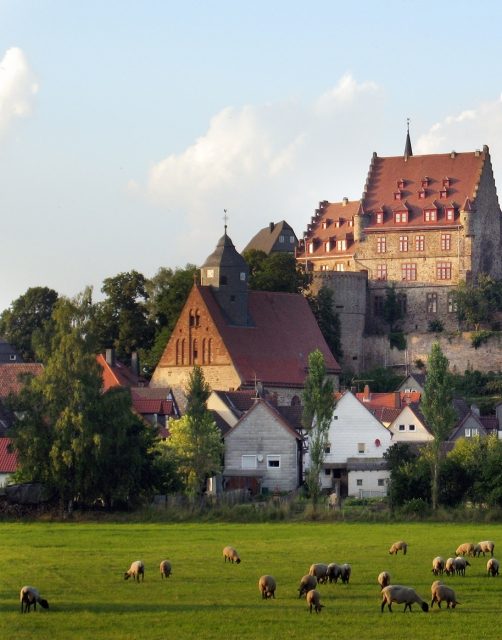
CastleSchweinsberg

Schweinsberg Castle

Schweinsberg Castle

To be privately owned
Apartments


Schweinsberg Castle is located at an elevation of approximately 215 m above sea level in the Schweinsberg district of the Hessian town of Stadtallendorf in the Marburg-Biedenkopf district.

In the 12th century, the area of present-day Schweinsberg was still owned by the von Merlau family and came into the possession of the later Schencken zu Schweinsberg through the marriage of Knight Guntram Vogt to a sister of Knight Eberhard von Merlau. Around 1230/31, at the time of Saint Elisabeth of Thuringia, Guntram's son, the Thuringian landgrave's castellan Guntram von Marburg and von Grünberg, built a castle on the small basalt cone. Guntram adopted the name "von Schweinsberg" and was appointed hereditary cupbearer of Hesse by the Landgrave of Thuringia, the German King Heinrich Raspe. Around 1482, the castle was significantly expanded and adapted to the latest requirements by the landgrave's fortress builder Jakob von Ettlingen. A massive outer bailey wall was built, secured by 3 semi-circular projecting towers and the mighty Hexenturm (Witches' Tower). The main house of the castle, the Kemenate (ladies' bower), was built between 1459 and 1497 by Conrad Schenck zu Schweinsberg, bailiff of Lich. A rectangular outer bailey was placed in front of the main entrance, its entrance covered by a round defensive tower, which is still preserved today. During the Thirty Years' War, part of the fortifications was destroyed by a fire and the explosion of the powder tower. Thereupon, Landgravine Amalie Elisabeth ordered the complete demolition of all fortifications of the castle, despite the efforts of the Schencken to save their ancestral castle from ruin. In 1852, the Kemenate was rebuilt by High Court Councillor Moritz Frhr. Schenck zu Schweinsberg, after it had been uninhabited for decades. Under the direction of the Marburg architect Prof. Lange, the Kemenate received a neo-Gothic extension. Although the alterations significantly distorted the style of the old Kemenate, they corresponded to the romantic idea of Gothic at the time. Parallel to the alterations, the garden was also redesigned, about which Landau rapturously reported. Due to this radical reconstruction, Schweinsberg Castle is today more a significant example of Romanticism and early Historicism than of a late medieval castle. The two still existing houses of the castle were extensively restored in 1982 (Fähnrichsbau) and 1998 (Conrads Kemenate). A total of 7 condominiums were created. A family of Schenck still lives in one of these apartments, the so-called "bel étage". The outer ramparts are also owned by a Schenck foundation. Thus, this family has been present in Schweinsberg and at the castle for over 780 years.

Take Mobile History with you

You are reading this text for free. Premium adds what matters on the road: descriptions read aloud, sites found through your camera, whole regions taken offline.

  • Every description, including the ~17,700 Premium sites
  • Audio guide: have descriptions read to you on location
  • AR finder: see sites through your camera, with distance and bearing
  • Unlimited saved sites

14 days free, then from €2.99 a month. Cancel anytime.

Source: Wikipedia · Licence: CC BY-SA 4.0

This description draws on the facts documented in the linked Wikipedia article; Wikipedia content is licensed under CC BY-SA 4.0. Wording and editing: Mobile History.

Location: 50.7676, 8.9614