CastleAachen - Laurensberg

Seffent Castle
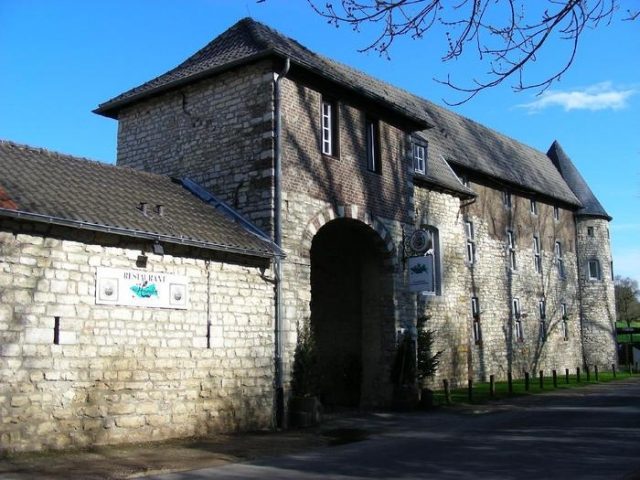
Seffent Castle

Restaurant
Apartments

Seffent Castle is a medieval castle complex in Seffent, a northwestern district of Aachen. Its history dates back to the Carolingian era.

Originally built as a supply manor for the Lotharingian Duchy, Seffent Castle developed into a four-winged complex with defensive architectural elements in the 17th century. After extensive restoration, which saved the buildings from final decay, it now houses apartments and a restaurant.

The castle is a four-winged complex made of sandstone-colored quarry stone. Once surrounded by moats, it has a round tower with a conical helmet at the north corner and a massive, semi-circular defensive tower at the eastern corner. The current building fabric largely dates from the Thirty Years' War and the 18th century. Inside, the complex has three old fireplaces.

A first documentary mention of the complex, then called Seffenter Hof, occurred in 896, when the Lotharingian Duke Zwentibold gifted the manor to his cousin, Abbess Gisela, and thus to the Nivelles Abbey. Further documents testify that Emperor Henry III transferred the property to the Aachen Marienstift in 1028. The court must therefore have previously reverted to the Empire.

For the following approximately 500 years, no records of the castle can be found, so its history during this time remains obscure. In the first half of the 17th century – building on remains from the 16th century – a new manor house was built and the two corner towers of the castle were erected. A drawing by the Aachen architect Laurenzius Mefferdatis from 1722 shows Seffent Castle as a two-part complex, whose halves were separated by a wall. In the 18th century, the castle belonged to the respected Aachen family Bouget, who leased it to Chevalier de Bellegarde in 1780. At the end of the 18th century, the manor house was extended and provided with a triangular gable.

After the Second World War, the dilapidated complex, threatened by decay, changed hands several times. Attempts to make it habitable after 1962 were unsuccessful. Only in 1985 could the restoration – after several attempts – be completed. In the course of these works, the castle's rooms were converted into 14 apartments and a restaurant.

Take Mobile History with you

You are reading this text for free. Premium adds what matters on the road: descriptions read aloud, sites found through your camera, whole regions taken offline.

  • Every description, including the ~17,700 Premium sites
  • Audio guide: have descriptions read to you on location
  • AR finder: see sites through your camera, with distance and bearing
  • Unlimited saved sites

14 days free, then from €2.99 a month. Cancel anytime.

Source: Wikipedia · Licence: CC BY-SA 4.0 · Image: http://www.wehrbauten.de/thread.php?threadid=845

This description draws on the facts documented in the linked Wikipedia article; Wikipedia content is licensed under CC BY-SA 4.0. Wording and editing: Mobile History.

Location: 50.7896, 6.0411